A shopper who starts checkout is not a casual browser anymore.
They picked a product.
They reached checkout.
They were close.
Then they left.
Maybe shipping made them pause.
Maybe they got distracted.
Maybe they wanted to compare.
Maybe they needed one more reason to trust the purchase.
Maybe the total cost felt different once they reached checkout.
That is why abandoned checkout matters.
This is one of the highest-intent customer moments inside your Shopify store because the shopper already moved beyond browsing.
They were not just curious.
They were considering the purchase.
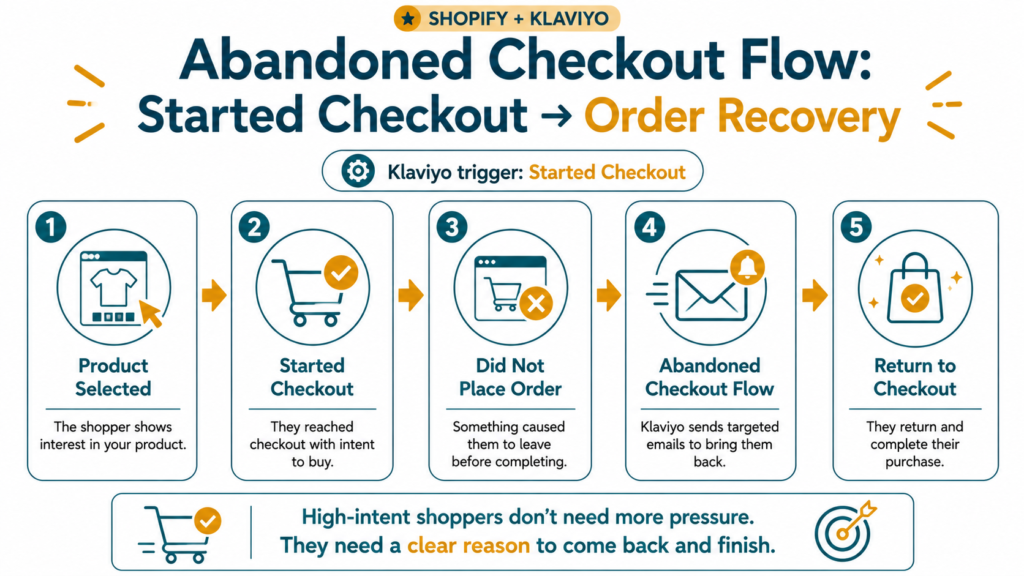
In Klaviyo for Shopify, this flow is triggered by Started Checkout.
That means someone started checkout but did not place an order.
And if there is no follow-up, that warm intent can go cold fast.
If you’re still building your automation foundation, start with the 5 Klaviyo email flows every Shopify store should set up first.
Before we talk about emails and timing, let’s define the flow clearly.
Quick Answer: What Is an Abandoned Checkout Flow?
An abandoned checkout flow is an automated email sequence that follows up with shoppers who started checkout but did not complete the order.
For Klaviyo and Shopify, here’s the simple version:
Item | Meaning |
Flow name | Abandoned Checkout Flow |
Klaviyo trigger | Started Checkout |
Main audience | Shoppers who reached checkout but did not place an order |
Main goal | Bring high-intent shoppers back to complete the purchase |
Many people call this an abandoned cart flow.
But in Klaviyo for Shopify, the common trigger is Started Checkout.
That is why we call it an abandoned checkout flow here.
Klaviyo’s abandoned cart flow documentation explains that the common Shopify setup uses the Started Checkout event, while Added to Cart is a separate event and flow option.
Source: Klaviyo Help Center: How to create an abandoned cart flow
That small difference matters.
Because checkout intent is stronger than casual browsing.
Why Abandoned Checkout Flow Matters for Shopify Stores
When I review Klaviyo accounts, abandoned checkout is one of the first flows I check because it sits close to purchase intent.
The shopper already selected a product.
They reached checkout.
They were close to placing an order.
That means they may not need a full introduction to the brand.
They may only need:
- a clear reminder
- reassurance
- product value
- trust
- shipping clarity
- one simple path back to checkout
Getting this flow right takes more than a template, it’s the kind of strategic setup our klaviyo email marketing services are built around.
And that moment matters.
Baymard’s cart abandonment research reports an average documented online cart abandonment rate of 70.22%, based on 50 different studies. That does not mean every Shopify store will see the same number, but it shows how common checkout and cart drop-off can be in ecommerce.
Source: Baymard Cart Abandonment Rate Statistics
But to write this flow well, you need to understand why shoppers leave in the first place.
Why Shoppers Start Checkout But Do Not Place an Order
Shoppers can leave checkout for many reasons.
Sometimes it is not because they changed their mind.
Sometimes they just paused.
Possible Reason | What the Email Can Do |
They got distracted | Send a clear reminder |
Shipping cost surprised them | Clarify shipping or free shipping threshold |
Delivery time was unclear | Set expectations |
They wanted to compare | Reinforce product value |
They did not fully trust the brand | Add reviews, returns, guarantees, or proof |
Payment issue happened | Make it easy to return to checkout |
They had product questions | Answer sizing, ingredients, quality, usage, or FAQ concerns |
They were not ready yet | Give them a useful reason to come back |
The point is not to guess one reason.
The point is to build a flow that handles the most common reasons people pause.
A good abandoned checkout flow should make the next step feel easy, clear, and safe.
That is also why abandoned checkout should not be written the same way as browse abandonment.
Abandoned Checkout vs Added-to-Cart vs Browse Abandonment
These flows are related.
But they are not the same.
Flow | Trigger | Intent Level | Best Message |
Browse Abandonment | Viewed product | Lower intent | Helpful product reminder or education |
Added-to-Cart Flow | Added product to cart | Mid intent | Product reminder and value reinforcement |
Abandoned Checkout Flow | Started Checkout | High intent | Checkout reminder, trust, hesitation handling |
Abandoned checkout should usually be more direct than browse abandonment.
Why?
Because the shopper already reached checkout.
They showed stronger intent.
So your message can be clearer.
Not pushy.
Clear.
If the shopper only viewed a product and never reached checkout, browse abandonment emails are the softer follow-up to use.
And once a shopper does complete the order, a post-purchase flow is what should take over next.
Once you know the intent level, the next step is building the sequence.
How Many Emails Should an Abandoned Checkout Flow Have?
For most Shopify stores, a 3-email abandoned checkout flow is a strong starting point.
Main Job | |
Email 1 | Remind them what they were about to buy |
Email 2 | Reinforce product value and trust |
Email 3 | Handle hesitation or add an incentive if needed |
I usually keep abandoned checkout flows short and focused.
This is not the place for a long nurture sequence.
The shopper already showed intent.
Your flow should help them finish the decision.
Now let’s break down what each email should actually say.
Email 1: Remind Them What They Were About to Buy
Timing
1 to 4 hours after Started Checkout.
Main job
Catch the intent while it is still fresh.
This email should be clear and easy.
No long story.
No heavy selling.
Just a simple reminder and a path back.
What to include
- Dynamic product block showing the item they were about to buy
- Product image
- Product name
- Short reminder
- CTA back to checkout
- Short support line if needed
The dynamic product block matters because the email should show the exact product the shopper was about to buy.
Do not make them remember.
Show the item.
Show the image.
Show the price if it fits your layout.
Make the return path obvious.
Element | Recommendation |
Timing | 1 to 4 hours after Started Checkout |
Goal | Bring the shopper back while intent is fresh |
CTA | Return to checkout, complete your order, finish checkout |
Sample subject lines
- You left something behind
- Your checkout is waiting
- Still interested in this?
- Your picks are still here
- Ready when you are
The first email is mostly about memory and convenience.
The shopper was already close.
So make the return path obvious.
The second email should do more work.
Email 2: Reinforce Product Value and Trust
Timing
1 day later.
Main job
Give the shopper more confidence to complete the order.
At this point, they may need more than a reminder.
They may need reassurance.
What to include
- Product benefits
- Reviews or ratings
- UGC if available
- Return policy or guarantee, if useful
- Shipping clarity
- CTA back to checkout
Element | Recommendation |
Timing | 1 day after Email 1 |
Goal | Reinforce why the product is worth buying |
CTA | Return to checkout, finish your order |
Sample subject lines
- Still thinking it over?
- Why customers choose [Product Name]
- A closer look at your pick
- Need help deciding?
- This might help you decide
This email should answer the quiet question in the shopper’s mind:
“Is this still worth buying?”
Show them why the answer is yes.
If they still have not ordered after that, the third email should answer the bigger hesitation.
Email 3: Handle Hesitation or Add an Incentive if Needed
Timing
2 to 3 days later.
Main job
Address the final hesitation.
This is where you can answer objections, clarify details, or add an incentive if it fits your strategy.
What to include
- FAQ
- Reviews
- Return policy
- Shipping reminder
- Payment options, if available
- Incentive only if needed
- Clear CTA
Element | Recommendation |
Timing | 2 to 3 days after Email 2 |
Goal | Handle hesitation and create a final reason to return |
CTA | Complete your order, return to checkout |
Sample subject lines
- One more reason to complete your order
- Before your checkout expires
- We can’t hold this forever
- Still deciding?
- Your [Product Name] is still waiting
Not every abandoned checkout flow needs a discount.
Start with clarity, trust, and product value first.
That brings us to the question most brands ask too early.
Should you offer a discount?
Sample Abandoned Checkout Email Structure
You do not need to make abandoned checkout emails complicated.
The structure should be simple enough for the shopper to understand quickly.
What did they leave?
Why should they come back?
What should they do next?
Here’s a simple way to think about each email.
If you want to visualize the layout, here’s how each abandoned checkout email can be structured using simple placeholder blocks.
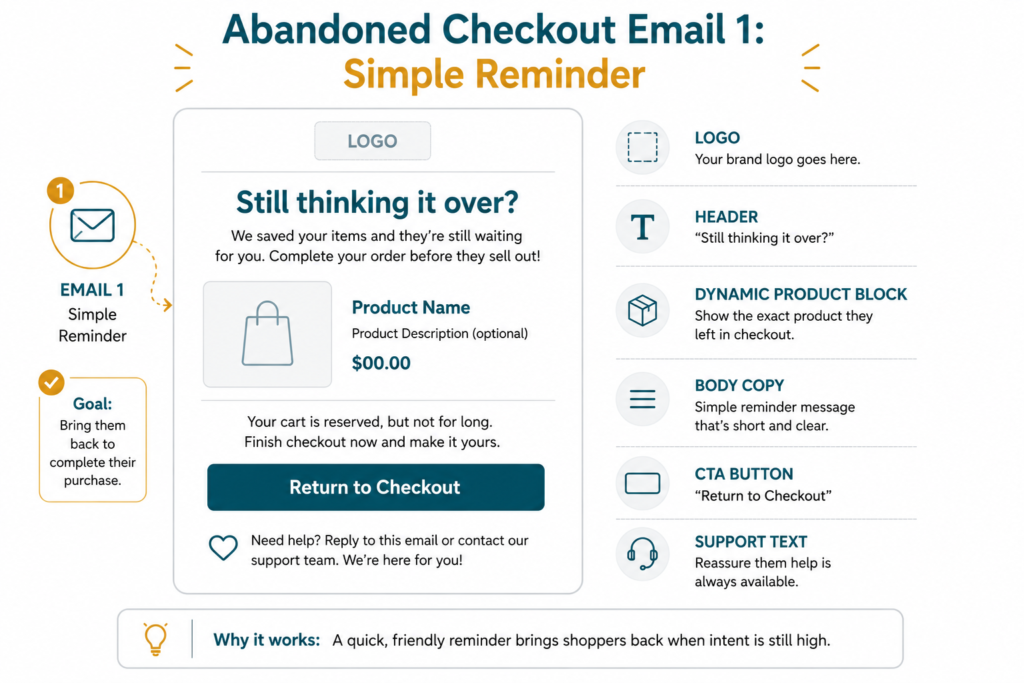
Sample Email 1: Simple Reminder
Purpose: Bring the shopper back while intent is fresh.
Header:
Still thinking it over?
Dynamic Block:
[Product Image]
[Product Name]
[Price]
Body:
You were close to checking out, but it looks like you didn’t finish your order.
Your pick is still waiting, and you can return to checkout anytime.
CTA:
Return to Checkout
This email does not need to over-explain.
The shopper already showed intent.
Your job is to make returning easy.
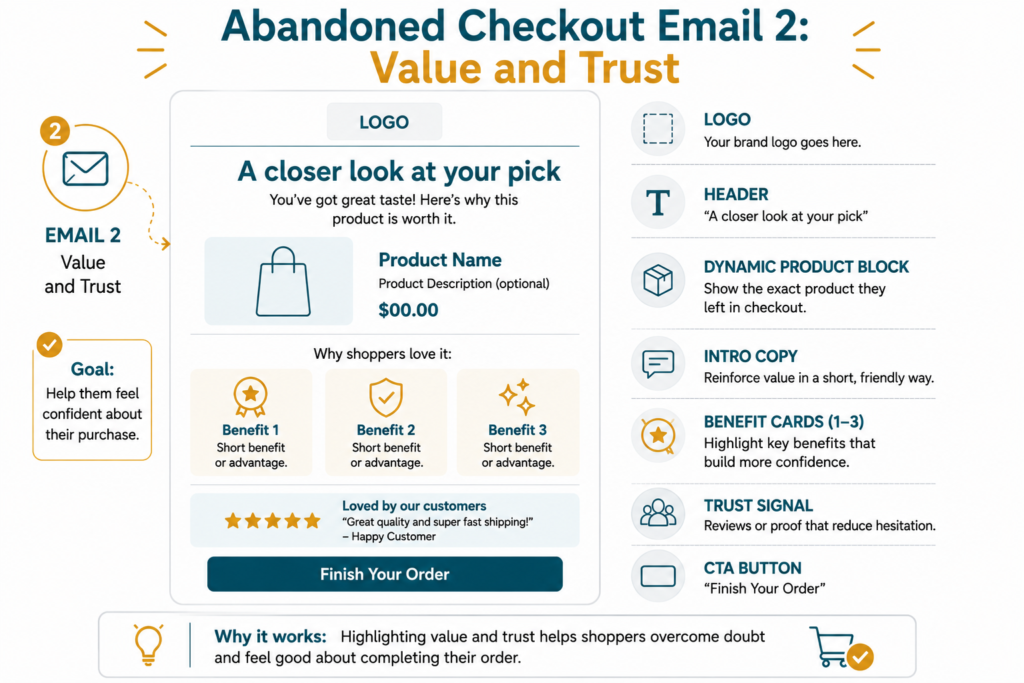
Sample Email 2: Value and Trust
Purpose: Reinforce why the product is worth buying.
Header:
A closer look at your pick
Body:
Before you decide, here’s why customers choose [Product Name].
[Benefit 1]
[Benefit 2]
[Benefit 3]
Still have questions? You can review your order and complete checkout when you’re ready.
CTA:
Finish Your Order
This email should make the shopper feel more confident.
Use product value, proof, and reassurance.
Not pressure.
Sample Email 3: Hesitation Handling
Purpose: Answer the final hesitation or add an incentive if needed.
Header:
One more reason to complete your order
Body:
Still deciding?
Here are a few things that may help:
Shipping: [short shipping note]
Returns: [short return policy note]
Support: [short support note]
Your checkout is still available, but we can’t hold it forever.
CTA:
Complete Your Order
This email should remove friction.
If you add a discount or incentive, make sure it fits your margin and strategy.
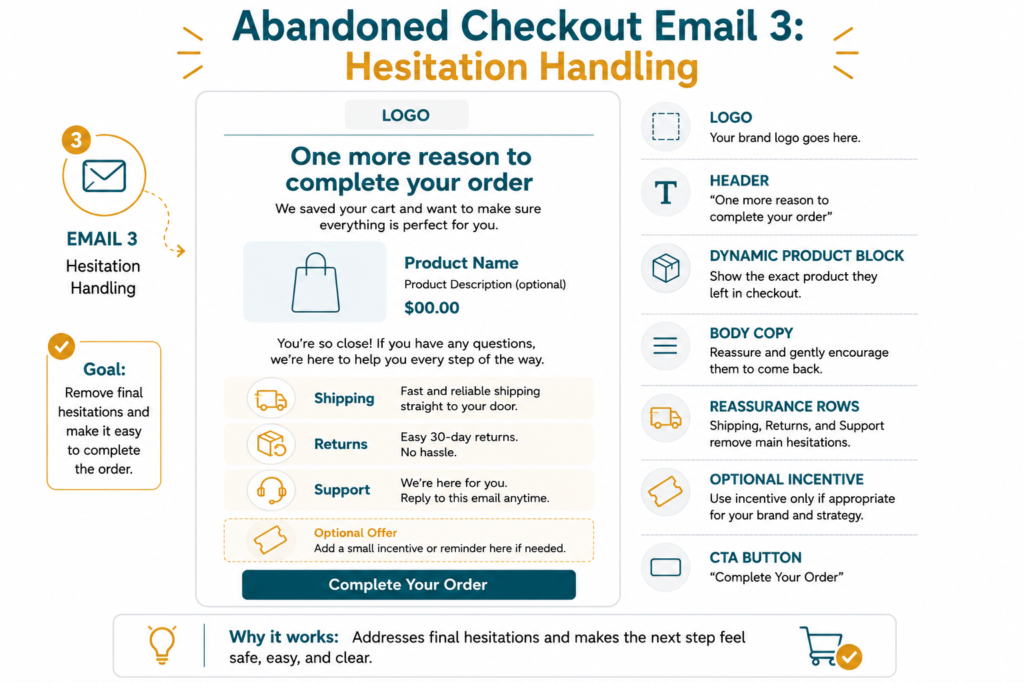
These layout directions are not meant to be final email designs. They are simple wireframe-style guides to show where the dynamic product block, copy, trust signals, and CTA should sit inside the email.
These are starting structures, not copy-and-paste templates.
Your abandoned checkout emails should still match your product, offer, brand voice, and the reason shoppers may be hesitating.
Should You Use a Discount in an Abandoned Checkout Flow?
A discount can help.
But it should not be the first thing your abandoned checkout flow depends on.
Email 1 should usually be a clean reminder.
Email 2 should reinforce value and trust.
Email 3 can use an incentive if it makes sense for your margin and strategy.
Situation | Discount Approach |
Strong brand or product demand | Start without a discount |
High shipping hesitation | Consider free shipping or threshold reminder |
High-ticket product | Use trust, FAQ, payment options, or reviews first |
Competitive product category | Incentive may help later |
Low-margin product | Avoid aggressive discounting |
The risk is simple.
If customers learn that abandoning checkout always gets them a code, you may train them to wait.
So use discounts carefully.
Let value, proof, and clarity do the first work.
Discounts can help, but the flow should still stand on stronger legs than a code.
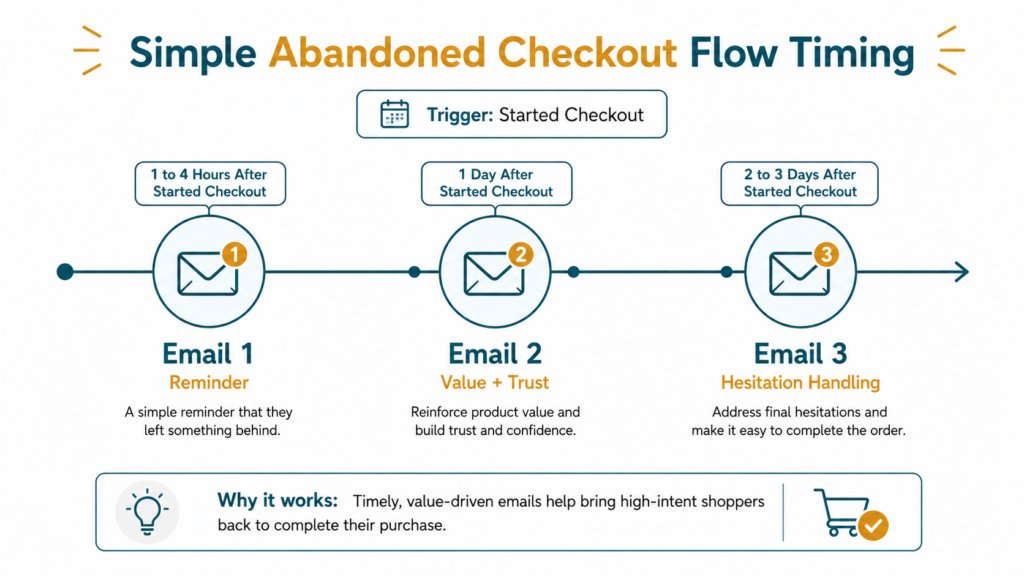
Abandoned Checkout Flow Timing Example
These timing examples are starting points, not fixed rules.
Adjust based on your product, price point, buying cycle, traffic volume, and customer behavior.
Suggested Timing | Main Job | |
Email 1 | 1 to 4 hours after Started Checkout | Clear reminder |
Email 2 | 1 day later | Value and trust |
Email 3 | 2 to 3 days later | Hesitation handling or incentive |
A low-ticket product may move faster.
A high-ticket product may need more reassurance.
A product with shipping concerns may need clearer shipping details earlier.
Timing matters.
But timing alone will not fix weak messaging.
The message still has to answer why the shopper should return.
Once the flow is live, the next question is whether it is actually recovering orders.
How to Know If Your Abandoned Checkout Flow Is Working
A flow being live does not mean it is working.
You need to check what shoppers do after receiving it.
Metric | What It Tells You |
Open rate | Are subject lines getting attention? |
Click rate | Are shoppers returning to checkout? |
Placed order rate | Are checkout abandoners completing orders? |
Revenue per recipient | How valuable the flow is per shopper |
Flow revenue | How much the flow contributes |
Unsubscribe rate | Whether the emails feel too aggressive |
Spam complaint rate | Whether trust is being affected |
Open rate is useful.
But clicks and placed order rate matter more here.
Because the goal is not just to get opened.
The goal is to bring shoppers back to complete the order.
Klaviyo’s flow analytics can help you review message performance, including open, click, and conversion-related metrics.
Source: Klaviyo Help Center: Understanding flow analytics
To review the numbers properly, you need to know which email marketing metrics every Shopify store should track.
If those numbers are weak, the problem is usually not the flow type.
It is the timing, message, offer, or setup.
And that is good news.
Because those are things you can improve.
Common Abandoned Checkout Flow Mistakes to Avoid
These are the mistakes I usually look for first.
Mistake | Better Approach |
Treating it like browse abandonment | Be more direct because checkout intent is higher |
Sending too late | Follow up while intent is fresh |
Leading with a discount too early | Use clarity and trust first |
Not using a dynamic product block | Show the exact product they were about to buy |
Not showing the product clearly | Show what they were about to buy |
Ignoring shipping, returns, or trust concerns | Address the reasons shoppers pause |
Using generic subject lines | Match the subject line to the email’s job |
Forgetting exclusions | Remove shoppers who already placed an order |
Not reviewing performance | Review clicks, orders, and revenue |
The goal is simple.
Make it easy for a warm shopper to come back without making the email feel desperate.
Because abandoned checkout is not just a reminder.
It is a chance to recover shoppers who were already close.
When Should You Get Help With Your Abandoned Checkout Flow?
You can build a basic abandoned checkout flow yourself.
But if checkout activity is happening and orders are not following, the flow may need a closer look.
You may need help if:
- People start checkout but do not order
- Your flow is missing or inactive
- Your Started Checkout trigger is confusing
- You are not sure what each email should say
- The flow depends too much on discounts
- Your emails get opens but low clicks
- Your clicks do not turn into orders
- Reporting is unclear
If shoppers regularly reach checkout but do not complete their orders, a Klaviyo email marketing agency can help improve the flow timing, messaging, segmentation, and testing strategy.
Because abandoned checkout is not just a reminder.
It is a chance to recover shoppers who were already close.
Final Thoughts
An abandoned checkout flow helps recover shoppers who started checkout but did not place an order.
They were close.
That means your follow-up should be clear, helpful, and timely.
Start simple.
Remind them what they were about to buy.
Reinforce product value.
Build trust.
Handle hesitation.
Use discounts carefully.
That is how an abandoned checkout flow helps recover lost sales.
At Your Proactive Media, we help Shopify brands build high-performing Klaviyo abandoned checkout flows that recover more lost sales and create a smoother customer journey.
Want to Recover More Checkout Drop-Offs?
If shoppers are starting checkout but not placing orders, your abandoned checkout flow may need a closer look.
FAQs About Abandoned Checkout Flows
What is an abandoned checkout flow?
+An abandoned checkout flow is an automated email sequence that follows up when someone starts checkout but does not place an order.
What is the Klaviyo trigger for abandoned checkout?
+In Klaviyo for Shopify, the trigger is usually Started Checkout.
Is abandoned checkout the same as abandoned cart?
+Not exactly. Abandoned checkout happens after someone starts checkout. Added-to-cart happens earlier when someone adds a product to cart but may not start checkout.
How many emails should an abandoned checkout flow have?
+Most Shopify stores can start with 3 emails: reminder, value and trust, and hesitation handling.
When should the first abandoned checkout email send?
+A good starting point is 1 to 4 hours after Started Checkout, but timing should be adjusted based on product type and customer behavior.
Should abandoned checkout emails include a discount?
+Not always. Start with product clarity, trust, and a clear CTA first. Add an incentive only if it makes sense for your margin and strategy.
What should abandoned checkout emails include?
+They should include the product, dynamic product block, CTA back to checkout, product value, reviews or trust signals, and hesitation handling.
How do I know if my abandoned checkout flow is working?
+Track click rate, placed order rate, revenue per recipient, flow revenue, unsubscribe rate, and spam complaint rate.

Jasmin Umali
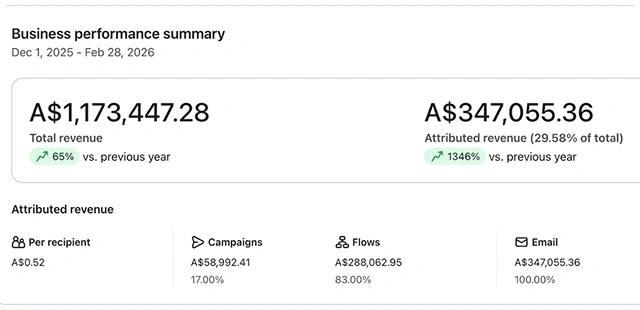
Jasmin Umali is the Founder of Your Proactive Media and a Klaviyo email marketing strategist with 6 years of experience helping ecommerce brands generate an additional 20%–30% or more revenue through email marketing.