A new subscriber is not just another email address.
They raised their hand.
Maybe they liked your product.
Maybe they wanted the welcome code.
Maybe they were curious about your brand.
Maybe they were not ready to buy yet.
That last part matters.
Because interest is not the same as trust.
A lot of Shopify stores treat the welcome flow like a simple greeting.
“Thanks for joining.”
“Here’s your code.”
“Shop now.”
That can work sometimes.
But for most Shopify stores, I recommend treating the welcome flow as the first guided path from subscriber to customer.
It should help answer:
Why this brand?
Why this product?
Why trust it?
Why buy now?
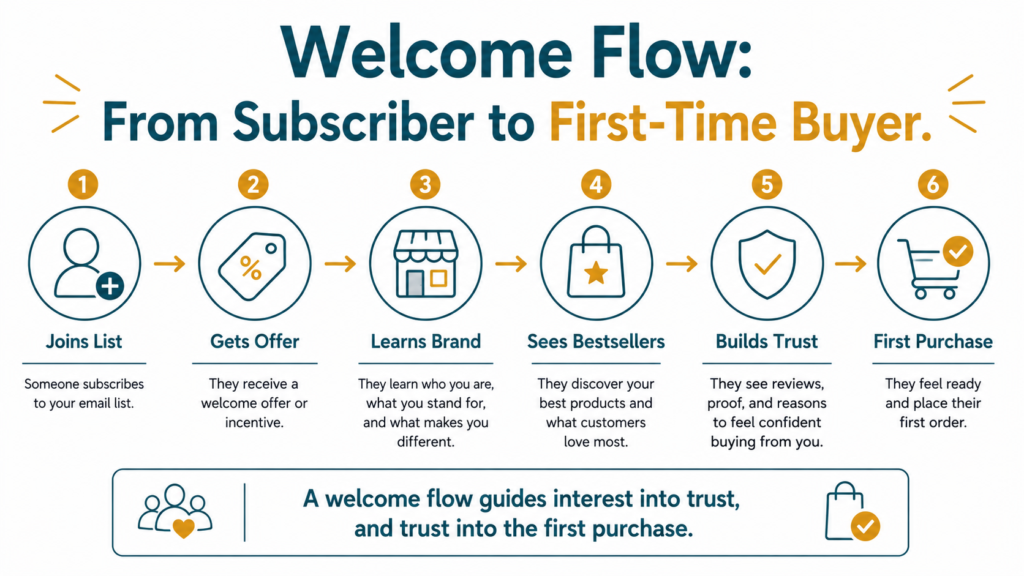
That is how a welcome flow turns new subscribers into first-time buyers.
Before we talk about structure, let’s make the main job of the welcome flow clear. If you’d rather have this built for you, our klaviyo email marketing services cover setup end to end, or if you want to see how this flow fits alongside the other core Klaviyo automations, our guide to the 5 Klaviyo flows every Shopify store should set up first covers the full picture.
Quick Answer: What Is a Welcome Flow?
A welcome flow is an automated email sequence that starts when someone joins your email list.
For Shopify stores, the goal is not only to say hello.
The goal is to guide a new subscriber toward the first purchase.
Klaviyo describes a welcome series as a sequence of emails sent right after someone subscribes, and notes that this is a critical moment to introduce interested prospects to your brand and product offering. (Klaviyo Help Center)
Subscriber Action | Welcome Flow Response |
Joins your list | Send welcome email |
Gets welcome offer | Remind them how to use it |
Learns about your brand | Build trust |
Sees bestsellers | Reduce decision friction |
Hesitates | Answer objections |
Is ready to buy | Give a clear CTA |
That sounds simple.
But the reason it works is because of what happens right after someone subscribes.
They are paying attention.
And that attention will not stay warm forever.
Why a Welcome Flow Matters for Shopify Stores
New subscribers are warm.
But warm does not always mean ready.
They may have clicked your popup because they liked the offer.
But they still may not know:
What makes your product different.
Which product to start with.
Whether they can trust your brand.
Whether the welcome offer is worth using today.
That is why your welcome flow matters.
When I review Shopify email setups, one common issue I see is that the welcome flow sells too fast without giving the subscriber enough reason to trust the brand first.
The flow should not only deliver the code.
It should build the first-purchase path.
Klaviyo’s welcome email guidance says welcome copy can introduce subscribers to product value, offer something in exchange for signup, feature social proof, and educate subscribers about how to use your products. (Klaviyo)
This is one reason Shopify stores use Klaviyo for email marketing: customer actions can trigger more relevant follow-up.
So the welcome flow should not feel like one random email.
It should feel like a short guided path.
What a Welcome Flow Should Do Before Selling
A good welcome flow should do a few jobs before asking for the sale.
It should:
- Welcome the subscriber.
- Deliver the offer, if there is one.
- Explain what makes the brand different.
- Show the easiest place to start.
- Build trust with proof, reviews, or education.
- Remind them before the offer or buying moment goes cold.
The first email catches attention.
The next emails build confidence.
And that confidence is what makes the first purchase easier.
Also, each email should have one clear next step.
Too many CTAs can make the subscriber think too hard.
A confused subscriber does not move faster.
They usually do nothing.
Once you know the job of the flow, the next question is how many emails it should include.
How Many Emails Should a Welcome Flow Have?
For most Shopify stores, a simple 4-email welcome flow is a strong starting point.
Main Job | |
Email 1 | Welcome and deliver the offer |
Email 2 | Introduce the brand and product promise |
Email 3 | Show bestsellers, proof, or education |
Email 4 | Give a clear reason to buy or remind them before the offer expires |
Some stores may only need 3 emails.
Some may need 5.
But if you’re starting from scratch, 4 emails gives you enough room to:
Welcome.
Explain.
Prove.
Guide action.
Klaviyo’s welcome series setup guide includes a pre-built welcome series flow, but it also emphasizes customizing the template content and branding before going live. (Klaviyo Help Center)
That is important.
Because a template can give you structure.
But it cannot explain your product, your offer, your proof, and your customer’s buying reason for you.
Now let’s break down what each email should actually say.
Welcome Flow Email 1: Welcome and Deliver the Offer
The first welcome email should send immediately after signup.
This is when attention is freshest.
The subscriber just gave you their email.
They are expecting something from you.
So do not make them wait.
And if they signed up for a code, do not make them hunt for it.
Keep this email clear.
A first welcome email can include:
- A warm welcome
- Welcome code or incentive, if promised
- Short brand expectation
- Clear CTA
- Simple product or collection direction
Element | Recommendation |
Timing | Immediately after signup |
Goal | Deliver the offer and guide the first click |
CTA | Shop bestsellers, shop the collection, use your code |
Sample subject lines
- Welcome to [Brand Name]
- Your welcome code is inside
- You’re in — here’s your [offer]
- Welcome to better [product/category benefit]
- Your [benefit/value prop] starts here
I usually keep the first welcome email very clear.
If the subscriber gave you their email for an offer, make the offer easy to find.
This is not the email where you need to explain everything.
Give them what they came for.
Then point them to the next best step.
Once the subscriber has the offer, the next email should help them understand why your brand is worth buying from.
Welcome Flow Email 2: Introduce the Brand and Product Promise
Email 2 usually sends 1 day after the first email.
The main job is simple: Build trust.
This is not the place for a long founder story.
Keep it short.
Tell the subscriber why your product exists, who it is for, and what makes it worth trying.
This email can include:
- Short brand story
- Product promise
- What makes the product different
- Who it is for
- Why customers choose it
- CTA to bestsellers or main collection
Element | Recommendation |
Timing | 1 day after Email 1 |
Goal | Build trust and explain your product promise |
CTA | Explore bestsellers, shop the collection, find your first pick |
Sample subject lines
- What makes [Brand Name] different
- Why customers choose [Brand Name]
- Meet your new [product/category] favorite
- The easiest way to start with [Brand Name]
- Made for [customer desire/problem]
The goal is not to sound impressive.
The goal is to make the subscriber think:
“Okay, I get why this brand exists.”
That is the bridge.
Because once they understand the value, your product recommendation feels less random.
But trust gets stronger when subscribers see what other people already love.
Welcome Flow Email 3: Show Bestsellers, Proof, or Helpful Education
Email 3 usually sends 2 to 3 days after Email 2.
The main job is to reduce decision friction.
A new subscriber may not need more choices.
They may need an easier first choice.
That is why bestsellers, reviews, and helpful education work well here.
This email can include:
- Bestselling products
- Beginner-friendly product picks
- Reviews or UGC
- Product education
- Buying guide angle
- One clear CTA
Element | Recommendation |
Timing | 2 to 3 days after Email 2 |
Goal | Make the first product choice easier |
CTA | Shop bestsellers, take the quiz, find your first pick |
Sample subject lines
- Start with our most-loved picks
- Our bestsellers are bestsellers for a reason
- Not sure where to start?
- See what customers are loving
- Your first [product/category] pick made easier
The key here is guidance.
Not pressure.
If your store has many products, the subscriber may not know where to begin.
So make the first step easy.
Show the product that most new customers start with.
Show the bestseller that solves the clearest problem.
Show the product that gives them the best first experience.
Because new subscribers often do not need a bigger catalog.
They need a clearer first pick.
Then, if they still have not bought, the final email can create a clean reason to act.
Welcome Flow Email 4: Give a Clear Reason to Buy
Email 4 usually sends 3 to 5 days after Email 3.
The main job is to create a clean nudge toward the first purchase.
This can be a code reminder.
It can be a true deadline.
It can be a product reason.
It can be an objection-handling email.
But it should feel useful.
Not desperate.
This email can include:
- Welcome code reminder, if applicable
- True expiry reminder, if true
- Strong product reason
- FAQ or objection handling
- Clear CTA
Element | Recommendation |
Timing | 3 to 5 days after Email 3 |
Goal | Encourage first purchase before interest goes cold |
CTA | Use your code, shop now, choose your first product |
Sample subject lines
- Last chance to use your welcome code
- Your welcome offer ends soon
- Still thinking it over?
- One more reason to start with [Brand Name]
- Before your code expires
This email can use urgency, but only if the urgency is true.
No fake deadline.
No fake scarcity.
No “last chance” if the code does not actually expire.
Subscribers can feel that.
And once trust breaks, the discount does not matter.
A welcome code can help.
But it should not carry the whole flow.
Should Your Welcome Flow Include a Discount?
A discount can help turn a new subscriber into a first-time buyer.
Especially if it was promised at signup.
But the discount should support the flow.
It should not carry the whole strategy.
If the only reason someone buys is the discount, the rest of the welcome flow may not be doing enough work.
Your emails still need to explain:
Why the product matters.
Why the brand is different.
Why the subscriber should trust you.
Why now is a good time to start.
Welcome Offer Type | Best For |
First-order discount | Stores that use a signup incentive |
Free shipping threshold | Stores with shipping hesitation |
Product guide | Brands that need education |
Quiz or recommendation | Stores with many product options |
Early access | Launch-driven brands |
Bundle recommendation | Stores with product sets |
I like using welcome offers when they make sense.
But I do not want the flow to become too discount-dependent.
Value, proof, and clarity should still do the heavy lifting.
Whether you use a discount or not, the flow still needs the right timing.
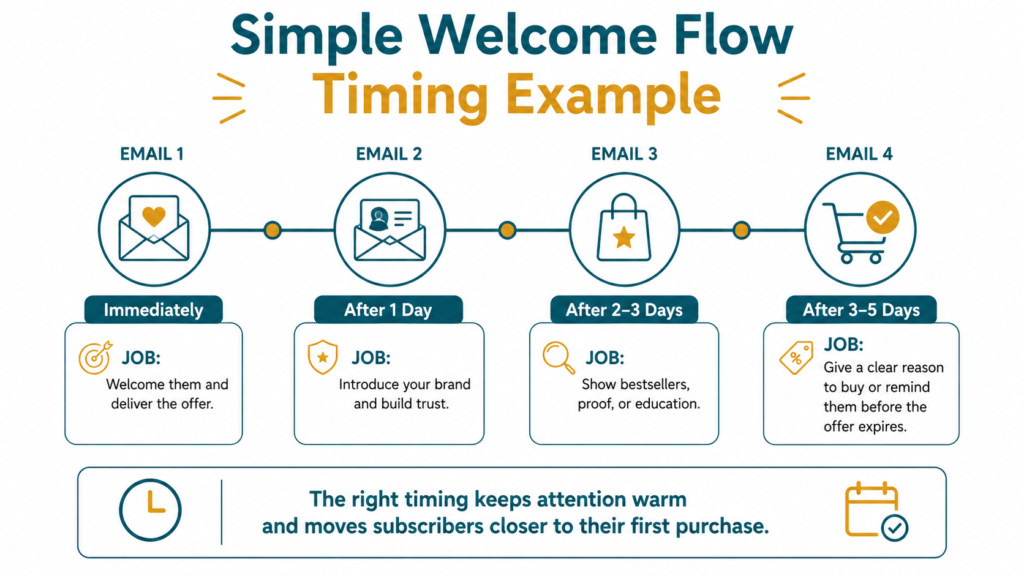
Welcome Flow Timing Example
These timing examples are starting points.
Not fixed rules.
Adjust based on your product, price point, buying cycle, offer, and customer behavior.
Suggested Timing | Main Job | |
Email 1 | Immediately after signup | Welcome and deliver the offer |
Email 2 | 1 day later | Introduce the brand |
Email 3 | 2–3 days later | Show bestsellers, proof, or education |
Email 4 | 3–5 days later | Give a clear reason to buy |
A low-ticket impulse product may move faster.
A higher-consideration product may need more education.
A skincare brand may need to explain routine and usage.
A supplement brand may need to explain consistency and benefits.
A fashion brand may need to guide sizing, fit, or bestsellers.
The timing should match how your customers actually decide.
Once the flow is live, you do not have to guess forever.
You can test what works. And once a subscriber makes their first purchase, the next moment to plan for is what happens after, see our post-purchase email guide for that stage.
What to A/B Test in Your Welcome Flow
A/B testing fits naturally inside a welcome flow because small changes can affect the first-purchase path.
But do not test everything at once.
Start with one change.
Wait for enough data.
Then review what actually improved.
Klaviyo’s welcome email guidance also points to A/B testing as a way to optimize your welcome series and improve performance over time. (Klaviyo)
Test | Why It Matters |
Subject line | Helps improve opens |
Welcome offer reminder | Shows if reminders improve first purchase |
CTA wording | Helps improve clicks |
Bestseller vs brand story | Shows what moves subscribers faster |
Timing between emails | Helps avoid sending too fast or too slow |
Discount-led vs value-led email | Helps avoid becoming too discount-dependent |
Product recommendation section | Shows which products drive first clicks |
The best tests are small and clear.
Do not test a new subject line, new offer, new product section, and new timing all at once.
You will not know what caused the change.
Test one thing.
Learn.
Then improve the next part.
Testing helps.
But it cannot fix a welcome flow built on the wrong foundation.
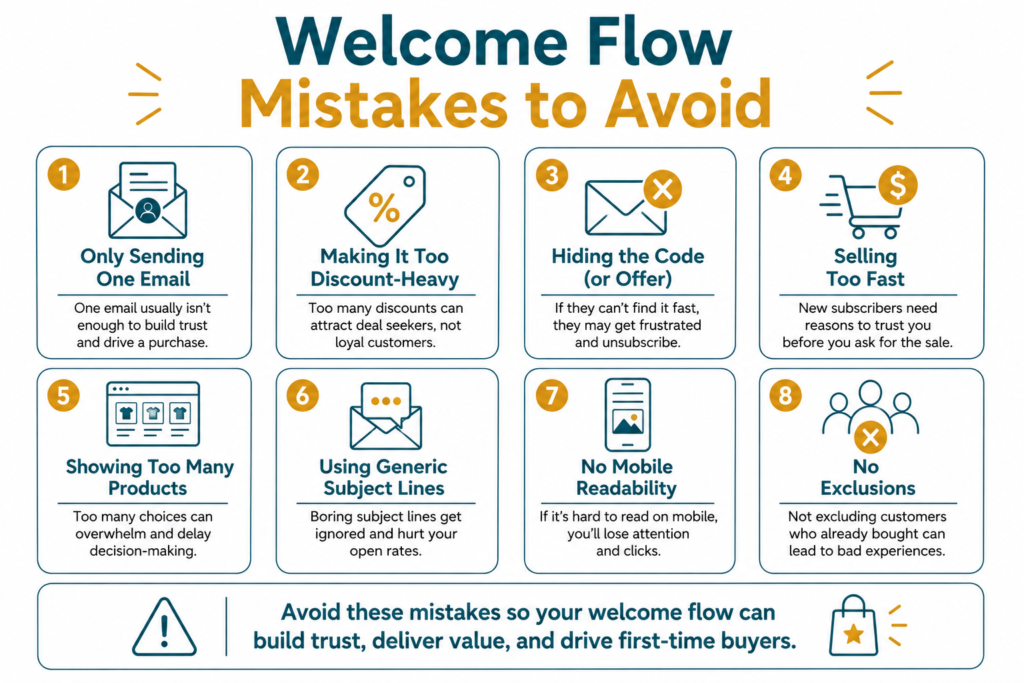
Common Welcome Flow Mistakes to Avoid
These are the welcome flow mistakes I usually look for first.
Mistake | Better Approach |
Sending only one welcome email | Use a short welcome sequence |
Making the flow too discount-heavy | Build value and trust too |
Not delivering the code clearly | Make the offer easy to find |
Selling before explaining the brand | Build trust before pushing too hard |
Showing too many products too soon | Guide them to bestsellers or first picks |
Using generic subject lines | Match the subject line to the email’s job |
Forgetting mobile readability | Make the email easy to scan |
Not excluding people who already purchased | Remove buyers from first-purchase nudges |
Turning on templates without editing them | Customize copy, timing, branding, and offer |
That last one matters.
Klaviyo’s welcome series guide gives you a starting structure, but you still need to personalize templates with your own content and brand before turning them live. (Klaviyo Help Center)
A default welcome flow may work as a draft.
But it should not sound like a default when the subscriber receives it. For the mechanics of how Klaviyo flows trigger and send, see Klaviyo email flows explained.
Avoiding mistakes is good.
But you still need to know if the flow is actually working.
How to Know If Your Welcome Flow Is Working
A welcome flow is not working just because it is live.
You need to check whether it turns attention into action.
Klaviyo’s flow analytics help you review flow message performance, including open, click, and conversion rates. (Klaviyo Help Center)
Metric | What It Tells You |
Signup-to-purchase rate | Are subscribers becoming buyers? |
Open rate | Are subject lines and sender name getting attention? |
Click rate | Are people interested enough to click? |
Placed order rate | Is the flow helping drive first purchases? |
Revenue per recipient | How valuable is the flow per subscriber? |
Code redemption rate | Are people using the welcome offer? |
Unsubscribe rate | Does the flow feel irrelevant or too aggressive? |
Open rate matters. But it is not enough.
A welcome flow can get opens and still fail to get clicks.
It can get clicks and still fail to get purchases.
It can drive purchases but create too many unsubscribes.
So look at the full picture.
To review the numbers properly, you need to know which email marketing metrics every Shopify store should track.
If the numbers are weak, the problem is usually not “email does not work.”
It is usually the message, timing, offer, or flow logic.
And that is fixable.
When Should You Get Help With Your Welcome Flow?
You can build a simple welcome flow yourself.
But if your list is growing and subscribers are not buying, the flow may need a closer look.
You may need help if:
- Subscribers join but do not buy
- Your welcome flow is only one email
- Your welcome code rarely gets used
- Your emails feel generic
- You are not sure what to say after Email 1
- You do not know what to test
- Your reporting is unclear
- Your flow looks fine but does not support first purchase
If subscribers join your list but rarely place their first order, a Klaviyo email marketing agency can help improve the welcome journey from signup to first purchase.
Because the goal is not just to welcome subscribers.
It is to turn attention into a first purchase.
Final Thoughts
A welcome flow is not just a hello.
It is the first guided path from subscriber to customer.
A strong welcome flow helps new subscribers understand:
Why your brand?
Why your product?
Why trust you?
Why buy now?
Start simple.
Welcome them.
Explain the value.
Show the easiest product to start with.
Build trust.
Give a clear reason to buy.
That is how a welcome flow turns new subscribers into first-time buyers.
At Your Proactive Media, we help Shopify brands create high-converting Klaviyo welcome flows that build trust, introduce products effectively, and turn new subscribers into loyal customers.
Want to Turn More New Subscribers Into First-Time Buyers?
If your Shopify store is growing its email list but new subscribers are not buying, your welcome flow may need a closer look.
FAQs About Welcome Flows
What is a welcome flow?
+A welcome flow is an automated email sequence that starts when someone joins your email list. For Shopify stores, the goal is to welcome the subscriber, build trust, explain the brand, and guide them toward the first purchase.
How many emails should a welcome flow have?
+Most Shopify stores can start with 3 to 4 emails. A 4-email welcome flow gives you enough room to welcome the subscriber, explain the brand, show proof or bestsellers, and give a clear reason to buy.
What should the first welcome email include?
+The first welcome email should welcome the subscriber, deliver the promised offer, set expectations, and give one clear CTA.
Should a welcome flow include a discount?
+It can, especially if the discount was promised at signup. But the welcome flow should still build trust, explain product value, and guide the subscriber toward the right first purchase.
How fast should welcome emails send?
+The first email should send immediately after signup. Follow-up emails can usually send 1 to 5 days apart, depending on your product, price point, buying cycle, and customer behavior.
What should I A/B test in a welcome flow?
+Start with subject lines, CTA wording, offer reminders, timing, bestseller sections, and product recommendation sections. Test one thing at a time so you can see what actually improved.
How do I know if my welcome flow is working?
+Track signup-to-purchase rate, click rate, placed order rate, revenue per recipient, code redemption rate, and unsubscribe rate.
Can I use Klaviyo for welcome flows on Shopify?
+Yes. Klaviyo can trigger welcome flows when someone joins your list and can use Shopify customer data to support better follow-up.

Jasmin Umali
Jasmin Umali is the Founder of Your Proactive Media and a Klaviyo email marketing strategist with 6 years of experience helping ecommerce brands generate an additional 20%–30% or more revenue through email marketing.