At some point, basic email sending is not enough.
Not because your Shopify store needs another tool.
But because your customers are doing different things.
Some are browsing.
Some are adding to cart.
Some are starting checkout.
Some are buying once.
Some are coming back.
Some are disappearing.
And if every customer gets the same email, you’re missing the point.
That’s why many Shopify stores use Klaviyo for email marketing.
Not just to send more emails.
But to send better emails based on what shoppers actually do inside the store.
Because the real goal is not to fill inboxes.
The goal is to bring shoppers back, recover missed sales, increase repeat purchases, and understand which emails actually help your store grow.
New to the bigger picture? Start with our guide on Klaviyo email marketing for Shopify stores.
Why Shopify Stores Need More Than Basic Email Sending
A basic email tool can help you send campaigns.
That’s useful.
You can send a sale.
A product launch.
A holiday promo.
A new arrival email.
But once your Shopify store starts getting more traffic, more customers, and more customer activity, basic email sending starts to feel limited.
Because your customers are not all in the same stage.
A new subscriber is not the same as a cart abandoner.
A first-time buyer is not the same as a repeat customer.
A VIP customer is not the same as someone who hasn’t bought in six months.
But if you send the same email to everyone, your email marketing becomes less relevant.
And when emails feel less relevant, people click less, buy less, unsubscribe more, or stop paying attention.
That’s the gap Klaviyo helps solve.
It gives Shopify stores a better way to follow up based on customer behavior, purchase history, and engagement.
The real value is not just sending emails.
It’s knowing who should receive which email, and when.
Shopify Has Built-In Email Tools, But There Are Limits
Shopify already gives store owners built-in tools for email marketing and automation.
And for many early-stage stores, that can be enough to start.
You can create basic emails.
You can send simple campaigns.
You can start building customer touchpoints without adding too many tools.
That’s useful.
Shopify says merchants can use its marketing automation tools to grow subscriber lists, personalize messages, and automate workflows from the Shopify admin. Shopify Messaging also lets merchants send email and SMS campaigns and automations directly to subscribers.
Source: Marketing automation tools
Source: Email and SMS marketing with Shopify Messaging
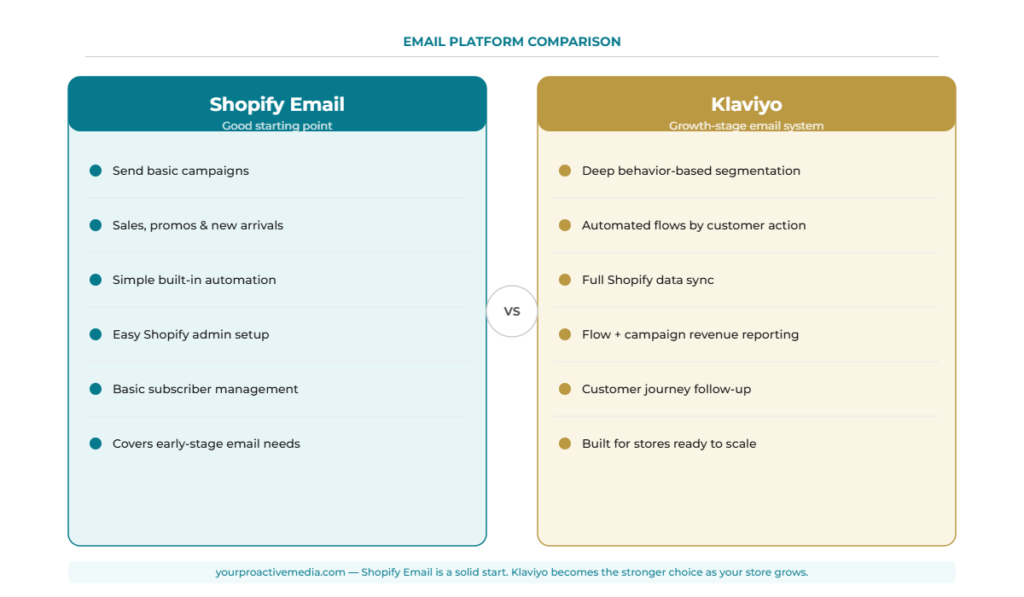
But as your store grows, email usually needs to do more than send basic campaigns.
You may want to follow up based on deeper customer behavior.
You may want to segment people by what they viewed, added to cart, bought, clicked, ignored, or haven’t done in months.
You may want clearer reporting on which flows and campaigns are actually driving sales.
That’s where Shopify’s built-in email tools can start to feel limited.
Not because they’re bad.
But because growing stores need more control.
More segmentation.
More automation.
More customer journey follow-up.
More revenue visibility.
That’s usually when Klaviyo starts to make more sense.
Not as “another email tool.”
But as a stronger email system for Shopify stores that are ready to use customer data more seriously.
For a deeper tool comparison, read Klaviyo vs Shopify Email.
What Makes Klaviyo Different for Shopify Stores?
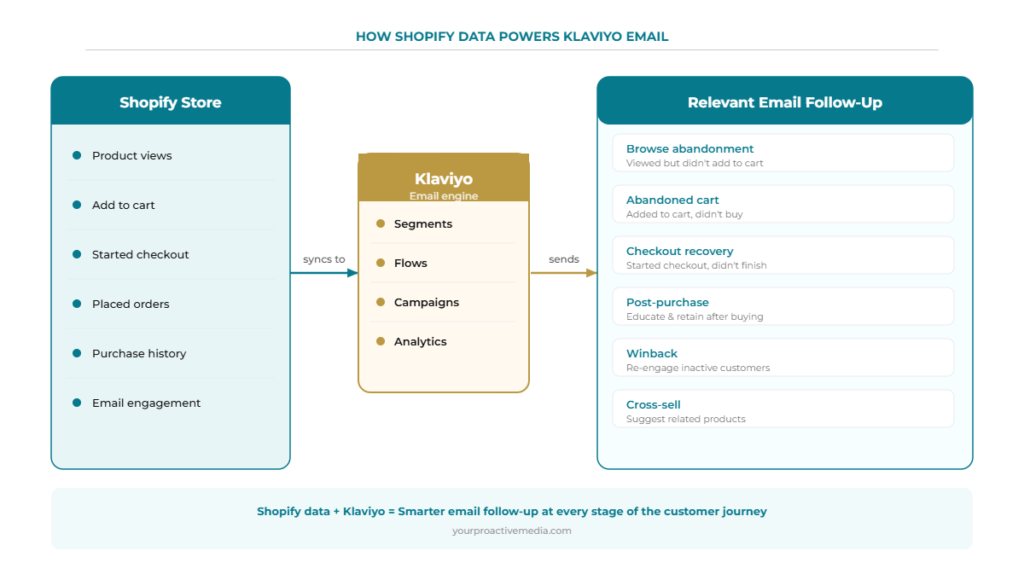
Klaviyo works well for Shopify stores because it connects with Shopify customer data.
That means your email marketing can use what’s already happening inside your store.
Product views.
Add-to-carts.
Started checkouts.
Placed orders.
Purchase history.
Email engagement.
Instead of guessing what customers might care about, you can build emails around what they actually did.
According to Klaviyo, its Shopify integration helps bring customer profile and order data into Klaviyo, enables onsite tracking and signup forms, and can sync data from Klaviyo back to Shopify.
Source: Getting started with Shopify
That matters because email marketing is stronger when it’s connected to real customer activity.
- A shopper who viewed a product may need more information.
- A shopper who added to cart may need a reminder.
- A customer who bought once may need education, support, or a reason to buy again.
- A past customer may need a winback email.
That’s why Klaviyo is not just useful as an email-sending platform.
For Shopify stores, it can become a customer follow-up system.
Klaviyo Uses Shopify Customer Data to Send Better Emails
Your Shopify store already collects buying signals.
Klaviyo helps you use those signals.
That’s the main reason Shopify brand owners and marketing managers should care about it.
Without customer data, your email strategy is usually basic.
You send one campaign to everyone.
- Same promo.
- Same product.
- Same timing.
- Same CTA.
But with Shopify data inside Klaviyo, you can create follow-up based on behavior.
Customer Action | Possible Email Follow-Up |
Viewed a product | Browse abandonment email |
Added to cart | Abandoned cart email |
Started checkout | Checkout recovery email |
Placed first order | Post-purchase email |
Bought before but inactive | Winback email |
Bought Product A | Cross-sell Product B |
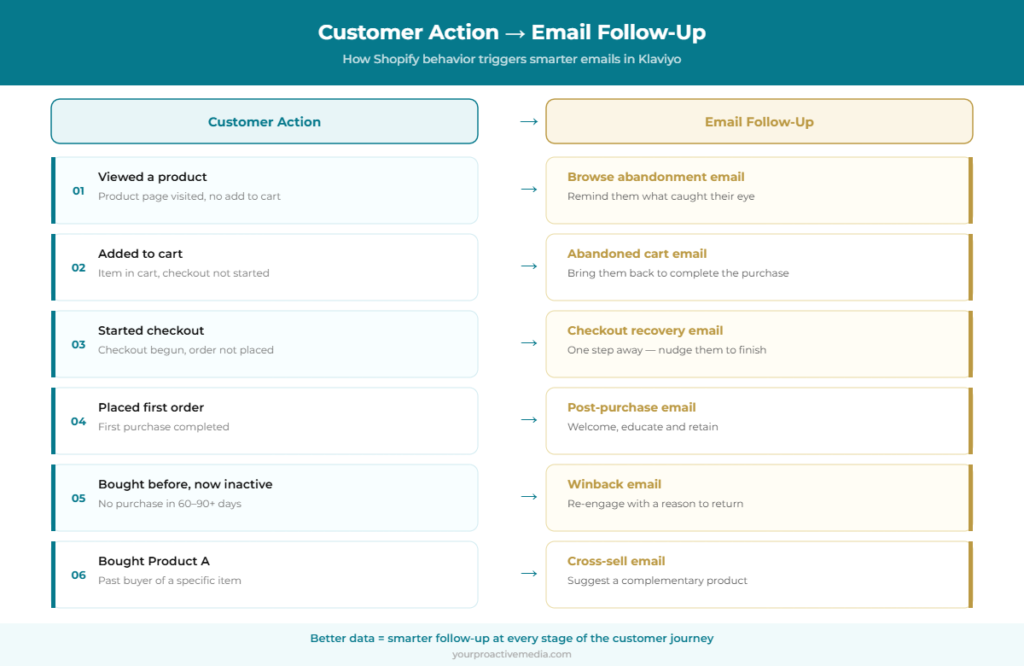
Klaviyo’s Shopify data reference explains that Shopify can sync data into Klaviyo and points merchants to resources for Shopify integration and Shopify data.
Source: Shopify data reference
Better data does not automatically create better sales.
But it gives your email strategy something better to work with.
Instead of asking:
- What email should we send this week?
- You can ask better questions.
- Who viewed this product but didn’t buy?
- Who added to cart but didn’t check out?
- Who bought once but never came back?
- Who clicked last month but hasn’t ordered?
That’s when email becomes more strategic.
Klaviyo Helps Shopify Stores Set Up Automated Email Flows
One of the biggest reasons Shopify stores use Klaviyo is automation.
In Klaviyo, these are called flows.
Email flows are automated emails triggered by customer behavior.
That means the email sends when someone takes a specific action.
Not when you manually schedule it.
For example:
- Someone joins your list.
Your welcome flow starts. - Someone adds to cart but doesn’t buy.
Your abandoned cart flow starts. - Someone places an order.
Your post-purchase flow starts. - Someone hasn’t bought in a while.
Your winback flow starts.
Klaviyo recommends starting with high-impact flows like a welcome series, abandoned cart flow, post-purchase flow, and winback flow.
Source: Getting started with flows
For Shopify stores, these flows matter because they work in the background.
You don’t have to manually check who abandoned cart.
You don’t have to manually remind every new subscriber.
You don’t have to manually follow up with every first-time buyer.
The system does the follow-up for you.
That’s useful for busy Shopify brand owners.
And it’s also useful for marketing managers who need a more organized way to support sales, retention, and customer experience.
For a full breakdown, read email flows explained for Shopify stores.
The Core Email Flows Shopify Stores Usually Need
You don’t need to build every possible flow right away.
Start with the flows closest to revenue and customer journey.
Flow | What It Does |
Welcome flow | Introduces your brand and guides new subscribers toward the first purchase |
Abandoned cart flow | Follows up with shoppers who added to cart but didn’t buy |
Browse abandonment flow | Follows up with shoppers who viewed a product but didn’t add to cart |
Post-purchase flow | Educates and supports customers after they buy |
Winback flow | Brings past customers back after they become inactive |
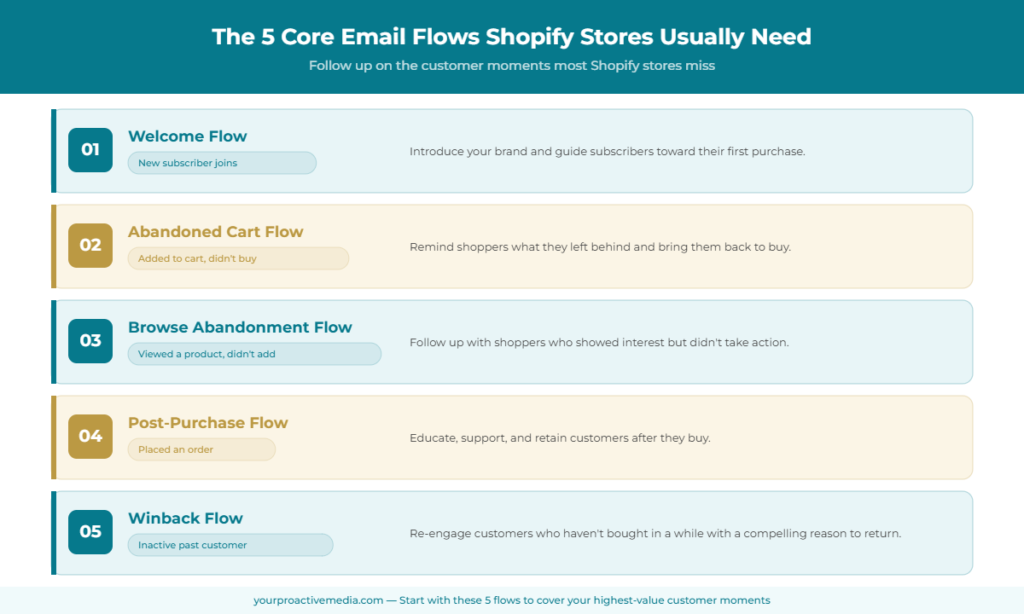
These flows help cover the moments where many Shopify stores lose potential revenue.
- A new subscriber joins but doesn’t buy.
- A shopper adds to cart but leaves.
- A customer buys once but disappears.
Without flows, those moments often go cold.
With flows, your store has a better chance to follow up at the right time.
You can also read our guide on 5 email flows every Shopify store should set up first.
Klaviyo Helps Shopify Stores Send More Relevant Campaigns
Campaigns are still important.
A campaign is a one-time email you send to a specific audience.
You can use campaigns for:
- Product launches
- New arrivals
- Bestseller emails
- Payday promos
- 6.6, 9.9, 11.11, or 12.12 campaigns
- Holiday offers
- Product education
- Customer review emails
- Bundle promotions
- Back-in-stock campaigns
But here’s where Klaviyo helps.
Campaigns do not always have to go to everyone.
You can send campaigns to specific segments.
Campaign | Better Targeting Idea |
Payday sale | Engaged subscribers |
Product launch | Past buyers of related products |
Bestseller email | New subscribers and non-buyers |
Bundle offer | First-time buyers |
VIP early access | High-value customers |
The campaign may be the same.
But the audience should not always be.
That’s a big shift.
Because if every campaign goes to the full list, you’re treating every subscriber like they care about the same thing.
They don’t.
- Some customers are ready to buy.
- Some need more trust.
- Some already bought.
- Some only care about one product category.
- Some haven’t clicked in months.
Klaviyo helps Shopify stores send campaigns with more context.
Need a clearer comparison? Read email campaigns vs flows.
Klaviyo Segmentation Helps You Stop Sending Every Email to Everyone
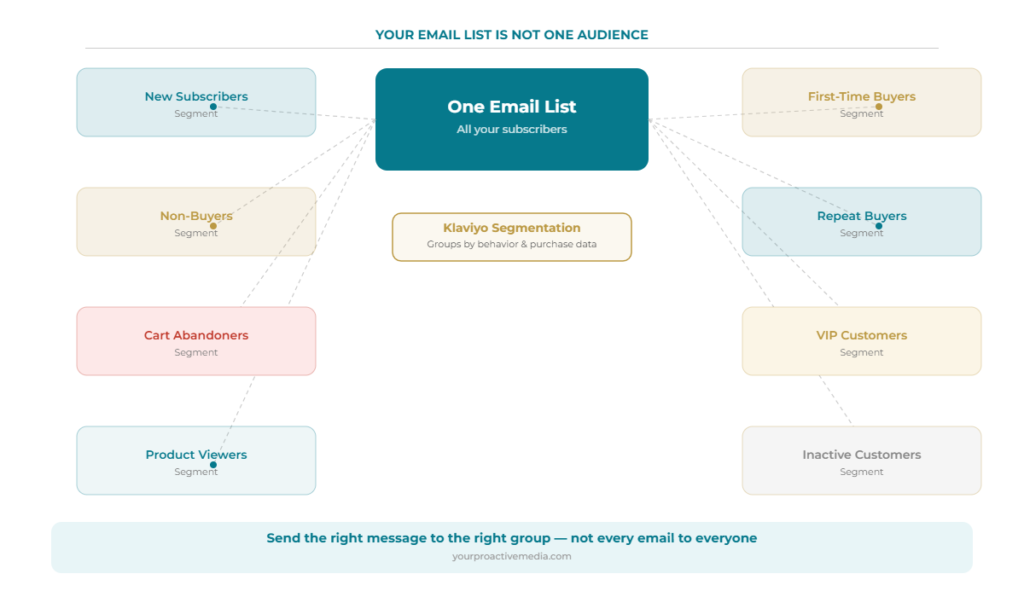
Your email list is not one big group of identical people.
It’s made of different customer types.
- New subscribers.
- Non-buyers.
- Cart abandoners.
- Product viewers.
- First-time buyers.
- Repeat buyers.
- VIP customers.
- Inactive customers.
Klaviyo segmentation helps you group people based on customer data.
Inside Klaviyo, segments are built using conditions. Klaviyo explains that segment conditions are the building blocks used to include or exclude parts of your audience.
Source: Segment conditions reference
For Shopify stores, one of the most useful condition types is:
What someone has done or not done.
This means you can create segments based on actions.
For example:
- Placed Order at least once
- Started Checkout but did not Place Order
- Viewed Product in the last 30 days
- Opened Email in the last 30 days
- Clicked Email in the last 30 days
- Added to Cart but did not buy
This is how your email marketing becomes more relevant.
Instead of sending the same campaign to everyone, you can send the right message to the right group.
And that matters because relevance affects performance.
How Better Targeting Can Improve Email Performance
This is the part many Shopify stores miss.
Better targeting is not just a nice idea.
It can show up in your metrics.
If you send emails that match customer interest, buying stage, or behavior, people are more likely to engage.
If you send emails that feel irrelevant, your metrics can expose the problem.
If You Send… | It Can Affect… | Why |
Relevant product emails | Click rate | People are more likely to click products they care about |
Cart or browse follow-ups | Flow revenue | You’re reaching shoppers who already showed intent |
Post-purchase emails | Repeat purchase rate | Buyers get a reason to come back |
Campaigns to engaged subscribers | Open rate and click rate | Active subscribers are more likely to respond |
The same email to everyone | Revenue per recipient | The message may not match every customer’s stage |
Too many irrelevant promos | Unsubscribe rate / spam complaints | People may feel the emails are not useful |
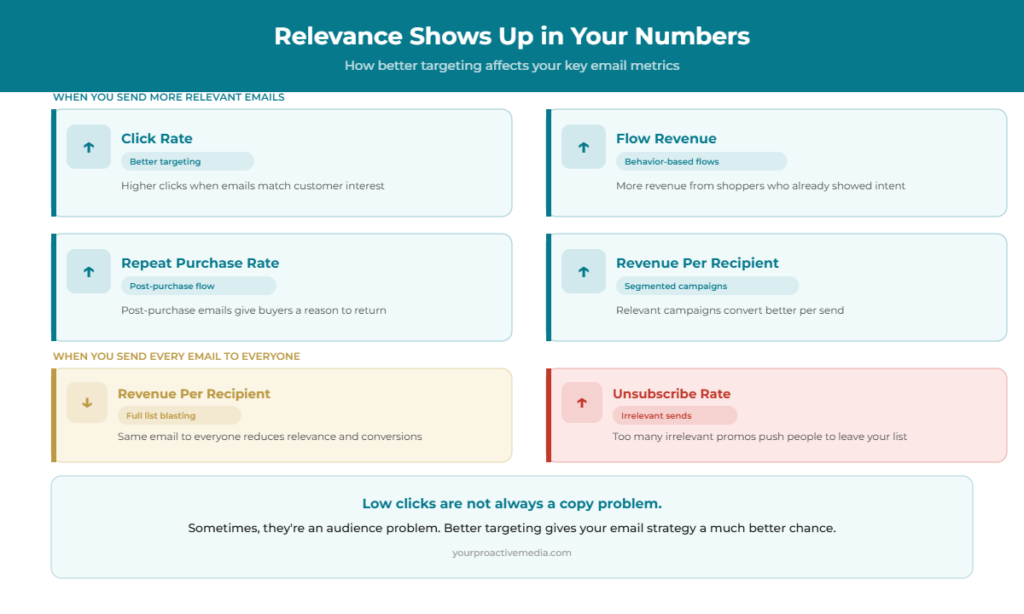
This is why Klaviyo is useful for Shopify stores.
It helps you send emails based on customer behavior instead of sending every campaign to the full list.
Better targeting does not guarantee better results.
But it gives your email strategy a much better chance.
Low clicks are not always a copy problem.
Sometimes, they’re an audience problem.
Klaviyo Analytics Helps You See What’s Actually Working
Shopify brand owners and marketing managers should not have to guess if email is working.
You need to know.
Which campaigns got clicks?
Which flows generated orders?
Which emails helped revenue?
Which messages are people ignoring?
Klaviyo’s campaign analytics documentation explains that campaign reporting includes open and click rates, plus conversion metric reporting.
Source: Understanding available campaign analytics
For Shopify stores, these are some of the key metrics to watch:
| Metric | Why It Matters |
| Open rate | Shows if your subject line and sender name are getting attention |
| Click rate | Shows if your email content, offer, and CTA are strong enough |
| Placed order rate | Shows if emails are helping drive purchases |
| Revenue per recipient | Helps compare campaign quality and audience fit |
| Flow revenue | Shows how much your automated emails are generating |
| Campaign revenue | Shows how much your one-time sends are generating |
| Unsubscribe rate | Shows if people are leaving your list |
| Spam rate | Shows if your emails may be hurting trust or deliverability |
Open rate matters.
But it’s not the full story.
An email can get opened and still fail to drive action.
That’s why Shopify stores should also look at clicks, orders, revenue per recipient, flow revenue, and campaign revenue.
Because the goal is not just to get opened.
The goal is to help the business grow.
When Does Klaviyo Make Sense for a Shopify Store?
Klaviyo is useful for many Shopify stores.
But it becomes more valuable when your store has customer activity worth following up on.
That means Klaviyo may make sense if your store has:
- Consistent website traffic
- Add-to-cart activity
- Checkout activity
- Email subscribers
- Regular orders
- Repeat purchase potential
- Product launches or promos
- A need for better segmentation
- A need for clearer reporting
If your store is brand new with almost no traffic, no email list, and no customer behavior yet, you may not feel the full value right away.
That does not mean email is useless.
It just means the system becomes more powerful when there are more customer signals to use.
Klaviyo is not worth it just because it’s popular.
It becomes worth it when it helps your store use customer behavior to recover sales, build retention, and make smarter email decisions.
Common Mistakes Shopify Stores Make Before Using Klaviyo Properly
Klaviyo is powerful.
But the tool is not the strategy.
Here are common mistakes Shopify stores make.
Mistake 1: Sending Every Campaign to Everyone
This is one of the most common problems.
A new subscriber, cart abandoner, repeat buyer, and inactive customer should not always get the same message.
When every campaign goes to everyone, emails become less relevant.
And less relevance can hurt clicks, conversions, and revenue per recipient.
Mistake 2: Only Emailing During Promos
Sales emails are important.
But if every email is a discount, customers may start waiting for the next promo.
Your campaigns can also include:
- Product education
- Customer reviews
- Buying guides
- Product comparisons
- Bestsellers
- New arrivals
- Usage tips
- Founder stories
Email should not only sell the discount.
It should also sell the product, the brand, and the reason to buy.
Mistake 3: Not Setting Up Core Flows
Some stores focus only on campaigns.
But flows are where important customer moments get handled automatically.
At minimum, most Shopify stores should have:
- Welcome flow
- Abandoned cart flow
- Browse abandonment flow
- Post-purchase flow
- Winback flow
If these are missing, your store may be losing follow-up opportunities from people who already showed interest.
Mistake 4: Looking Only at Open Rate
Open rate can tell you if people opened.
But it does not tell you if they clicked, bought, or came back.
That’s why you also need to look at:
- Click rate
- Placed order rate
- Revenue per recipient
- Flow revenue
- Campaign revenue
- Unsubscribe rate
- Spam rate
A high open rate with low clicks may mean your subject line worked, but your email did not.
A high click rate with low orders may mean your product page, offer, price, or audience needs review.
Metrics help you diagnose the real issue.
Mistake 5: Treating Klaviyo Like a Basic Email Sender
If you only use Klaviyo to send promos, you’re missing its main value.
Klaviyo works best when you use:
- Shopify data
- Customer behavior
- Automated flows
- Segments
- Campaign targeting
- Revenue tracking
The goal is not to send more emails.
The goal is to send more relevant emails.
Is Klaviyo Worth It for Shopify Stores?
For many growing Shopify stores, yes.
Especially if the store already has traffic, customer activity, and repeat purchase potential.
Klaviyo can help Shopify brands:
- Bring shoppers back
- Recover abandoned carts
- Follow up after purchase
- Increase repeat purchases
- Send more targeted campaigns
- Segment customers by behavior
- Track campaign and flow revenue
But the best way to think about Klaviyo is this:
It’s not just an email platform.
It’s a customer follow-up system.
Your Shopify store already has signals.
Klaviyo helps you use them.
Once you’re ready to act, use this Klaviyo setup checklist for Shopify stores.
Want to Make Klaviyo Work Better for Your Shopify Store?
If your Shopify store already has traffic, carts, and customers, email should not be treated like an afterthought.
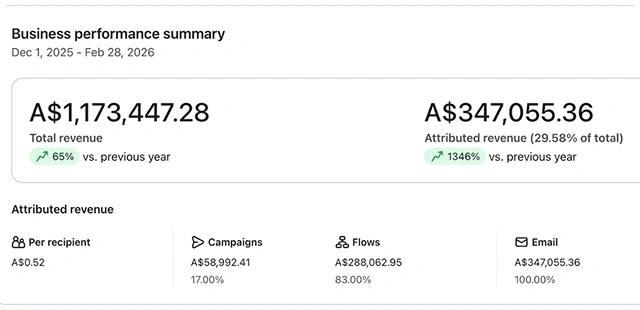
The right setup can help you recover missed sales, follow up with new subscribers, bring past buyers back, and understand which emails actually drive revenue. Your Proactive Media can help you get there.
You don’t need more random emails.
You need a better follow-up system.
Final Thoughts
Shopify stores do not just need more traffic.
They need better follow-up.
Because traffic alone does not guarantee sales.
People browse and leave.
People add to cart and get distracted.
People buy once and forget to come back.
Shopify’s built-in email tools can help you start.
But as your store grows, you may need stronger automation, segmentation, and reporting.
That’s where Klaviyo becomes useful.
Klaviyo helps Shopify stores turn customer moments into smarter email decisions.
The goal is not more random emails.
The goal is more relevant emails that support sales, retention, and customer experience.
If your Shopify store is already getting traffic, carts, and customers, Klaviyo can help you make more of those moments instead of letting them go cold.
Klaviyo provides the data and automation tools. A Klaviyo email marketing agency can help turn those capabilities into clearer customer journeys, stronger campaigns, and more consistent optimisation.
FAQs About Klaviyo for Shopify
What is Klaviyo for Shopify?
Klaviyo for Shopify is an email marketing setup where Klaviyo connects with your Shopify store so you can use customer data, order data, and store activity to send campaigns and automated flows.
Why do Shopify stores use Klaviyo?
Shopify stores use Klaviyo because it helps with customer behavior tracking, automated flows, segmentation, targeted campaigns, and revenue reporting.
Is Klaviyo better than Shopify Email?
Shopify Email can work for simple campaigns and early-stage email marketing. Klaviyo usually makes more sense for growing Shopify stores that need stronger automation, segmentation, customer behavior tracking, and revenue reporting.
Does Shopify have built-in email marketing?
Yes. Shopify has built-in email marketing and automation tools through Shopify Messaging and Shopify’s marketing automation tools. These can be useful for basic campaigns and early-stage email marketing. Growing stores may eventually need a more advanced platform like Klaviyo for deeper segmentation, automation, and reporting.
Source: Marketing automation tools
What email flows should Shopify stores set up in Klaviyo?
Most Shopify stores should start with a welcome flow, abandoned cart flow, browse abandonment flow, post-purchase flow, and winback flow.
Does Klaviyo help increase repeat purchases?
Yes, Klaviyo can support repeat purchases through post-purchase emails, winback flows, replenishment emails, cross-sell emails, and segmented campaigns.
Is Klaviyo worth it for small Shopify stores?
It depends on the store. Klaviyo becomes more valuable when a Shopify store has traffic, add-to-cart activity, email subscribers, regular sales, and customer behavior worth following up on.

Jasmin Umali
Jasmin Umali is the Founder of Your Proactive Media and a Klaviyo email marketing strategist with 6 years of experience helping ecommerce brands generate an additional 20%–30% or more revenue through email marketing.