Your Shopify store is collecting more data than you think.
Every product view.
Every add to cart.
Every checkout started.
Every order placed.
Every customer who buys once, twice, or never again.
The problem?
Most of that data doesn’t help your sales unless your email platform can actually use it.
That’s where Klaviyo email marketing comes in.
Klaviyo helps Shopify stores turn customer behavior into better emails, better timing, and better follow-up.
Instead of sending the same campaign to everyone, you can send emails based on what shoppers actually do inside your store.
That’s the real advantage. Not just “email marketing.”
Smarter Shopify email marketing powered by customer data.
What Is Klaviyo Email Marketing?
Klaviyo email marketing is the use of Klaviyo to send email campaigns and automated email flows for ecommerce stores.
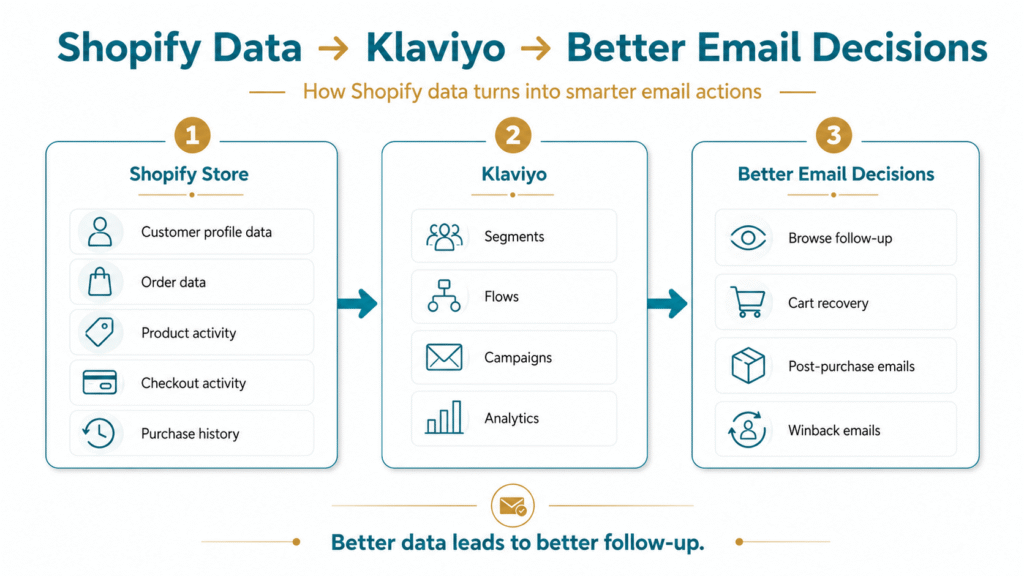
For Shopify stores, Klaviyo connects with your store so you can use customer profile data, order data, onsite tracking, signup forms, and Shopify activity to send more targeted emails. Klaviyo’s Shopify guide says the integration brings customer profile and order data into Klaviyo so brands can reach customers with targeted messaging.
Source: Getting started with Shopify
In simple terms:
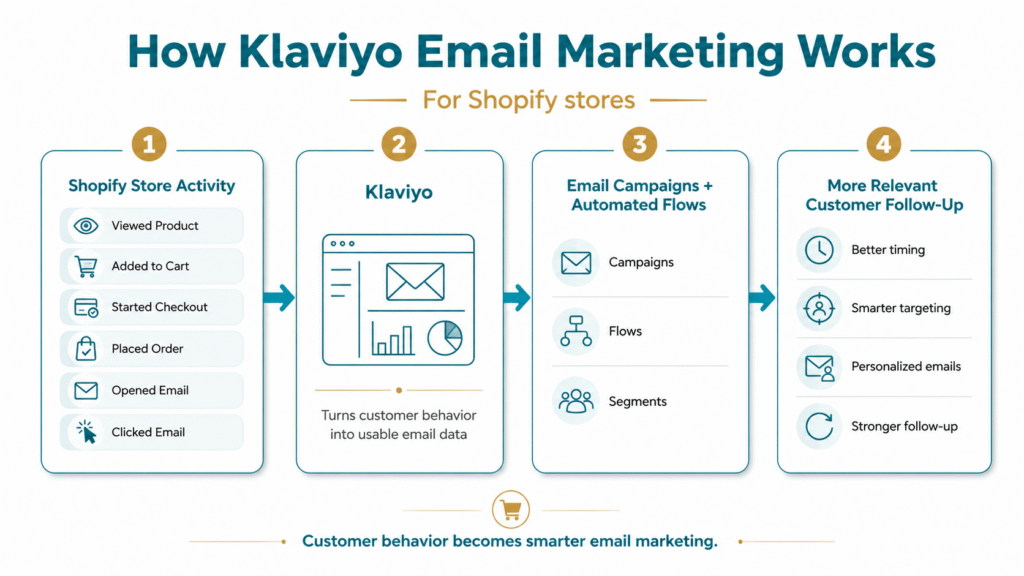
Klaviyo helps your Shopify store send emails based on customer behavior.
That behavior can include things like:
- Viewed Product
- Added to Cart
- Started Checkout
- Placed Order
- Ordered Product
- Opened Email
- Clicked Email
So you’re not just guessing what to send. You’re using actual customer actions.
That matters because a shopper who viewed a product is different from someone who added to cart.
A first-time buyer is different from a repeat buyer.
A VIP customer is different from someone who hasn’t bought in six months.
Klaviyo helps you treat those people differently.
And that’s where better email marketing starts.
Why Klaviyo Works Well for Shopify Stores
The biggest reason we recommend Klaviyo for Shopify is the integration.
If you’re running a Shopify store, your email platform should not just send emails.
It should understand what’s happening inside your store.
Klaviyo’s Shopify data reference says Shopify can sync order data, delivery data, onsite tracking data, and customer data into Klaviyo. This includes ecommerce events like Placed Order and Ordered Product.
That gives you a better foundation for email.
Because once Klaviyo has your Shopify data, you can create emails based on real actions.
For example:
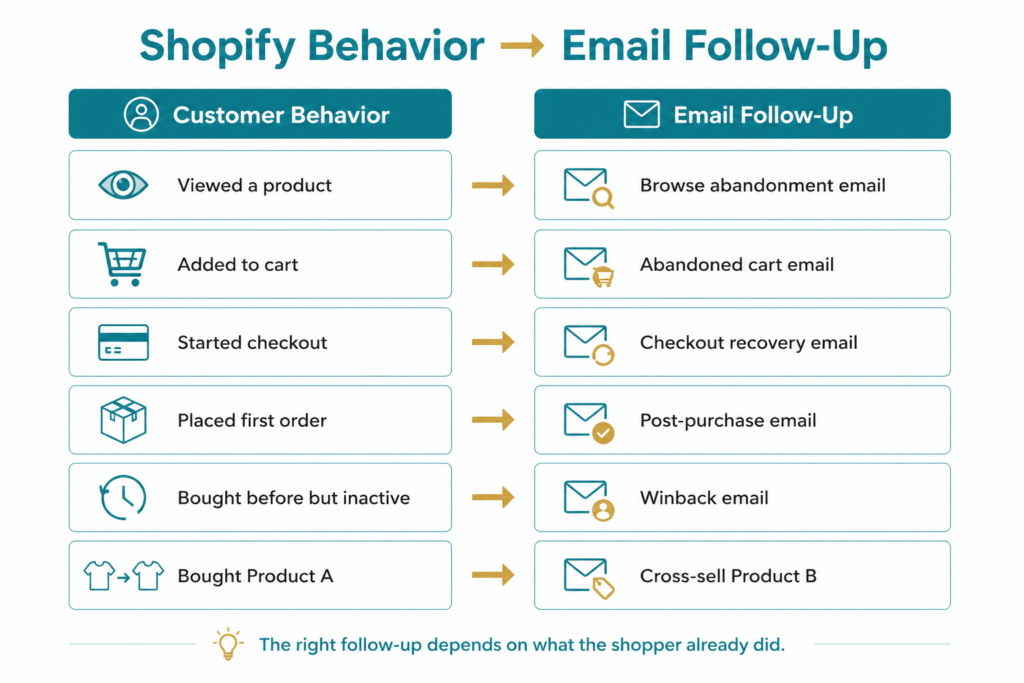
A customer views a product but doesn’t buy.
You can send a browse abandonment flow.
A shopper starts checkout but leaves.
You can send an abandoned checkout flow.
A customer places their first order.
You can send a post-purchase flow.
A past buyer hasn’t returned.
You can send a winback flow.
That’s why the Klaviyo Shopify integration matters.
It turns your store activity into email opportunities.
Why Shopify Data Matters in Email Marketing
A lot of ecommerce brands think email marketing is about writing promos.
That’s only part of it.
The real power comes from sending the right message to the right person based on what they already did.
That’s why Shopify customer data is important.
Without customer data, your email strategy becomes basic.
You send one message to everyone.
Same promo.
Same product.
Same timing.
Same CTA.
But with Shopify data inside Klaviyo, you can be more specific.
You can send:
- A product reminder to someone who viewed an item
- A cart reminder to someone who added to cart
- A first-purchase offer to a new subscriber
- A cross-sell email to someone who bought a related product
- A winback email to someone who hasn’t ordered in months
- A VIP email to your best customers
That’s a better customer experience.
And For Shopify business owners or marketing managers in the Philippines working with Your Proactive Media, this matters even more.
Because many ecommerce brands in the Philippines already spend time and money getting traffic from Meta ads, TikTok, influencers, Google, or marketplace audiences.
But traffic alone is not enough.
You need follow-up.
A Klaviyo email marketing agency in the Philippines can help turn that paid traffic into structured follow-up across campaigns, automated flows, segmentation, and retention.
Klaviyo helps make that follow-up smarter.
Klaviyo Email Flows: Automated Follow-Up Based on Behavior
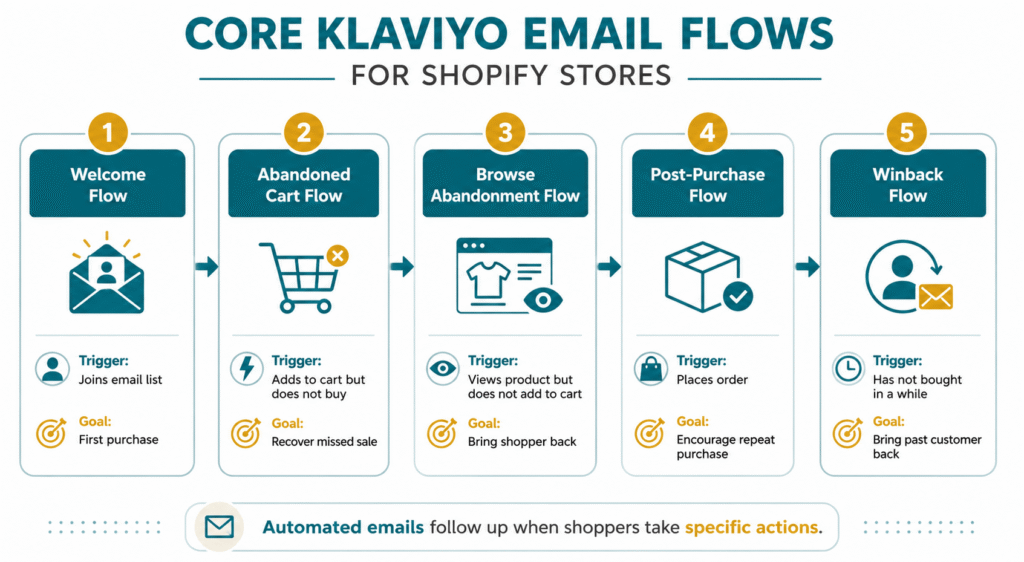
Klaviyo email flows are automated emails triggered by customer behavior.
That means the email sends when a shopper does something specific.
Not when you manually schedule it.
Klaviyo recommends starting with high-impact flows like a welcome series, abandoned cart flow, post-purchase flow, and winback flow.
Source: Getting started with flows
Here are the core Klaviyo email flows Shopify stores should understand.
If your store has these customer moments but your flows are missing, outdated, or unclear, Klaviyo email marketing agency can help with flow strategy, campaign planning, segmentation, and reporting.
You can also read our full guide on email flows every Shopify store should set up.
Welcome Flow
A welcome flow starts when someone joins your email list.
This is usually your first real chance to turn a subscriber into a buyer.
A good welcome flow can:
- Introduce your brand
- Explain what makes your products different
- Show bestsellers
- Share reviews
- Offer a first-purchase incentive
- Guide shoppers to the right collection
This matters because many new subscribers are interested, but not ready yet.
The welcome flow helps move them closer to their first order. For a deeper breakdown, see our welcome flow guide for Shopify stores.
Abandoned Cart Flow
An abandoned cart flow starts when someone adds a product to cart but doesn’t buy.
This is one of the most important Klaviyo email flows for Shopify stores.
Why?
Because the shopper already showed buying intent.
They didn’t just browse.
They added something to cart.
A strong abandoned cart flow can include:
- Cart reminder
- Product image
- Product benefits
- Reviews
- Objection handling
- Clear CTA to return to checkout
The job is simple:
Bring them back while the interest is still warm. Our abandoned checkout flow guide covers timing, copy, and structure in more detail.
Browse Abandonment Flow
A browse abandonment flow starts when someone views a product but doesn’t add it to cart.
This flow is softer than abandoned cart.
The shopper showed interest, but they may still be comparing or thinking.
So the email should feel helpful.
You can include:
- Product details
- Bestsellers
- Similar products
- Product education
- Customer reviews
- Reasons to choose the product
This is useful for Shopify stores with products that need more consideration, like skincare, supplements, apparel, beauty tools, wellness products, or food products. See our full browse abandonment email guide for sample timing and copy.
Post-Purchase Flow
A post-purchase flow starts after someone places an order.
This is where many stores miss a big opportunity.
They get the sale, then go quiet.
But after someone buys, you still have work to do.
You can help them:
- Know what happens next
- Use the product properly
- Feel confident about their purchase
- Discover related products
- Leave a review
- Come back for a second order
Your first purchase should not be the end.
It should be the start of the customer relationship.
Winback Flow
A winback flow targets customers who haven’t bought in a while.
Maybe they bought once and disappeared.
Maybe they used to buy but stopped.
Maybe they still like the brand, but they forgot to come back.
A winback flow gives them a reason to return.
You can feature:
- New products
- Bestsellers
- A limited-time offer
- Product recommendations
- What changed since their last order
Past customers are valuable because they already know you.
They may just need the right reminder.
Klaviyo Campaigns: Better Sends, Not Just Email Blasts
Klaviyo email campaigns are one-time emails you send to a specific audience.
You use campaigns for planned messages like:
- Product launches
- New arrivals
- Bestseller emails
- Payday campaigns
- 6.6, 9.9, 11.11, or 12.12 promos
- Holiday offers
- Product education
- Customer review emails
- Bundle promotions
- Back-in-stock campaigns
But here’s the important part:
In Klaviyo, campaigns don’t have to be generic blasts.
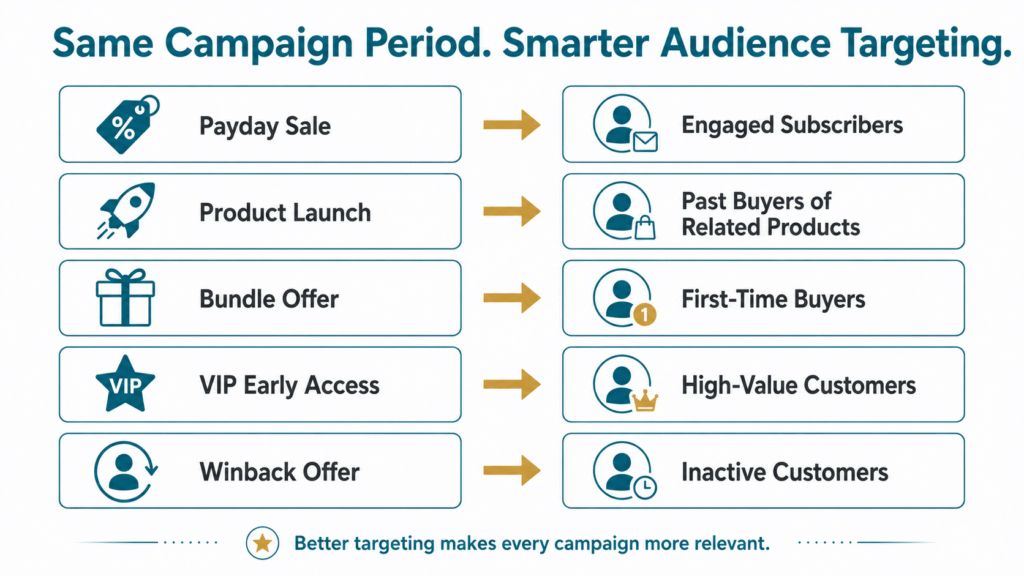
You can send campaigns to specific segments.
For example:
Instead of sending a payday sale to everyone, you can send it to engaged subscribers.
Instead of sending a product launch to your full list, you can send it first to past buyers of a related product.
Instead of sending a discount to VIP customers, you can give them early access.
This is where Klaviyo email marketing becomes more strategic.
You’re not only deciding what to send.
You’re deciding who should receive it.
If you are comparing tools before going deeper into Klaviyo, read Klaviyo vs Shopify Email.
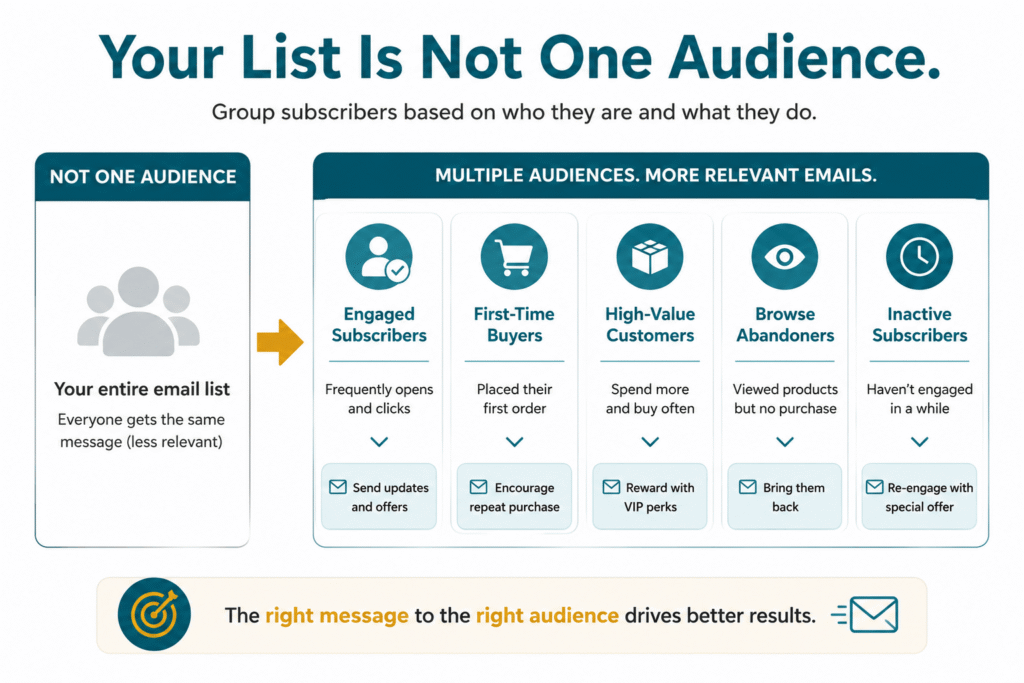
Klaviyo Segmentation: How You Send More Relevant Emails
Klaviyo segmentation lets you group people based on customer data.
Inside Klaviyo, segments are built using conditions. Klaviyo describes segment conditions as the building blocks used to include or exclude parts of your audience.
Source: Segment conditions reference
This sounds technical.
But it’s simple once you see it.
You can create segments based on things like:
- What someone has done or not done
- Properties about someone
- Where someone is located
- If someone is in or not in a list
- If someone can or cannot receive marketing
One of the most useful Klaviyo segmentation conditions is:
What someone has done or not done.
This lets you create segments based on actions.
Examples:
- Placed Order at least once
- Started Checkout but did not Place Order
- Viewed Product in the last 30 days
- Opened Email in the last 30 days
- Clicked Email in the last 30 days
- Added to Cart but did not buy
Klaviyo also explains that segments are dynamic, meaning profiles appear in a segment only when they meet the conditions you set.
That’s powerful.
Because your audience updates automatically.
If someone becomes a repeat buyer, they can enter a repeat buyer segment.
If someone stops engaging, they can move into an inactive segment.
If someone views a product, they can qualify for a more relevant follow-up.
This is how you stop sending the same email to everyone.
Klaviyo Analytics: What Shopify Stores Should Track
You don’t want to guess if your emails are working.
You want to know.
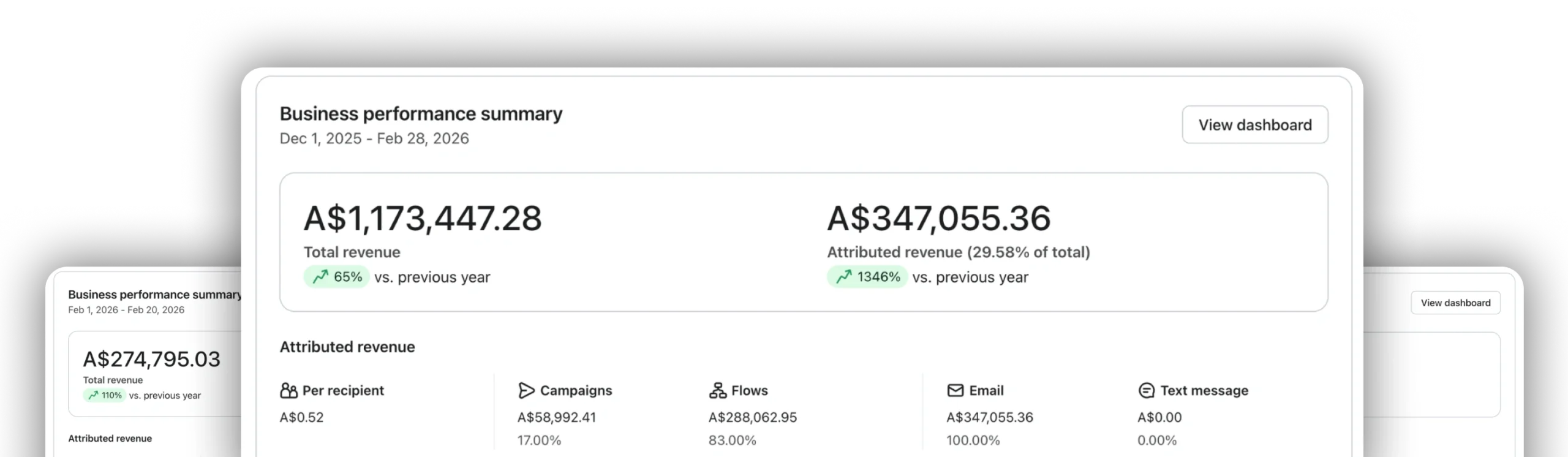
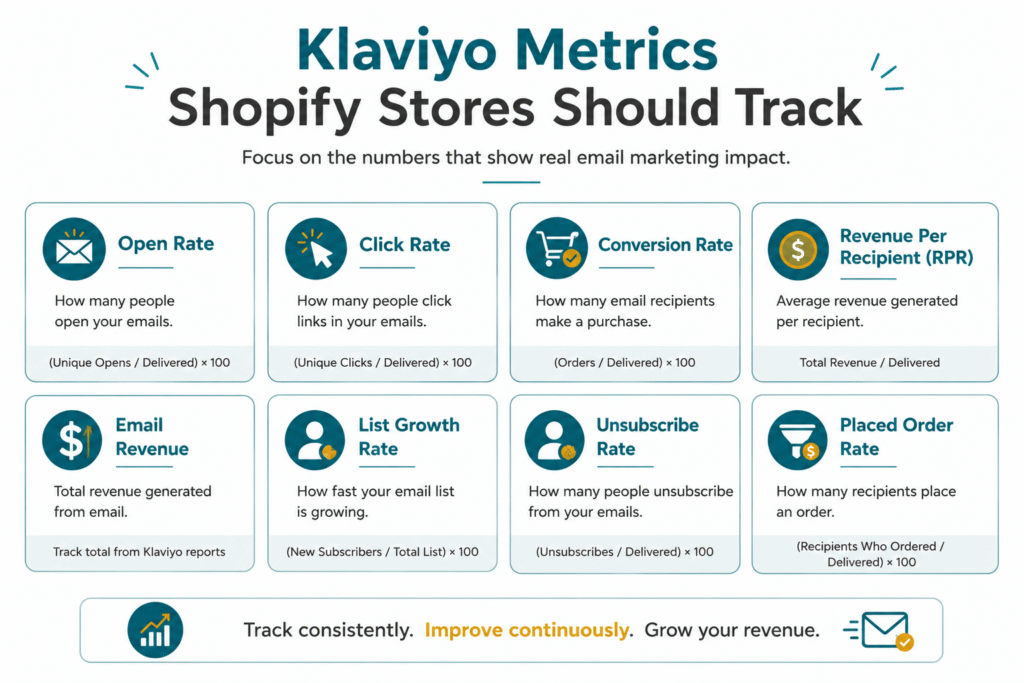
Klaviyo analytics helps you track how your campaigns and flows perform.
Klaviyo’s campaign analytics include metrics such as average open rate, average click rate, placed order rate, and revenue per recipient.
Source: Understanding available campaign analytics
For Shopify stores, these are the main numbers to watch.
Open Rate
Open rate shows how many people opened your email.
This helps you check your subject line, sender name, and audience quality.
But don’t stop here.
An open is not a sale.
Click Rate
Click rate shows how many people clicked inside your email.
This tells you if your email message, offer, product, and CTA are strong enough to move people.
If people open but don’t click, the email may not be clear or relevant enough.
Placed Order Rate
Placed order rate shows how many recipients placed an order within the attribution window.
This is important because ecommerce email marketing should not only get attention.
It should help drive purchases.
Revenue Per Recipient
Revenue per recipient shows how much revenue your email made per recipient.
This helps you compare campaigns better.
Sometimes, a campaign with fewer opens can still make more money if the audience is more qualified.
Flow Revenue
Flow revenue shows how much your automated emails are generating.
This helps you understand if your welcome flow, abandoned cart flow, post-purchase flow, and winback flow are doing their job.
Campaign Revenue
Campaign revenue shows how much your one-time sends are generating.
This helps you understand which campaigns work best, whether that’s payday promos, product education, reviews, launches, or seasonal offers.
The goal is not to stare at dashboards all day.
The goal is to know what to improve next.
Is Klaviyo Worth It for Shopify Stores in the Philippines?
For many Shopify stores, yes.
Especially if you already have traffic, customers, and products people are viewing or buying.
Klaviyo is not just useful because it sends emails.
It’s useful because it helps you use your Shopify data.
That’s the difference.
If your store is still very new with almost no traffic or email list, you may not feel the full power right away.
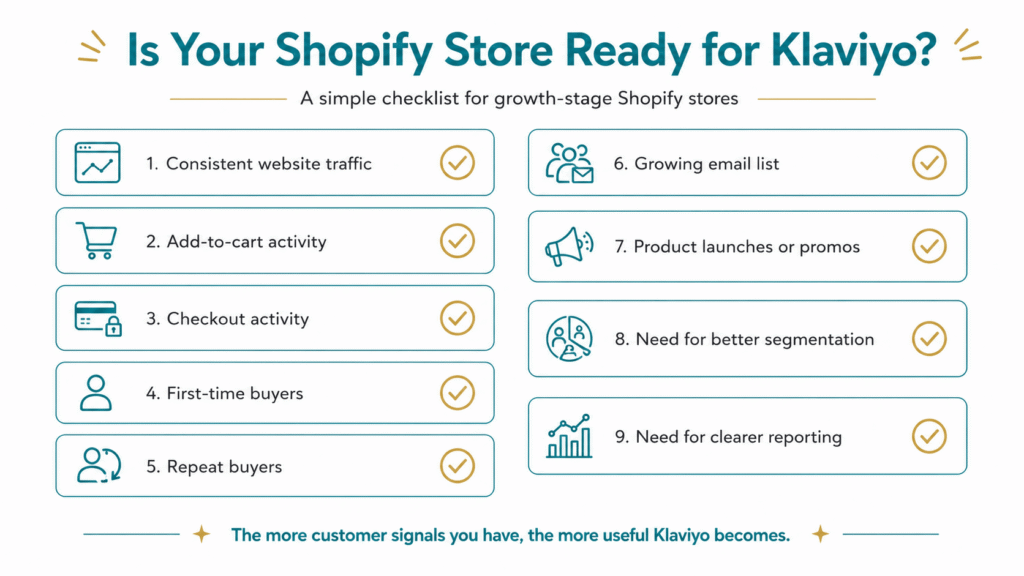
But if your store already has:
- Website visitors
- Add-to-cart activity
- Checkout activity
- First-time buyers
- Repeat buyers
- A growing email list
- Product launches or promos
- Regular ecommerce campaigns
Then Klaviyo can help you build a stronger email system.
For Philippine Shopify brands, this can be especially useful during moments like:
- Payday promos
- 6.6, 9.9, 11.11, 12.12 campaigns
- Christmas season
- Mother’s Day and Father’s Day
- New product launches
- Restocks
- Bundle offers
But the real value is not just during sale events.
The real value is what happens between campaigns.
The welcome flow.
The abandoned cart flow.
The post-purchase flow.
The winback flow.
The segmentation.
The analytics.
That’s where Klaviyo can help your email marketing become more consistent.
For a more decision-focused breakdown, read is Klaviyo worth it for small Shopify businesses.
Common Klaviyo Email Marketing Mistakes
Klaviyo is powerful.
But the platform won’t fix a weak strategy by itself.
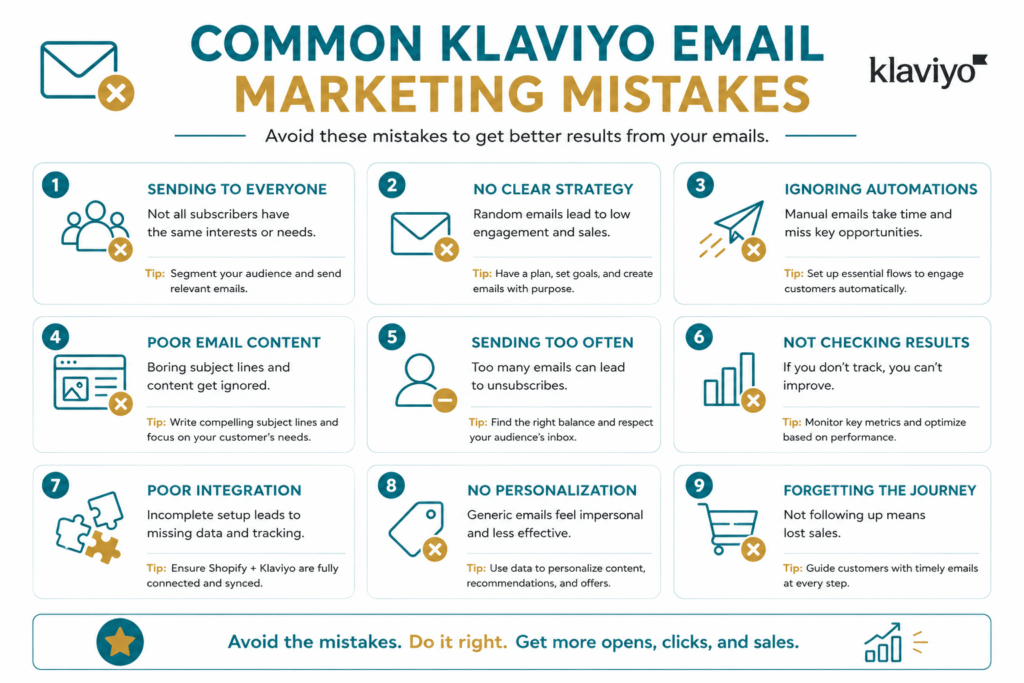
Here are common mistakes Shopify stores should avoid.
These are also the types of gaps we look for when reviewing email marketing services for ecommerce brands, especially when flows, campaigns, segmentation, and reporting are not working together clearly.
Mistake 1: Treating Klaviyo Like a Basic Email Tool
If you only use Klaviyo to send promos to everyone, you’re missing the point.
Klaviyo is strongest when you use:
- Shopify data
- Segments
- Flows
- Customer behavior
- Product recommendations
- Revenue tracking
Don’t just send more emails.
Send smarter emails.
Mistake 2: Not Setting Up Core Flows
Campaigns are important.
But flows do the follow-up work automatically.
At minimum, most Shopify stores should start with:
- Welcome flow
- Abandoned cart flow
- Browse abandonment flow
- Post-purchase flow
- Winback flow
If these are missing, your store may be losing sales from people who already showed interest.
Before building more campaigns, use this Klaviyo setup checklist for Shopify to check if the foundation is ready.
Mistake 3: Sending Every Campaign to Everyone
Not everyone on your list is the same.
A new subscriber is different from a repeat buyer.
A cart abandoner is different from a VIP customer.
Someone who clicked recently is different from someone who hasn’t opened in months.
Use Klaviyo segmentation to send more relevant campaigns.
Mistake 4: Looking Only at Open Rate
Open rate matters.
But it doesn’t tell the full story.
You also need to check:
- Click rate
- Placed order rate
- Revenue per recipient
- Flow revenue
- Campaign revenue
- Unsubscribe rate
- Spam rate
Because the goal is not just to get opened.
The goal is to drive the right action.
Mistake 5: Making Emails Too Complicated
One email should not do everything.
Keep each email focused.
One reader.
One message.
One offer.
One action.
That’s how your campaigns and flows become easier to read, easier to click, and easier to improve.
Final Thoughts
Klaviyo email marketing is not just about sending emails from a nicer platform.
It’s about using your Shopify customer data properly.
Your store already has signals.
Product views.
Cart activity.
Checkout activity.
Purchase history.
Email engagement.
Customer profiles.
Klaviyo helps turn those signals into targeted campaigns, automated flows, smarter segments, and clearer revenue tracking.
For Shopify business owners and marketing managers in the Philippines, that matters.
Because every visitor costs effort.
Every abandoned cart is a missed chance.
Every first-time buyer could become a repeat buyer.
And every campaign should have a clear purpose.
That’s what Klaviyo helps you build.
Not just more emails.
A better follow-up system for your Shopify store.
At Your Proactive Media, we help Shopify businesses implement Klaviyo email marketing strategies that turn customer data into personalized campaigns, automated flows, and measurable revenue growth.
Want to Turn Your Shopify Customer Data Into Better Email Revenue?
Your Shopify store is already giving you buying signals.
Product views.
Add-to-carts.
Started checkouts.
First-time buyers.
Repeat buyers.
Customers who haven’t come back.
Klaviyo can help you turn those signals into smarter campaigns, automated flows, better segments, and clearer revenue tracking.
You don’t need more random emails.
You need an email system that follows up with the right customer at the right moment.
FAQs About Klaviyo Email Marketing
What is Klaviyo email marketing?+
Klaviyo email marketing is the use of Klaviyo to send email campaigns and automated flows for ecommerce stores. For Shopify stores, Klaviyo can use customer data, order data, onsite activity, and email engagement to send more targeted messages.
Why use Klaviyo for Shopify?+
Klaviyo works well with Shopify because it can sync customer profile data, order data, onsite tracking data, and customer behavior. This helps Shopify stores create more relevant segments, flows, and campaigns.
What are Klaviyo email flows?+
Klaviyo email flows are automated email sequences triggered by customer behavior. Common flows include welcome flow, abandoned cart flow, browse abandonment flow, post-purchase flow, review request flow, and winback flow.
What is the difference between Klaviyo campaigns and flows?+
Klaviyo campaigns are one-time emails sent to a selected audience. Klaviyo flows are automated emails triggered by actions like subscribing, viewing a product, starting checkout, placing an order, or becoming inactive.
What Klaviyo flows should a Shopify store set up first?+
A Shopify store should usually start with a welcome flow, abandoned cart flow, browse abandonment flow, post-purchase flow, and winback flow. Klaviyo also recommends starting with impactful flows like welcome series, abandoned cart, post-purchase, and winback.
What metrics should you track in Klaviyo?+
You should track open rate, click rate, placed order rate, revenue per recipient, flow revenue, campaign revenue, unsubscribe rate, and spam rate. Klaviyo's campaign analytics include open rate, click rate, placed order rate, and revenue per recipient.

Jasmin Umali
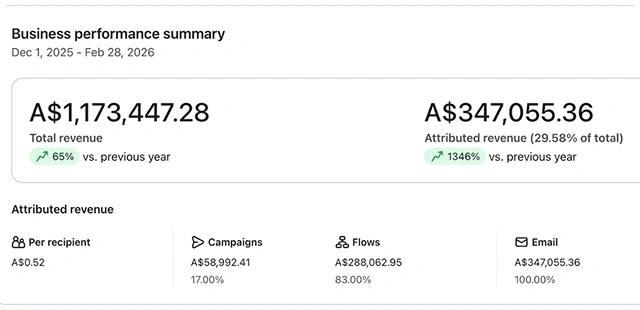
Jasmin Umali is the Founder of Your Proactive Media and a Klaviyo email marketing strategist with 6 years of experience helping ecommerce brands generate an additional 20%–30% or more revenue through email marketing.