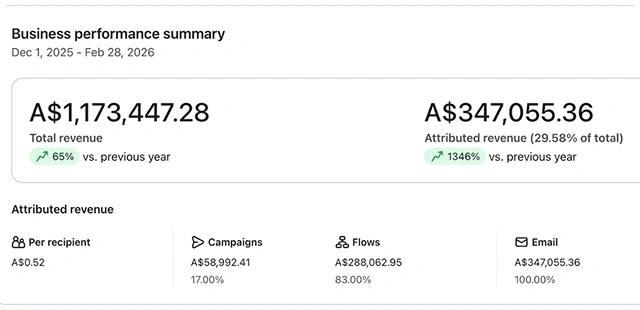
A lot of Shopify stores only send emails when there is a sale.
A payday sale.
A holiday sale.
A clearance sale.
A “we need revenue this week” sale.
And yes, sale emails can work.
But if every campaign is just another discount, your subscribers start learning one thing:
Wait for the next offer.
That is where email campaigns get misunderstood.
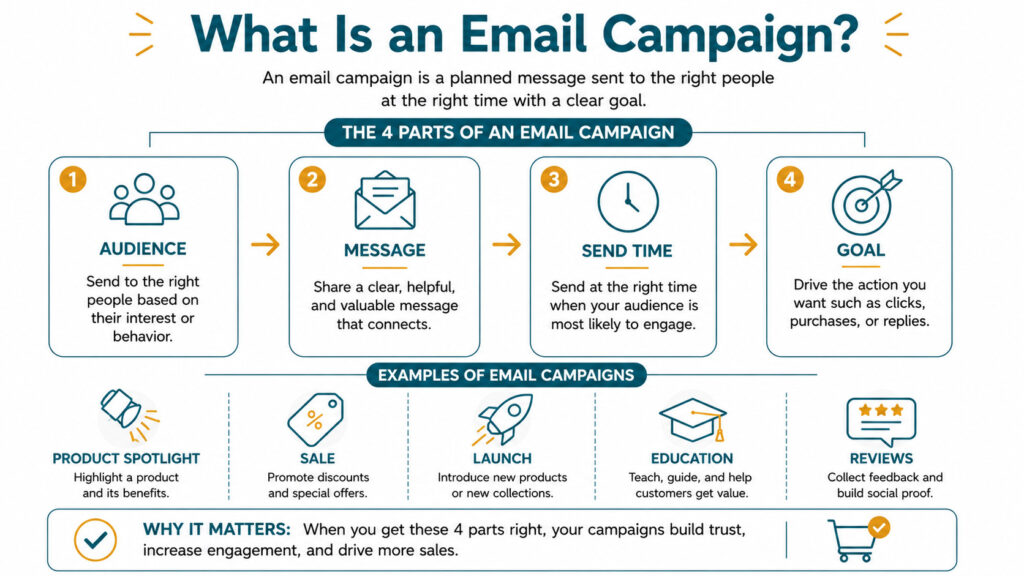
An email campaign is not just a blast.
It is a planned message sent to a specific audience for a specific reason.
It can promote a product.
Educate customers.
Support a launch.
Feature bestsellers.
Share reviews.
Bring attention to a seasonal moment.
The problem is not sending campaigns.
The problem is sending random campaigns.
That is what this blog will help you fix.
Quick Answer: What Are Email Campaigns?
Email campaigns are planned emails sent to a selected audience at a specific time.
For Shopify stores, campaigns are usually used to:
Campaign Purpose | Example |
Promote products | Bestseller email, product spotlight, new arrival |
Support launches | New product teaser, now live, launch reminder |
Drive seasonal sales | Payday sale, holiday sale, end-of-month offer |
Educate customers | Product education, how-to, comparison, buying guide |
Build trust | Reviews, UGC, customer stories |
Bring shoppers back | Back-in-stock, restock, limited stock, product reminder |
Simple definition:
An email campaign is a planned message with one clear audience, one clear idea, and one clear next step.
Why Email Campaigns Matter for Shopify Stores
Email campaigns help Shopify stores stay visible between customer-triggered moments.
Flows respond when customers do something.
Campaigns help you decide what message your brand wants to send now.
For example:
- launching a product
- promoting a bestseller
- educating customers before a sale
- sharing product benefits
- announcing restocks
- running seasonal campaigns
- building demand before payday or holiday periods
Campaigns matter because your subscribers may not be ready to buy every time.
Sometimes they need education first.
Sometimes they need proof.
Sometimes they need product clarity.
Sometimes they need a reason to revisit.
That is why strong campaigns are not only sales emails.
They are part of your brand’s ongoing customer conversation.
Email Campaigns vs Email Flows: What’s the Difference?
Email campaigns and email flows both help your Shopify store make more from email.
But they do different jobs.
Email Type | How It Sends | Best For |
Email Campaign | Manually scheduled or planned for a specific send date | Product launches, seasonal sends, education, sales, announcements |
Email Flow | Automatically triggered by customer behavior or profile data | Welcome, abandoned checkout, browse abandonment, post-purchase, winback |
Simple line:
Campaigns are planned by your brand. Flows are triggered by your customers.
If you want to see the automation side laid out step by step, the 5 Klaviyo email flows every Shopify store should set up first is a good place to start.
Examples:
Situation | Campaign or Flow? |
You send a Father’s Day sale to engaged subscribers | Campaign |
Someone joins your list and receives a welcome series | Flow |
You send a product education email to your list | Campaign |
Someone starts checkout and receives an abandoned checkout reminder | Flow |
You announce a new product drop | Campaign |
A customer buys and gets post-purchase tips | Flow |
If you want the automation side first, start with how Klaviyo email flows work for Shopify stores.
Common Types of Email Campaigns for Shopify Stores
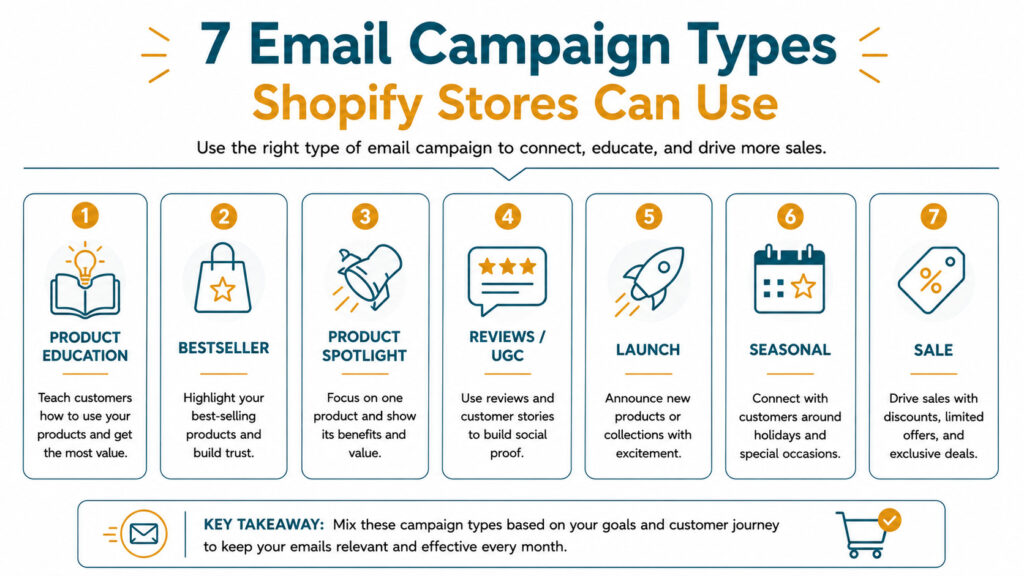
Shopify stores do not need to learn every possible campaign type right away.
Start with the ones that help customers understand, trust, and buy from your store.
1. Product education campaigns
Use these when customers need to understand the product better.
Examples:
- how to use the product
- what makes it different
- ingredients or materials
- product benefits
- common mistakes
- buying guide
- before and after
- science behind the product
Best when:
The product is useful, but customers need more context before buying.
2. Bestseller campaigns
Use these when customers have too many choices.
Examples:
- most-loved products
- customer favorites
- bestsellers by category
- staff picks
- beginner-friendly picks
Best when:
You want to reduce decision friction and make choosing easier.
3. Product spotlight campaigns
Use these when one product needs attention.
Examples:
- why this product exists
- who it is best for
- how it fits into a routine
- what problem it solves
- why customers choose it
Best when:
You want to build demand around one product without making it feel like a hard sell.
4. Review or UGC campaigns
Use these when customers need proof.
Examples:
- customer reviews
- before and after
- product-in-use photos
- testimonial roundups
- “why customers love it”
Best when:
People are interested, but they need trust before clicking or buying.
5. Launch campaigns
Use these for new products or collections.
Examples:
- teaser
- early access
- now live
- product education
- launch reminder
Best when:
You want to build attention before and during a new release.
6. Seasonal campaigns
Use these around relevant customer moments.
Examples:
- payday
- summer
- back-to-school
- Mother’s Day
- Father’s Day
- Christmas
- local holidays or shopping moments
Best when:
The buying moment already exists, and your email connects the product to that moment.
7. Sale campaigns
Use these when there is a real offer.
Examples:
- sitewide sale
- category sale
- bundle offer
- free gift
- limited-time discount
- clearance or end-of-season sale
Best when:
There is a clear offer, clear deadline, and clear reason to buy now.
Important line:
The strongest Shopify email calendars usually mix education, product storytelling, proof, and offers instead of relying on sales every week.
What Should You Send When There Is No Sale?
This is where many Shopify brands get stuck.
No sale.
No launch.
No holiday.
No new product.
So they either force a discount or send nothing.
But you still have useful campaign angles.
If You Have No Sale | Send This Instead |
Customers do not understand the product | Product education campaign |
Customers hesitate before buying | FAQ or objection-handling campaign |
Customers need proof | Review or UGC campaign |
Too many choices | Bestseller or buying guide campaign |
One product needs attention | Product spotlight campaign |
Category needs traffic | Category education campaign |
Customers need routine ideas | How-to or use-case campaign |
Simple rule:
If there is no offer, create a reason to care.
This section should be one of the most useful parts of the blog because it helps Shopify owners stop treating campaigns as “sale-only” emails.
What Makes a Good Email Campaign?
A good campaign has one clear job.
Not three.
Not five.
One.
Use this simple checklist:
Campaign Element | Question to Ask |
Audience | Who should receive this? |
Purpose | Why are we sending this now? |
One main idea | What is the email really about? |
Offer or value | What is the reader getting from this? |
Product bridge | How does the product fit naturally? |
CTA | What should the reader do next? |
Metric | How will we know if it worked? |
Example:
Weak campaign direction:
Send an email about our products.
Better campaign direction:
Send an email to engaged subscribers explaining why our bestselling serum helps with dry skin, then drive clicks to the product page.
That is clearer.
Clear campaigns are easier to write.
Easier to design.
Easier to measure.
Should You Send Email Campaigns to Everyone?
Usually, no.
Sending every campaign to everyone can hurt performance.
Some subscribers are engaged.
Some are inactive.
Some bought recently.
Some never bought.
Some only care about one category.
Some are VIP customers.
A stronger campaign uses basic segmentation.
Segment | Campaign Example |
Engaged subscribers | Regular campaigns, product education, launches |
Recent buyers | Product tips, complementary products, review-led content |
Past buyers | Restocks, new arrivals, repeat purchase campaigns |
VIP customers | Early access, appreciation emails, exclusive drops |
Inactive subscribers | Re-engagement or winback-style campaigns |
Category buyers | Category-specific product recommendations |
Simple rule:
The more relevant the campaign is, the less it feels like a blast.
How Often Should Shopify Stores Send Email Campaigns?
There is no one perfect sending frequency.
It depends on list size, engagement, product type, campaign quality, and business goals.
But for many Shopify stores, a practical starting point is:
Store Stage | Possible Campaign Frequency |
Small or early-stage list | 1 email per week |
Active ecommerce list | 1 to 2 emails per week |
Strong product calendar or frequent drops | 2 to 3 emails per week |
Sale or launch period | More frequent for a short period |
Low engagement list | Send less and clean up relevance first |
Important note:
More emails only help if the emails are relevant. Sending more random campaigns usually creates more unsubscribes, not more revenue.
A simple monthly email campaign calendar helps you plan sends before they become last-minute.
How to Plan Better Email Campaigns
A campaign calendar does not need to be complicated.
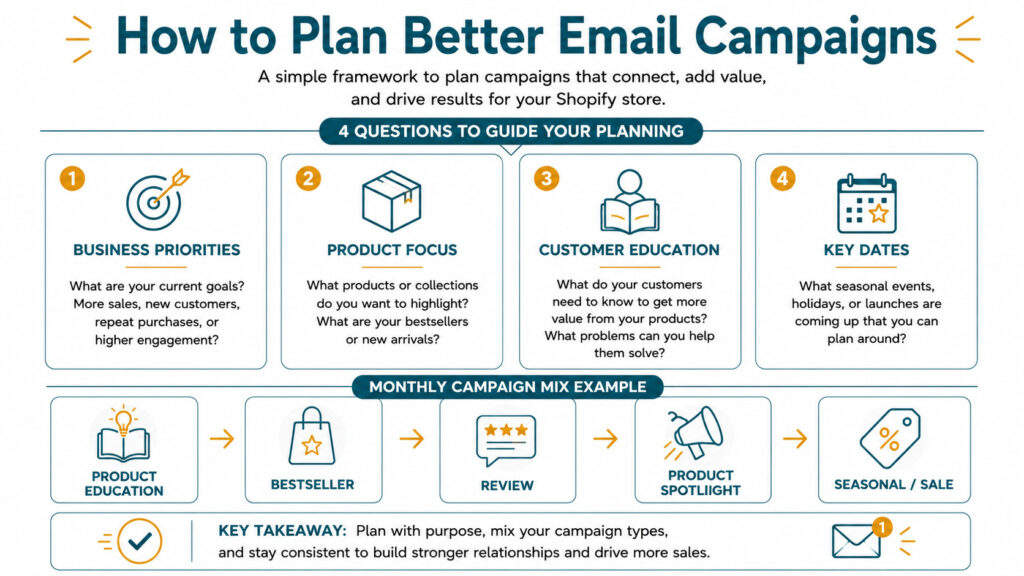
Start with four questions:
- What are our business priorities this month?
- What products or categories need attention?
- What does the customer need to understand before buying?
- What key dates or seasonal moments matter?
Then build a simple monthly mix.
Example campaign mix:
Campaign Type | Purpose |
Product education | Teach customers why a product matters |
Bestseller campaign | Help customers choose faster |
Review campaign | Build trust |
Product spotlight | Push attention to one product |
Seasonal or sale campaign | Drive urgency when relevant |
For a Philippine Shopify store, this may include:
- payday campaigns
- 6.6, 7.7, 8.8 style shopping moments
- Mother’s Day or Father’s Day
- Christmas season
- summer or back-to-school relevance
- local buying behavior
Email Campaign Metrics to Track
Open rate is useful.
But it is not the whole story.
For Shopify stores, these are the campaign metrics worth checking:
| Metric | What It Tells You |
| Open rate | Did the subject line and sender get attention? |
| Click rate | Did the email make people interested enough to click? |
| Placed order rate | Did the campaign drive purchases? |
| Revenue per recipient | How valuable was the campaign per person sent? |
| Campaign revenue | How much revenue came from the send? |
| Unsubscribe rate | Did the email feel irrelevant or too frequent? |
| Spam complaint rate | Did the email hurt trust or deliverability? |
To review performance properly, you need to know which email marketing metrics every Shopify store should track.
Common Email Campaign Mistakes to Avoid
| Mistake | Better Approach |
| Only sending discounts | Mix education, proof, product stories, and offers |
| Sending to everyone | Segment based on engagement and customer behavior |
| Trying to say too much | Give each campaign one clear job |
| No campaign calendar | Plan sends around products, dates, and customer needs |
| Weak CTA | Make the next step obvious |
| No product bridge | Connect the message to why the product matters |
| Only checking open rate | Review clicks, orders, revenue, and unsubscribes |
The goal is not to send more emails just to fill the calendar.
The goal is to send better campaigns with clearer purpose.
When Should You Get Help With Email Campaigns?
You may need help if:
- you only email during sales
- your campaigns feel random
- you do not know what to send weekly
- you send every campaign to everyone
- your emails get opens but low clicks
- your campaigns drive little revenue
- your team has no monthly campaign plan
- you are unsure how campaigns should work with flows
If your campaigns feel random, overly promotional, or difficult to plan consistently, a Klaviyo email marketing agency can help bring strategy, segmentation, copy, design, testing, and reporting together.
Final Thoughts
Email campaigns are not just blasts.
For Shopify stores, they are planned messages sent to a specific audience for a specific reason.
A strong campaign has one clear job.
It may educate.
Promote.
Launch.
Build trust.
Highlight bestsellers.
Support a seasonal moment.
Drive repeat purchase.
But it should not feel random.
Start with the audience.
Choose one main idea.
Connect it to a product or customer need.
Give one clear next step.
Review the numbers after.
That is how email campaigns become more than another send.
They become part of your Shopify store’s growth system.
At Your Proactive Media, our klaviyo email marketing services help Shopify stores create strategic email campaigns that engage customers, strengthen brand loyalty, and support long-term ecommerce growth.
Want Better Email Campaigns for Your Shopify Store?
If your campaigns feel random, last-minute, or too dependent on discounts, your email strategy may need a clearer plan.
FAQs About Email Campaigns
What are email campaigns?
+Email campaigns are planned emails sent to a specific audience at a specific time for a clear purpose, such as promoting a product, educating customers, announcing a launch, or driving sales.
What is an email campaign for Shopify stores?
+For Shopify stores, an email campaign is a planned message sent to subscribers or customers to promote products, share education, build trust, support launches, or drive repeat purchases.
Are email campaigns the same as email flows?
+No. Campaigns are planned one-time sends. Flows are automated emails triggered by customer behavior, such as signup, checkout, purchase, or inactivity.
How often should Shopify stores send email campaigns?
+It depends on list size, engagement, product type, and campaign quality. Many Shopify stores can start with 1 email per week and increase if engagement stays healthy.
What should I send if there is no sale?
+Send product education, bestsellers, reviews, UGC, buying guides, product spotlights, FAQs, or seasonal content that helps customers understand why a product matters.
Should I send campaigns to my whole list?
+Not always. It is usually better to segment based on engagement, purchase history, customer type, or product interest.
What makes a good email campaign?
+A good email campaign has one clear audience, one clear purpose, one main idea, one product bridge, one CTA, and clear metrics to measure success.
What metrics should I track for email campaigns?
+Track open rate, click rate, placed order rate, revenue per recipient, campaign revenue, unsubscribe rate, and spam complaint rate.

Jasmin Umali
Jasmin Umali is the Founder of Your Proactive Media and a Klaviyo email marketing strategist with 6 years of experience helping ecommerce brands generate an additional 20%–30% or more revenue through email marketing.