A lot of ecommerce brands know they should be using email.
But here’s where things get messy.
Some brands send campaigns every week but barely use flows.
Others build flows once and stop sending campaigns.
And plenty still call every email a campaign.
That confusion creates gaps.
Because campaigns and flows do different jobs.
The main difference between an email campaign and an automated email flow is how the message gets sent.
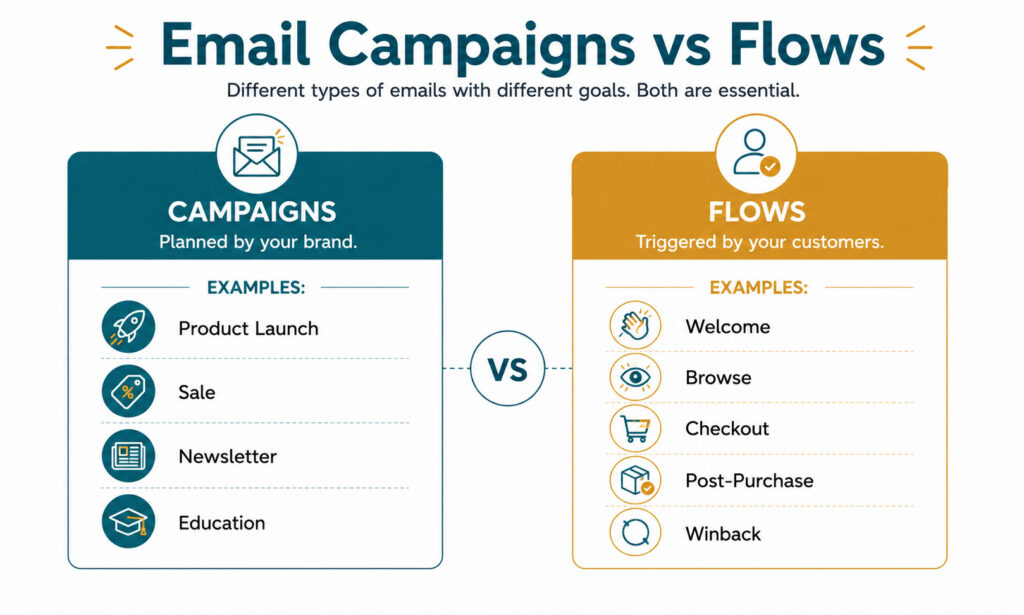
Campaigns are planned and scheduled by your brand.
Flows are triggered automatically by customer behavior, data, or lifecycle timing.
One helps you send timely messages to a selected audience.
The other responds automatically when customers take specific actions.
You do not need to choose one.
You need both working together.
If you want a campaign foundation first, start with email campaigns explained for Shopify stores.
Let’s make the difference simple.
Quick Answer: What Is the Difference Between Email Campaigns and Flows?
Email campaigns are planned one-time sends.
Email flows are automated emails triggered by customer behavior, profile data, or lifecycle timing.
Email Type | Simple Meaning | Example |
Email Campaign | A planned message sent by your brand | Product launch, sale, newsletter, product education |
Email Flow | An automated message triggered by customer behavior | Welcome flow, abandoned checkout, post-purchase, winback |
Simple line:
Campaigns are planned. Flows are triggered.
For ecommerce brands, campaigns and flows should not compete.
They work together.
To understand the difference deeper, let’s look at each one separately.
What Is an Email Campaign?
An email campaign is a planned email sent to a selected audience at a specific time.
Campaigns are useful when your brand has a message to send.
Examples:
- product launches
- product education
- sale announcements
- seasonal campaigns
- bestseller features
- review or UGC emails
- back-in-stock announcements
- monthly newsletters
A campaign answers:
Who are we sending this to?
Why are we sending it now?
What is the one main message?
What should the reader do next?
For a deeper breakdown, read email campaigns explained for Shopify stores.
Flows are different because they do not start with your calendar. They start with the customer.
What Is an Email Flow?
An email flow is an automated email or sequence triggered by a customer action, profile property, or lifecycle moment.
Flows are useful when your customer does something that deserves a follow-up.
Examples:
- someone joins your list
- someone views a product
- someone starts checkout
- someone places an order
- someone has not bought again
- someone becomes inactive
Common flows include:
- welcome flow
- browse abandonment flow
- abandoned checkout flow
- post-purchase flow
- winback flow
See how each one works in detail: the welcome flow, the browse abandonment flow, the abandoned checkout flow, and the post-purchase flow.
A flow answers:
What did the customer do?
What do they need next?
When should we follow up?
What should happen if they buy, click, or ignore the email?
If you want the automation side, start with how Klaviyo email flows work for Shopify stores.
Once you understand both, the difference becomes much easier to see.
Email Campaigns vs Flows: Side-by-Side Comparison
Category | Email Campaigns | Email Flows |
How they send | Scheduled by your brand | Triggered automatically |
Main purpose | Send planned messages | Respond to customer behavior |
Best for | Launches, sales, education, seasonal sends | Welcome, checkout recovery, post-purchase, winback |
Audience | Selected segment or list | People who meet the trigger rules |
Timing | Based on calendar or campaign plan | Based on customer action or delay |
Content | Product pushes, education, announcements, offers | Journey-based messages |
Setup | Created per send | Built once, then optimized |
Review cycle | Reviewed after each campaign | Reviewed regularly over time |
Simple takeaway:
Campaigns help you create demand. Flows help you capture customer moments.
The easiest way to understand this is through real ecommerce examples.
Campaign or Flow? Ecommerce Examples
Situation | Best Email Type | Why |
You are launching a new product | Campaign | It is a planned brand message |
Someone signs up for your email list | Flow | It is triggered by subscriber behavior |
You want to send a payday sale | Campaign | It is tied to a calendar moment |
Someone starts checkout but does not buy | Flow | It is triggered by buying intent |
You want to educate customers about a product category | Campaign | It is a planned education send |
Someone buys for the first time | Flow | They need post-purchase support |
You want to promote bestsellers this weekend | Campaign | It is planned by your brand |
A customer has not bought again in 90 days | Flow | It is based on customer lifecycle timing |
This is where the system becomes clearer.
If your brand decides the message and timing, it is usually a campaign.
If the customer action decides the message and timing, it is usually a flow.
Now let’s make the decision even easier.
When Should You Use an Email Campaign?
Use an email campaign when you have a planned message to send.
Campaigns are best for:
- product launches
- new arrivals
- product education
- sale announcements
- seasonal moments
- newsletters
- review or UGC highlights
- bestseller features
- content or buying guides
Campaigns are especially useful when you want to:
- drive attention to a product
- support a business priority
- build demand before a launch
- explain product value
- promote a time-sensitive offer
- keep your brand top of mind
Simple rule:
Use campaigns when your brand has a message to send now.
If you are not sure what to send, the foundation blog on email campaigns for Shopify stores gives you campaign types and examples.
But not every important email should wait for your team to schedule it.
When Should You Use an Email Flow?
Use an email flow when a customer action should trigger the next message.
Flows are best for:
- new subscribers
- product viewers
- checkout abandoners
- first-time buyers
- repeat customers
- inactive customers
- review requests
- replenishment reminders
Flows are useful because they run based on timing and behavior.
That means the email can send even when your team is not manually planning it.
Simple rule:
Use flows when the customer’s behavior creates the moment.
The 5 Klaviyo email flows every Shopify store should set up first are a good starting point if you want to build the automation foundation.
This is why the best email systems do not pick one over the other.
Why You Need Both Campaigns and Flows
Campaigns and flows solve different problems.
If you only send campaigns, you may miss key customer moments.
If You Only Use Campaigns | What Happens |
No welcome flow | New subscribers may go cold |
No abandoned checkout flow | High-intent shoppers may not return |
No post-purchase flow | First-time buyers may not feel supported |
No winback flow | Past buyers may disappear |
If you only build flows, your brand may stop creating demand.
If You Only Use Flows | What Happens |
No product campaigns | Subscribers may not learn about your products |
No launch campaigns | New releases may get less attention |
No seasonal campaigns | You may miss timely buying moments |
No education campaigns | Customers may not understand product value |
The stronger email system uses both.
Campaigns create planned demand.
Flows respond to customer intent.
Together, they help your emails feel less random and more connected.
And inside Klaviyo, that connection becomes even more useful.
How Campaigns and Flows Work Together in Klaviyo
In Klaviyo, campaigns and flows work from the same customer data.
That means customer behavior, purchase history, engagement, and segments can help both sides.
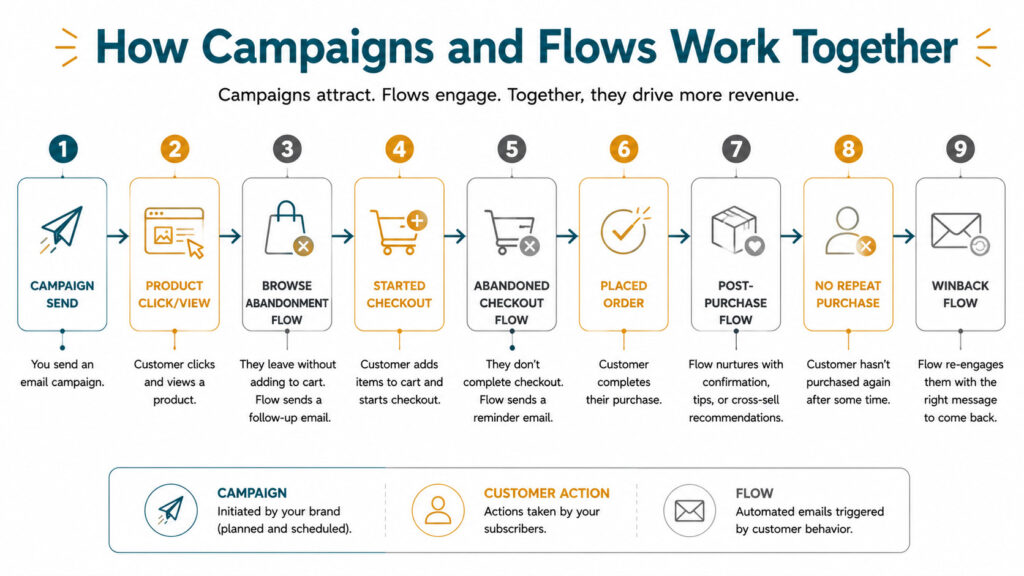
Example:
A campaign promotes a product category.
A shopper clicks and views a product.
A browse abandonment flow can follow up if they do not add to cart.
If they start checkout, an abandoned checkout flow can take over.
If they buy, a post-purchase flow supports them after the order.
Later, a winback flow can bring them back if they go inactive.
That is the system.
Campaigns create the planned touchpoints.
Flows respond to what customers do next.
This also brings up a common question: which one makes more money?
Which One Makes More Revenue: Campaigns or Flows?
This is the wrong question.
A better question is:
What job is each one doing?
Campaigns can create demand around launches, products, seasons, and offers.
Flows can recover missed intent and guide customer journeys automatically.
Both can drive revenue.
But they do it differently.
Campaign revenue usually comes from planned sends.
Flow revenue usually comes from automated customer moments.
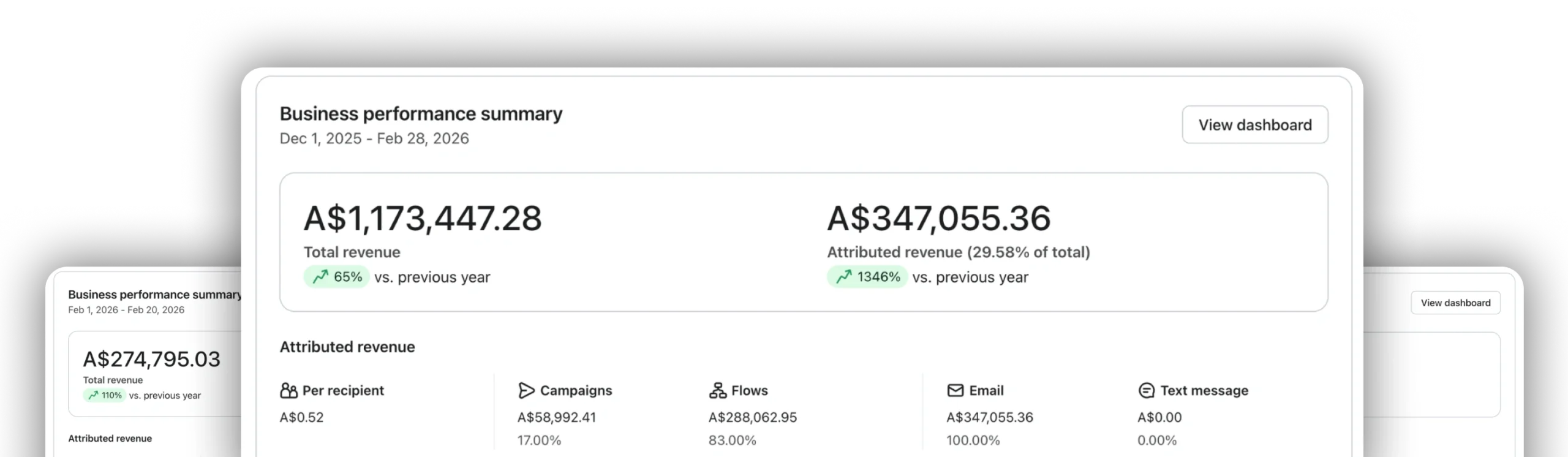
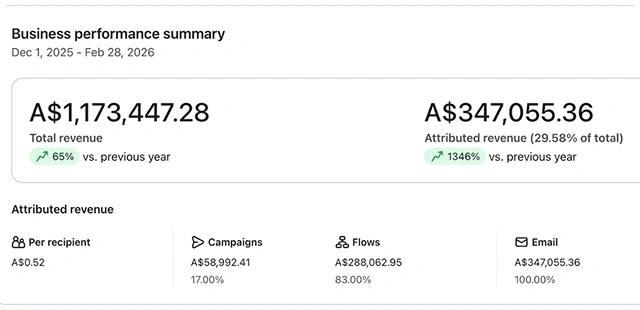
Klaviyo has reported that automations can generate much higher revenue per recipient than one-off campaigns because they are based on real-time customer actions. But that does not mean campaigns are optional. Campaigns still create demand around launches, products, seasons, and offers.
So instead of comparing them like competitors, measure them by the job they are supposed to do.
Metrics to Track for Campaigns vs Flows
Metric | Campaigns | Flows |
Open rate | Subject line and timing | Subject line and trigger relevance |
Click rate | Message and CTA strength | Message fit with customer moment |
Placed order rate | Purchase response from a planned send | Purchase response from behavior-triggered email |
Revenue per recipient | Value of the campaign audience | Value of the triggered audience |
Unsubscribe rate | Relevance and send frequency | Flow pressure or poor timing |
Flow / campaign revenue | Revenue from a specific send | Revenue from automation over time |
Open rate helps.
But clicks, placed order rate, revenue per recipient, and unsubscribe rate tell the better story.
The goal is not just to send emails.
The goal is to send the right email for the right moment.
And that is where many brands make avoidable mistakes.
Common Mistakes When Using Campaigns and Flows
Mistake | Better Approach |
Calling every email a campaign | Separate planned sends from automated flows |
Sending campaigns but ignoring flows | Build automated customer journeys |
Building flows but stopping campaigns | Keep planned product and seasonal messaging active |
Sending every campaign to everyone | Use segments based on engagement and behavior |
Treating flows as set-and-forget | Review and optimize flow performance |
Using campaigns for customer-triggered moments | Automate repeatable lifecycle moments |
Using flows for every brand message | Use campaigns for planned launches, education, and seasonal sends |
If campaign relevance is a challenge, email segmentation for ecommerce brands helps you send better messages to the right people.
The goal is not to label emails correctly for the sake of it.
The goal is to build an email system where every message has the right job.
When Should You Get Help With Campaigns and Flows?
You may need help if:
- you are sending campaigns but have weak or missing flows
- your flows are live but not improving revenue
- your campaigns feel random
- you are unsure what should be a campaign vs a flow
- your emails get opens but low clicks
- your automation logic feels messy
- you do not know how to report campaign and flow revenue separately
If your ecommerce brand needs a clearer email system, our Klaviyo email marketing agency can help with campaign strategy, flow setup, segmentation, copy, design, testing, and reporting.
Because campaigns and flows should not work in separate corners. They should support the same customer journey.
When campaigns and flows are planned separately, customers can receive disconnected or repetitive messages. A Klaviyo email marketing agency can help align both around one customer journey and retention strategy.
Final Thoughts
Email campaigns and flows are not the same.
Campaigns are planned by your brand.
Flows are triggered by your customers.
Campaigns help you promote, educate, launch, and stay visible.
Flows help you respond to customer behavior automatically.
You need both.
Because email works best when planned messages and customer-triggered journeys support each other.
That is how email stops feeling random.
It starts working like a system.
At Your Proactive Media, we help Shopify brands build email strategies where campaigns and automated flows work together to drive stronger customer engagement and long-term revenue.
Want Campaigns and Flows Working Together?
If your emails feel random, disconnected, or too dependent on manual sends, your strategy may need a clearer system.
FAQs About Email Campaigns vs Flows
What is the difference between email campaigns and flows?
+Email campaigns are planned sends created by your brand. Email flows are automated emails triggered by customer behavior or profile data.
Are email campaigns automated?
+Usually, campaigns are scheduled manually for a specific date or audience. Flows are the automated side of email marketing.
What is an example of an email campaign?
+Examples include product launches, sale announcements, product education emails, newsletters, review campaigns, and seasonal sends.
What is an example of an email flow?
+Examples include welcome flow, abandoned checkout flow, browse abandonment flow, post-purchase flow, and winback flow.
Should Shopify stores use campaigns or flows?
+Use both. Campaigns handle planned messages. Flows handle customer-triggered moments.
Do campaigns or flows make more revenue?
+Both can drive revenue, but in different ways. Campaigns create demand through planned sends, while flows capture customer intent automatically.
How do campaigns and flows work together in Klaviyo?
+Campaigns can drive traffic and product interest. Flows can follow up based on what customers do next, such as viewing a product, starting checkout, buying, or becoming inactive.

Jasmin Umali
Jasmin Umali is the Founder of Your Proactive Media and a Klaviyo email marketing strategist with 6 years of experience helping ecommerce brands generate an additional 20%–30% or more revenue through email marketing.