A first-time purchase is a big moment.
The customer trusted your store.
They chose your product.
They placed the order.
But here’s where many Shopify stores go quiet.
The customer buys, then the only thing they receive is the order confirmation.
That’s not enough.
Because after the first purchase, the customer may still be thinking:
When will my order arrive?
Did I make the right choice?
How do I use this product?
What should I expect next?
Should I buy from this brand again?
That is why post-purchase emails matter.
They help support the customer after the sale, build confidence, and create a better path toward repeat purchase.
In Klaviyo, this usually happens through a post-purchase flow triggered after someone places an order, often the shopper you already worked to bring back with an abandoned checkout flow.
The customer already trusted you once.
Now the flow should help them feel good enough to trust you again.
If you’re still building your automation foundation, our klaviyo email marketing services can help you set that up properly, or start with the 5 Klaviyo email flows every Shopify store should set up first.
Before we map the emails, let’s define what post-purchase emails actually are.
Quick Answer: What Are Post-Purchase Emails?
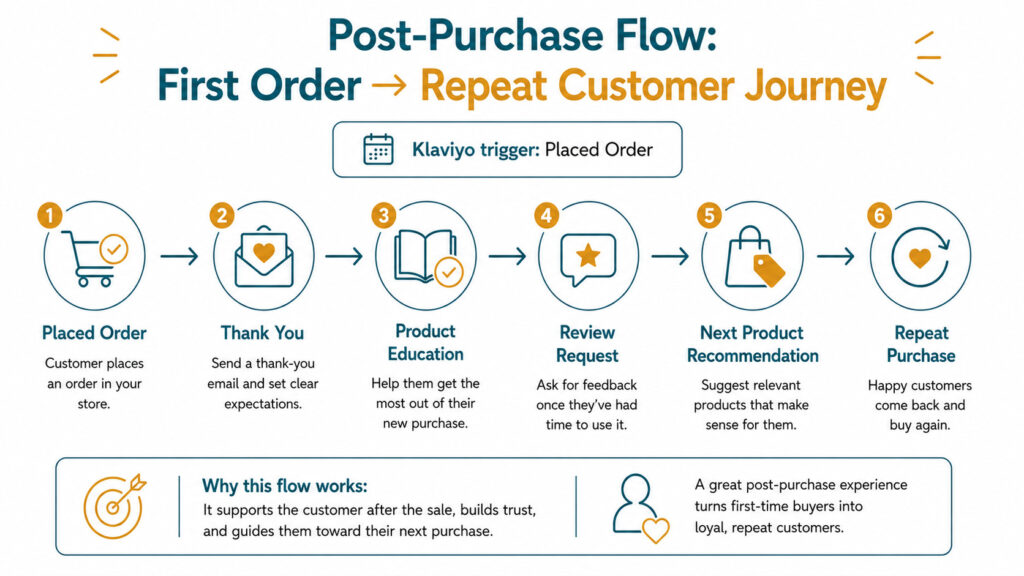
Post-purchase emails are automated emails sent after someone places an order.
For Klaviyo and Shopify, here’s the simple version:
Item | Meaning |
Flow name | Post-Purchase Flow |
Klaviyo trigger | Placed Order |
Main audience | Customers who recently bought |
Main goal | Support the customer, improve experience, and encourage repeat purchase when timing makes sense |
Post-purchase emails are not the same as order confirmation emails.
Order confirmation is transactional.
Post-purchase emails are part of the customer journey after the order.
That difference matters.
Because a customer does not become loyal just because they bought once.
They become more likely to come back when the experience after buying feels clear, useful, and trustworthy.
Post-Purchase Emails vs Order Confirmation Emails
A lot of brands mix these up.
That’s why their post-purchase flow feels too thin.
The order confirmation confirms the transaction.
The post-purchase flow supports the customer after the transaction.
Email Type | Main Job | Example |
Order Confirmation Email | Confirm the transaction | Receipt, order number, payment, shipping info |
Post-Purchase Email Flow | Support and guide the customer after purchase | Thank you, product tips, review request, next product recommendation |
Your order confirmation tells the customer the order went through.
Your post-purchase flow helps them feel good about what happens next.
That is the gap.
And for many Shopify stores, that gap is where repeat purchase either gets stronger or starts to fade.
Why Post-Purchase Emails Matter for Shopify Stores
When I review Shopify email setups, one mistake I often see is brands moving too fast from “thank you” to “buy again.”
Sometimes the customer has not even received the product yet.
That is a problem.
First-time buyers are not loyal customers yet.
They trusted you once.
But repeat purchase is not automatic.
A post-purchase flow can help:
- reduce buyer’s remorse
- set expectations after purchase
- educate customers
- improve product experience
- collect reviews at the right time
- recommend the next product naturally
- encourage repeat purchase without rushing
The first question should not be:
What can we sell next?
It should be:
What does the customer need after buying?
That shift changes the whole flow.
Because if the first post-purchase emails support the customer well, the next product recommendation feels more natural later.
Not forced.
Not random.
Not too soon.
What Customers Need After Their First Purchase
After a customer buys, they are not always fully confident yet.
They may still need reassurance.
They may need guidance.
They may need support.
They may need to understand how to get the best result from the product.
Customer Need | What the Email Can Do |
Reassurance | Confirm they made a good choice |
Expectations | Explain what happens next |
Product education | Help them use or enjoy the product |
Support | Answer common questions |
Confidence | Share tips, proof, or helpful guidance |
Review timing | Ask after they’ve had time to experience the product |
Next step | Recommend a relevant product when timing makes sense |
The post-purchase flow should support first.
Then sell later.
That one rule keeps the flow from feeling too aggressive.
It also makes the customer feel like you care about their experience, not just their next order.
First-Time Buyers vs Repeat Buyers
Not every customer should receive the exact same post-purchase journey.
A first-time buyer may need more reassurance, education, and trust-building.
A repeat buyer may need recognition, loyalty messaging, or a more relevant next step.
Customer Type | What They May Need |
First-time buyer | Reassurance, product education, trust-building |
Repeat buyer | Recognition, loyalty, relevant next product |
VIP customer | Appreciation, exclusive access, early drops |
Category-specific buyer | Product education or recommendations based on what they bought |
This matters because a first-time buyer and a repeat customer are in different moments. A first-time buyer’s trust-building often starts even earlier, in the welcome flow, and the post-purchase flow should continue that same tone.
The message should match.
Inside Klaviyo, this can be handled with filters, splits, or separate flows based on order count, product purchased, category, or customer value.
You do not need to overcomplicate it at the start.
But you should avoid sending the exact same journey to every buyer forever.
How Many Emails Should a Post-Purchase Flow Have?
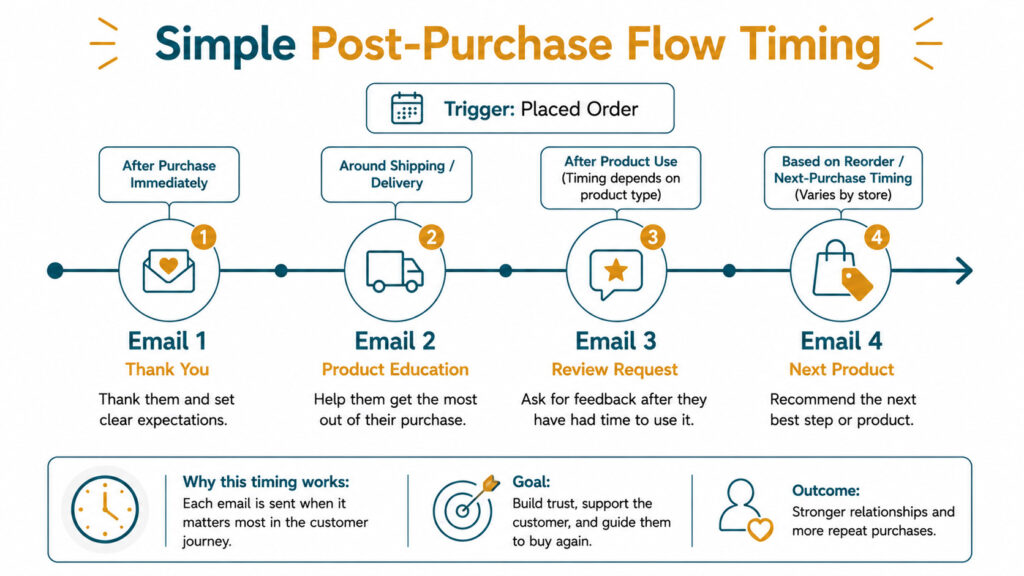
For most Shopify stores, a 3 to 4-email post-purchase flow is a strong starting point.
Main Job | |
Email 1 | Thank the customer and set expectations |
Email 2 | Help them use or enjoy the product |
Email 3 | Ask for a review at the right time |
Email 4 | Recommend the next product or encourage repeat purchase |
I usually separate support, review request, and repeat purchase emails because each one has a different job.
If you combine everything too early, the email feels messy.
Imagine one email trying to say:
Thanks for your order.
Here’s how shipping works.
Here’s how to use the product.
Please leave a review.
Also, buy this next.
That is too much.
Each email should have one job.
That makes the flow easier to read and easier to improve.
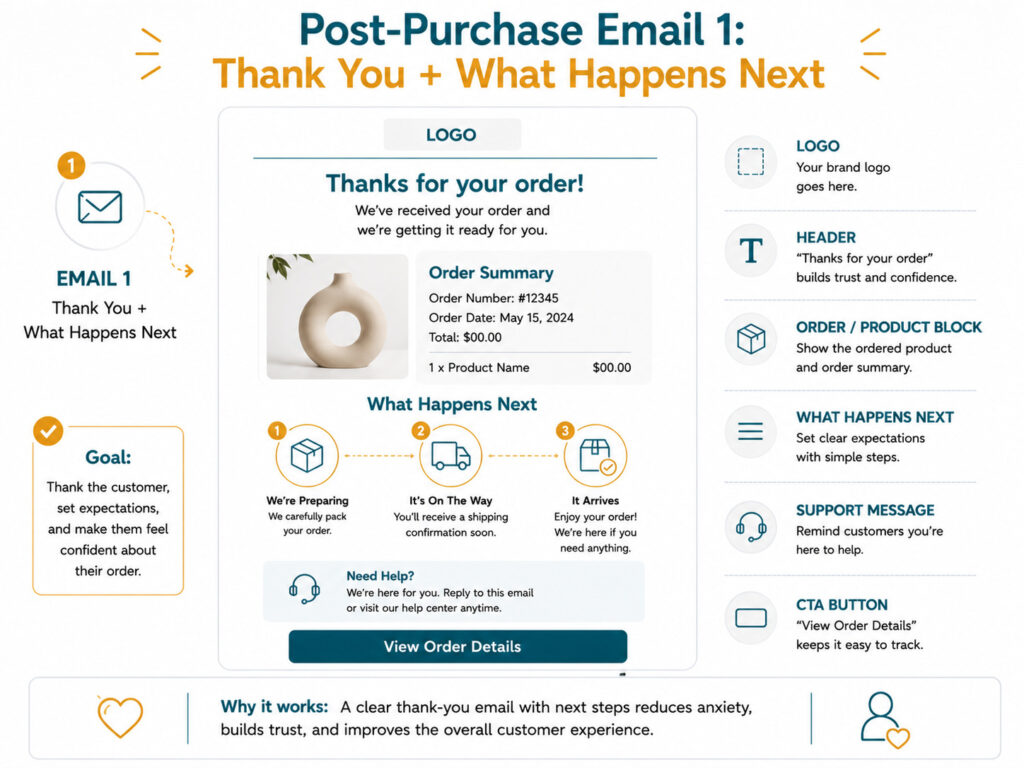
Email 1: Thank the Customer and Set Expectations
Timing
Immediately after purchase or shortly after the transactional order confirmation.
Main job
Make the customer feel confident after buying.
This email is not just a polite thank-you.
It should reduce uncertainty.
The customer should understand what happens next and where to go if they need help.
What to include
- Thank-you message
- Brand reassurance
- What happens next
- Shipping expectation note
- Support contact or FAQ link
- Soft CTA to order details, account, or helpful guide
Element | Recommendation |
Timing | Immediately or shortly after purchase |
Goal | Reassure the customer and set expectations |
CTA | View order details, read what happens next, visit help center |
Sample subject lines
- Thanks for your order
- We got your order — here’s what’s next
- You’re all set
- Welcome to [Brand Name]
- Your [Brand Name] order is in
The goal is simple.
Make the customer feel like buying from you was a good decision.
Once the customer feels reassured, the next email should help them get value from the product.
Email 2: Help Them Use or Enjoy the Product
Timing
Based on delivery or expected product usage.
Main job
Help the customer get the best first experience.
This is where many brands can create a stronger post-purchase experience.
Instead of only saying “your order shipped,” you can help the customer use the product better.
That can reduce confusion.
It can reduce buyer’s remorse.
It can also make the product feel more valuable.
What to include
- Product usage tips
- Care instructions
- Routine guide
- How-to steps
- Common mistakes to avoid
- FAQ
- CTA to product guide or support
Element | Recommendation |
Timing | After shipping or around expected delivery/use window |
Goal | Improve product experience |
CTA | Read the guide, see how to use it, get tips |
Sample subject lines
- How to get the most from your [Product Name]
- A few tips before it arrives
- Your first-use guide
- Before you open your order
- Make the most of your new [Product Category]
This email is especially useful for products that need guidance.
Skincare.
Supplements.
Beauty tools.
Apparel sizing or care.
Food products.
Digital products.
Anything with a routine, setup, or usage window.
If the customer gets a better first experience, they are more likely to trust the brand again.
And that leads naturally into the review request later.
Email 3: Ask for a Review at the Right Time
Timing
After the customer has received and used the product.
Main job
Ask for feedback without rushing.
Review requests are powerful.
But only when the timing makes sense.
If you ask too early, the customer may not have received the product yet.
Or they may have received it but not used it enough to form an opinion.
That makes the email feel careless.
What to include
- Warm review request
- Short reason why feedback matters
- Product reminder
- CTA to leave a review
- Optional support line if something went wrong
Element | Recommendation |
Timing | After expected delivery and product use |
Goal | Collect reviews and customer feedback |
CTA | Leave a review, share your thoughts |
Sample subject lines
- How did it go?
- What did you think?
- We’d love your feedback
- Tell us about your experience
- Your thoughts help more than you know
Do not ask for a review before the customer has had time to receive and use the product.
Also, give customers a support path.
If something was not right, they should have a way to get help before they leave frustrated.
That makes the review request feel more human.
Email 4: Recommend the Next Product Naturally
Timing
After the customer has had time to experience the first product.
Main job
Encourage repeat purchase with relevance.
This is where you can guide the next order.
But timing and relevance matter.
The recommendation should feel like the next logical step.
Not a random upsell.
What to include
- Related product recommendation
- Replenishment reminder, if applicable
- Cross-sell or complementary product
- Bestseller from same category
- Customer education
- CTA to shop next product
Element | Recommendation |
Timing | Based on product lifecycle and buying cycle |
Goal | Encourage repeat purchase naturally |
CTA | Shop next, explore related picks, complete your routine |
Sample subject lines
- Ready for your next pick?
- What pairs well with [Product Name]
- Complete your routine
- You may also like this
- Your next [Product Category] pick
The key word is relevant.
If someone bought shampoo, maybe the next step is conditioner.
If someone bought a skincare cleanser, maybe the next step is a moisturizer.
If someone bought a beginner course, maybe the next step is an advanced guide.
If someone bought peanut butter, maybe the next step is a flavor variant or bundle.
The product recommendation should make sense based on what they already bought.
That is how the email feels helpful, not pushy.
Post-Purchase Flow Timing Example
These timing examples are starting points, not fixed rules.
Timing should depend on shipping time, product type, usage cycle, and buying cycle.
Suggested Timing | Main Job | |
Email 1 | Immediately or shortly after purchase | Thank you and expectations |
Email 2 | After shipping or around delivery | Product education |
Email 3 | After enough usage time | Review request |
Email 4 | Based on reorder or next-purchase timing | Relevant recommendation |
A skincare product may need more usage time before review.
An apparel product may only need delivery and try-on time.
A supplement product may need a longer consistency window.
A food or CPG product may need enough time for first use.
A digital product may need enough time for access, learning, or completion.
Timing should match the real customer experience.
Not your desire to send another email.
Sample Post-Purchase Email Structure
You do not need to make post-purchase emails complicated.
The structure should be supportive, useful, and timed around the customer experience.
What happens next?
How do they use the product?
When should they leave a review?
What should they try next?
Here’s a simple way to structure each email inside Klaviyo.
Sample Email 1: Thank You + What Happens Next
Purpose: Reassure the customer and set expectations.
Header:
Thanks for your order
Order / Product Block:
[Product Image]
[Product Name]
[Order Summary Placeholder]
Body:
Your order is in, and we’re getting it ready.
Here’s what happens next:
[Step 1: Order confirmation]
[Step 2: Shipping update]
[Step 3: Delivery]
If you have questions, our support team is here to help.
CTA:
View Order Details
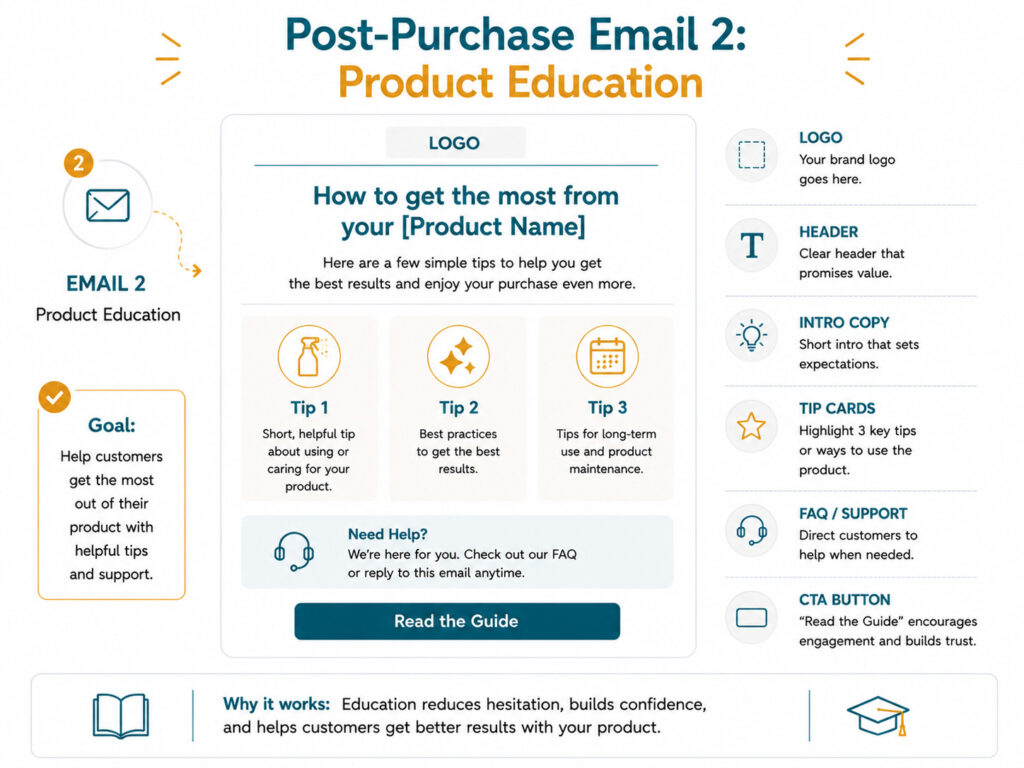
Sample Email 2: Product Education
Purpose: Help the customer use or enjoy the product.
Header:
How to get the most from your [Product Name]
Body:
Your order is on the way, so here are a few quick tips to help you get the best first experience.
Tips:
[Tip 1]
[Tip 2]
[Tip 3]
Need help? You can check our guide or contact support anytime.
CTA:
Read the Guide
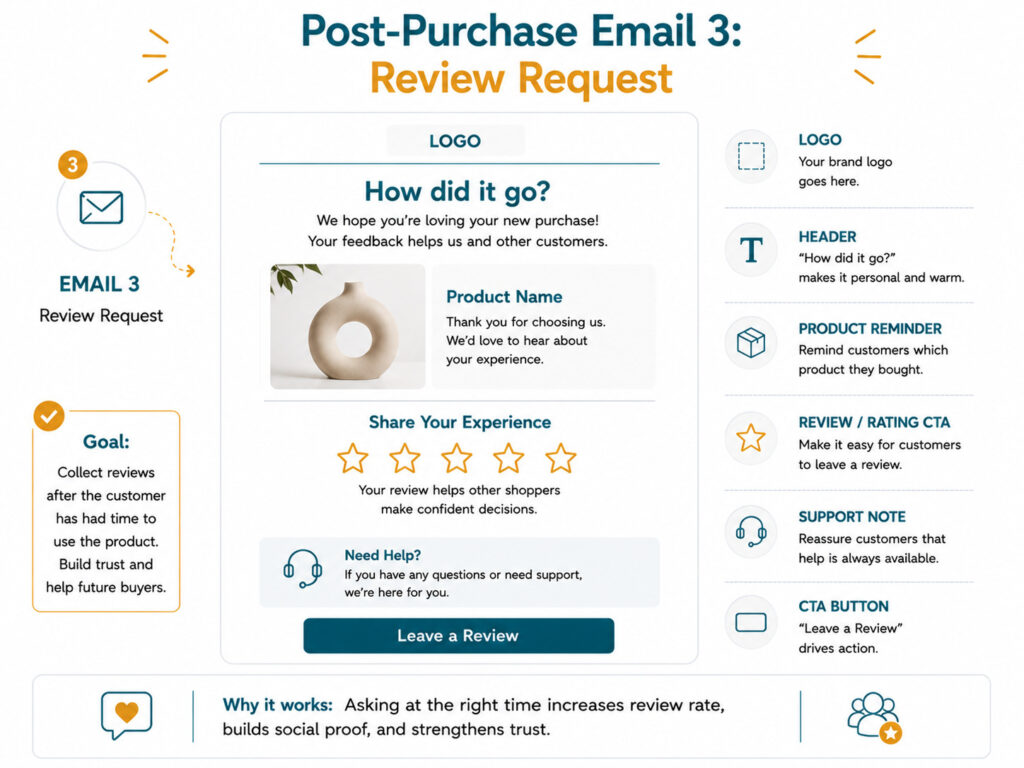
Sample Email 3: Review Request
Purpose: Ask for feedback after the customer has had time to use the product.
Header:
How did it go?
Body:
We hope you’ve had a chance to try your [Product Name].
Your feedback helps us improve and helps other customers choose with more confidence.
If everything went well, we’d love to hear your thoughts.
If something was not right, our support team is here to help.
CTA:
Leave a Review
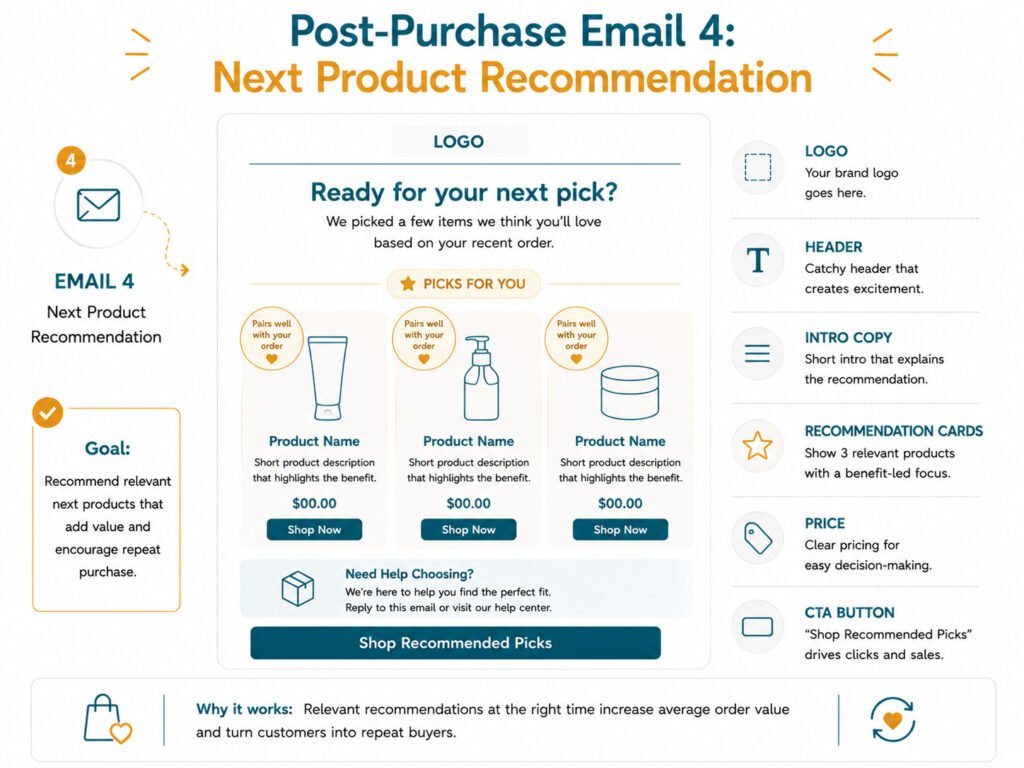
Sample Email 4: Next Product Recommendation
Purpose: Recommend the next product naturally.
Header:
Ready for your next pick?
Body:
Now that you’ve started with [Product Name], here are a few products that pair well with it.
Recommended Picks:
[Product 1]
[Product 2]
[Product 3]
Choose what fits your routine, style, or next step best.
CTA:
Shop Recommended Picks
These are starting structures, not copy-and-paste templates.
Your post-purchase emails should still match your product, delivery timing, brand voice, customer experience, and next-purchase logic.
When Should You Ask for Reviews?
Do not ask for a review before the customer has had time to receive and use the product.
Timing depends on product type.
Product Type | Review Timing Consideration |
Apparel | After delivery and try-on |
Skincare | After enough usage time |
Supplements | After consistency window |
Food / CPG | After likely first use |
Digital products | After access and learning time |
A review request should also include a support path.
If the customer had a bad experience, give them a way to get help before they leave frustrated.
This protects the customer experience.
It also makes the review request feel fair.
When Should You Recommend the Next Product?
Do not recommend the next product too early.
The next product should be relevant to what they bought.
Product Situation | Better Recommendation |
Product has a natural pair | Cross-sell complementary item |
Product runs out | Replenishment reminder |
Customer bought starter product | Recommend next-step product |
Customer bought from one category | Show bestsellers from same category |
Customer bought again | Use repeat buyer thank-you flow |
If you already have repeat buyers, a repeat buyer thank-you flow can help make loyal customers feel recognized.
For this post-purchase flow, the main idea is simple:
Do not sell just because you can.
Recommend when it makes the customer’s next step easier, the same relevance principle that makes browse abandonment emails work earlier in the journey.
Klaviyo Flow Filters and Segmentation to Check
Post-purchase flows work best when the message matches the customer and product.
Filter / Split | Why It Matters |
First-time buyer | Needs reassurance and onboarding |
Repeat buyer | May need recognition or loyalty messaging |
Product or category purchased | Makes education and recommendations relevant |
Has placed another order | Prevents outdated next-purchase nudges |
Has already reviewed | Prevents repeat review asks |
Fulfillment or delivery status | Helps timing match the real customer experience |
In Klaviyo, Placed Order is usually the main trigger.
But fulfillment, delivery, product category, or time delay logic may help later emails feel more relevant.
This is where your post-purchase flow can become more precise.
A skincare buyer should not always get the same education as an apparel buyer.
A first-time buyer should not always get the same message as a VIP.
A customer who already placed another order should not keep receiving a “come back and buy again” email from the old sequence.
Good filters keep the journey clean.
How to Know If Your Post-Purchase Flow Is Working
A post-purchase flow being live does not mean it is working.
You need to review what customers do after receiving it.
Metric | What It Tells You |
Open rate | Are customers opening the emails? |
Click rate | Are customers engaging with tips, guides, or products? |
Review rate | Are customers leaving feedback? |
Repeat purchase rate | Are first-time buyers coming back? |
Placed order rate | Are recommendation emails driving orders? |
Revenue per recipient | How valuable the flow is per customer |
Unsubscribe rate | Does the flow feel too aggressive? |
Open rate is useful.
But retention metrics matter more here.
You want to know:
Are customers engaging?
Are they leaving reviews?
Are they buying again?
Are they unsubscribing?
To review the numbers properly, you need to know which email marketing metrics every Shopify store should track.
If the numbers are weak, the issue may be timing, relevance, product education, or the next offer.
All of those can be improved.
Common Post-Purchase Email Mistakes to Avoid
Mistake | Better Approach |
Treating order confirmation as the full flow | Use a real post-purchase sequence |
Selling again too soon | Support the customer first |
Asking for reviews too early | Wait until the product experience happens |
Recommending random products | Recommend relevant next steps |
Sending the same flow to every buyer | Segment by product, category, or customer type |
Ignoring support questions | Add FAQs, care tips, or help links |
Not tracking repeat purchase | Review retention metrics |
The goal is not just to send more emails after purchase.
The goal is to make the customer feel supported enough to come back.
That is the difference between a post-purchase flow that feels useful and one that feels like another sales push.
When Should You Get Help With Post-Purchase Emails?
You may need help if:
- First-time buyers are not buying again
- Customers go quiet after purchase
- Your flow is only a thank-you email
- Review requests are too early or not working
- Cross-sells feel random
- You are not segmenting by product or category
- You do not know when to recommend the next product
- Reporting is unclear
If first-time buyers rarely return, a Klaviyo email marketing agency can help build a post-purchase journey that supports the product experience, collects feedback, and introduces the next relevant purchase.
Because post-purchase is not the end of the sale.
It is the start of retention.
Final Thoughts
Post-purchase emails help turn first-time buyers into repeat customers by supporting them after the sale.
Start simple.
Thank them.
Set expectations.
Help them use the product.
Ask for reviews at the right time.
Recommend the next product when it makes sense.
The customer already trusted you once.
Your post-purchase flow should help them feel confident enough to trust you again.
That is how post-purchase emails turn first-time buyers into repeat customers.
At Your Proactive Media we help Shopify brands build strategic Klaviyo post-purchase flows that strengthen customer relationships, encourage repeat purchases, and increase customer lifetime value.
Want to Turn More First-Time Buyers Into Repeat Customers?
If customers buy once but do not come back, your post-purchase flow may need a closer look.
FAQs About Post-Purchase Emails
What are post-purchase emails?
+Post-purchase emails are automated emails sent after someone places an order. They help support the customer after the sale, explain what happens next, provide product education, ask for reviews at the right time, and encourage repeat purchase when relevant.
What triggers a post-purchase flow in Klaviyo?
+In Klaviyo, a post-purchase flow is usually triggered by Placed Order. Some later emails may also use fulfillment, delivery, product category, or time delay logic depending on the customer journey.
Are post-purchase emails the same as order confirmation emails?
+No. Order confirmation emails confirm the transaction. Post-purchase emails support the customer after the order and help guide retention.
How many post-purchase emails should I send?
+Most Shopify stores can start with 3 to 4 post-purchase emails: thank you and expectations, product education, review request, and relevant next product recommendation.
When should I ask for a review?
+Ask after the customer has received and used the product. Timing depends on shipping time and product type.
Should post-purchase emails sell another product?
+Yes, but not too early. Support the customer first, then recommend a relevant next product when timing makes sense.
What should post-purchase emails include?
+They can include thank-you messages, expectations, product education, FAQs, review requests, support notes, and relevant product recommendations.
How do I know if post-purchase emails are working?
+Track click rate, review rate, repeat purchase rate, placed order rate, revenue per recipient, and unsubscribe rate.

Jasmin Umali
Jasmin Umali is the Founder of Your Proactive Media and a Klaviyo email marketing strategist with 6 years of experience helping ecommerce brands generate an additional 20%–30% or more revenue through email marketing.