You don’t always need the most advanced email tool.
Sometimes, you just need to send a simple campaign.
A promo.
A new arrival.
A product update.
A holiday sale.
For that, Shopify Email can help.
It’s built into Shopify.
It’s simple to access.
It keeps your email marketing close to your store.
But as your Shopify store grows, the question changes.
It’s no longer:
Can we send emails?
It becomes:
Can we send the right email to the right customer based on what they actually do?
That’s where the real comparison begins.
Because Shopify Email and Klaviyo can both help Shopify stores send emails.
But they are not built for the same stage, depth, or level of email marketing.
Shopify Email can be a good starting point.
Klaviyo usually makes more sense when your store needs stronger automation, deeper segmentation, better customer behavior tracking, and clearer revenue reporting.
So which one should your store use?
Let’s break it down.
New to the bigger picture? Start with our guide on Klaviyo email marketing for Shopify stores.
Quick Answer: Shopify Email vs Klaviyo
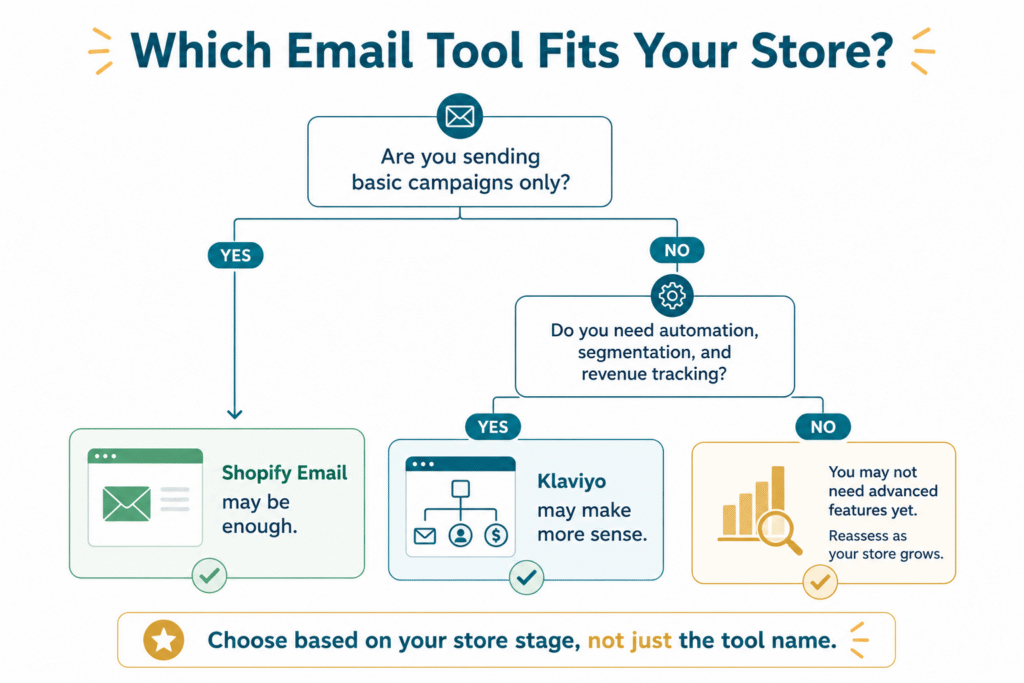
If you’re an early-stage Shopify store that only needs simple campaigns, Shopify Email may be enough.
If your Shopify store already has traffic, add-to-cart activity, customer behavior, repeat purchase potential, and a growing list, Klaviyo may make more sense.
Here’s the simple version:
Tool | Best For |
Shopify Email | Early-stage stores that need simple email campaigns and basic automations |
Klaviyo | Growing Shopify stores that need stronger flows, segmentation, customer behavior tracking, and revenue reporting |
This is not about saying Shopify Email is bad.
It isn’t.
Shopify Email is useful, especially when you’re starting.
But once email needs to become a serious revenue and retention channel, Klaviyo gives you more room to build.
What Is Shopify Email?
Shopify Email is Shopify’s built-in email marketing tool.
It lets Shopify merchants create and send email campaigns directly from the Shopify admin. You can use templates, customize emails to match your store, and send campaigns to selected customer segments.
Shopify Messaging, formerly known as Shopify Email, also supports email and SMS campaigns and automations for subscribers.
Source: Email and SMS marketing with Shopify Messaging
Source: Shopify Email app
For Shopify brand owners, the biggest advantage is convenience.
You’re already inside Shopify.
Your products, customer list, and store setup are already there.
So if you only need basic campaigns, Shopify Email can be a simple way to start.
You can send:
- Product announcements
- Sale campaigns
- New arrival emails
- Store updates
- Simple promotional emails
- Basic customer touchpoints
That makes it useful for early-stage Shopify stores.
Especially if you’re not ready to manage a separate email platform yet.
What Is Klaviyo?
Klaviyo is an email marketing platform built for ecommerce brands that need deeper customer data, segmentation, automation, and performance tracking.
For Shopify stores, Klaviyo connects with Shopify so customer profile data and order data can sync into Klaviyo. Klaviyo also supports onsite tracking, signup forms, and syncing data back to Shopify.
Source: Getting started with Shopify
In simple terms:
Klaviyo helps your Shopify store send emails based on customer behavior.
That behavior can include:
- Viewed Product
- Added to Cart
- Started Checkout
- Placed Order
- Ordered Product
- Opened Email
- Clicked Email
That matters because not all customers are in the same stage.
A product viewer is different from a cart abandoner.
A first-time buyer is different from a repeat buyer.
A VIP customer is different from someone who hasn’t bought in six months.
Klaviyo helps Shopify stores treat those customers differently.
That’s why many growing stores move from basic email sending to a more behavior-based email system.
For more context, read why Shopify stores use Klaviyo for email marketing.
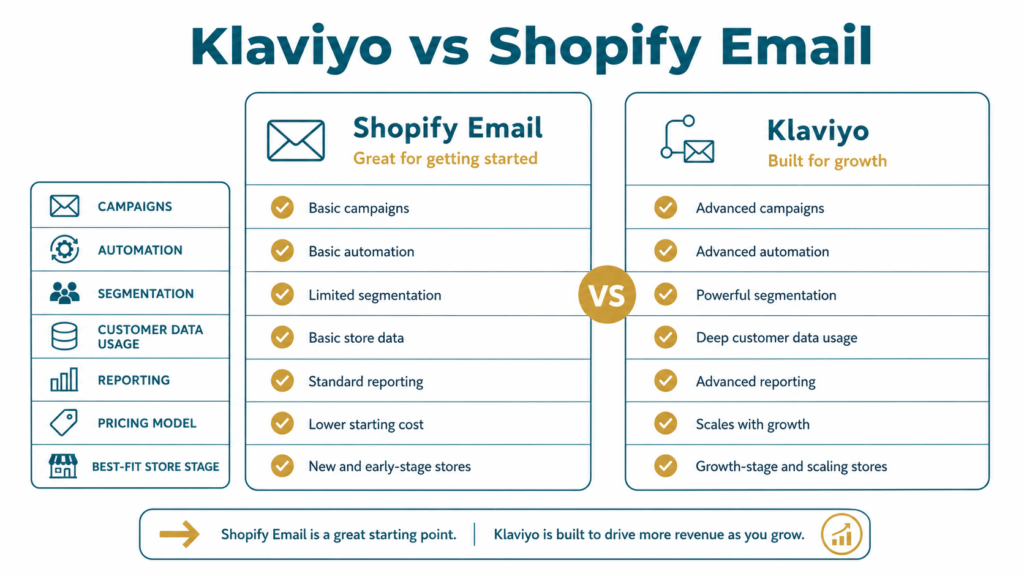
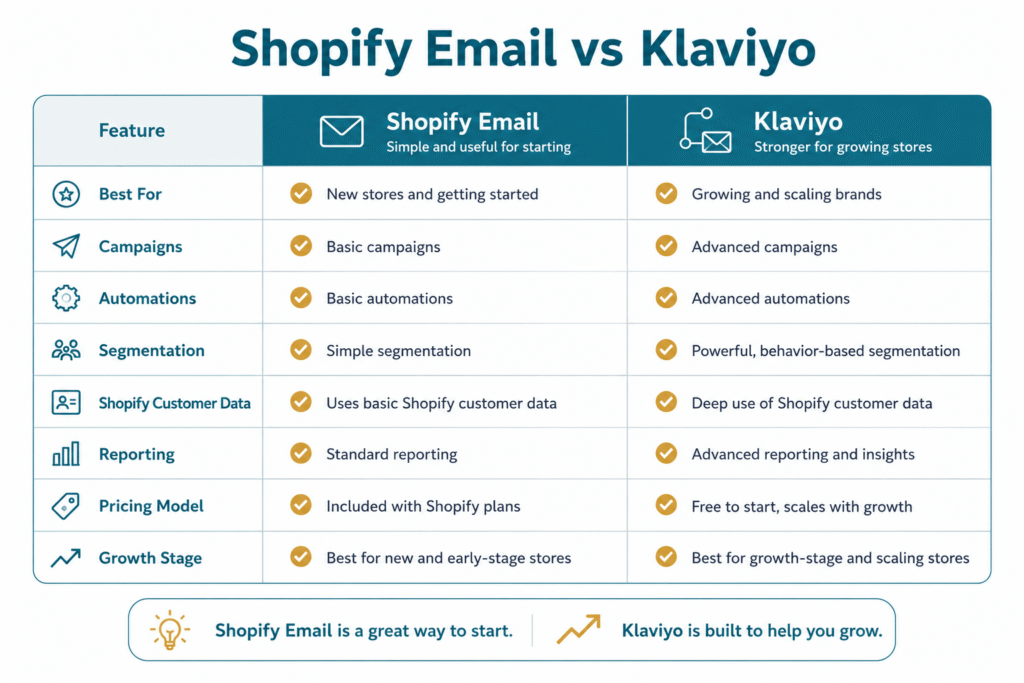
Shopify Email vs Klaviyo: Quick Comparison
Here’s the clean comparison.
Feature | Shopify Email | Klaviyo |
Best for | Early-stage Shopify stores | Growing Shopify stores |
Main strength | Simple email campaigns inside Shopify | Customer-data-driven email marketing |
Campaigns | Good for basic campaigns | Stronger for targeted campaigns |
Automations | Useful built-in automations | More advanced behavior-based flows |
Segmentation | Basic customer segment targeting | Deeper segmentation based on behavior and profile data |
Shopify data usage | Works inside Shopify | Uses Shopify data for flows, segments, campaigns, and reporting |
Reporting | Basic performance visibility | Deeper campaign and flow analytics |
Pricing model | Free monthly email allowance, then pay-per-send | Free plan at small scale, then paid based on active profiles and plan needs |
Best use case | Simple sends and early email marketing | Revenue-focused email system |
Shopify Email helps you start.
Klaviyo helps you scale your email marketing when your store has more customer behavior to use.
Moving to Klaviyo also means managing more advanced data, segmentation, flows, and reporting. A Klaviyo email marketing agency can help plan that transition without overcomplicating the account.
When Shopify Email Makes Sense
Shopify Email can make sense when your store is still early.
Maybe you’re just starting to build your list.
Maybe you only send occasional campaigns.
Maybe your email strategy is still simple.
In that case, you may not need a more advanced setup yet.
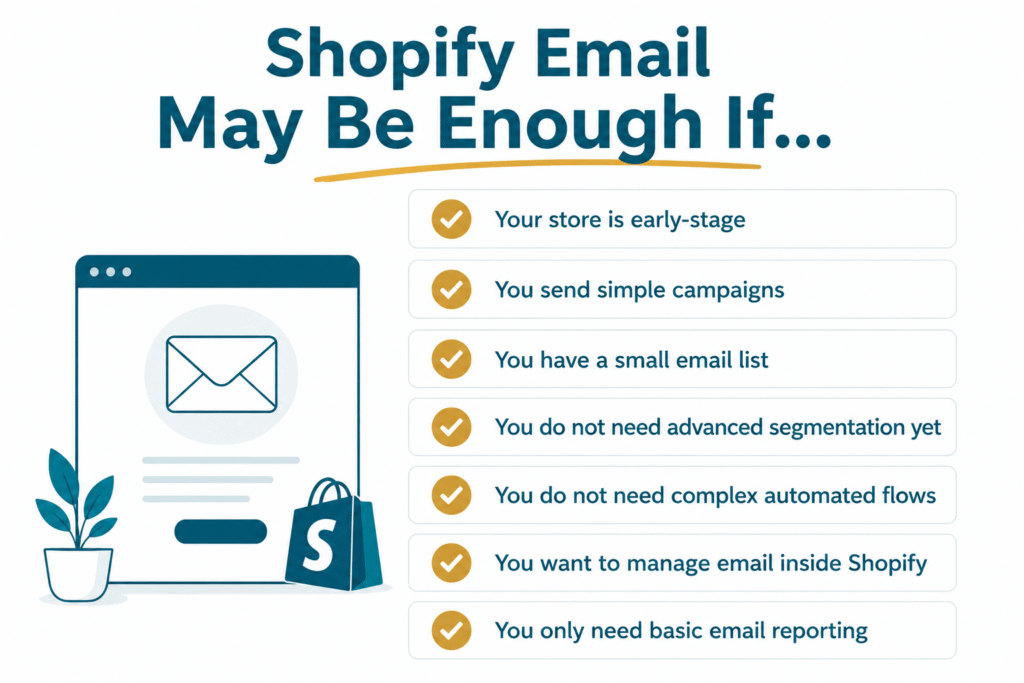
Shopify Email may be enough if:
- Your store is early-stage
- Your email list is still small
- You only need simple campaigns
- You send occasional promos or updates
- You don’t need advanced segmentation yet
- You don’t need complex automated flows
- You want to manage email inside Shopify
- You only need basic email performance reporting
That’s a practical starting point.
You don’t need to overbuild your email marketing before your store has enough traffic, customers, or buying signals.
If your current need is simple email sending, Shopify Email can help you begin.
When Klaviyo Makes More Sense
Klaviyo starts to make more sense when your Shopify store needs more than basic sending.
This usually happens when your store already has traffic, customer activity, and a need for better follow-up.
For example:
People are visiting products.
People are adding to cart.
People are starting checkout.
People are buying once.
People are not coming back.
At that point, you don’t just need email campaigns.
You need an email system that reacts to customer behavior.
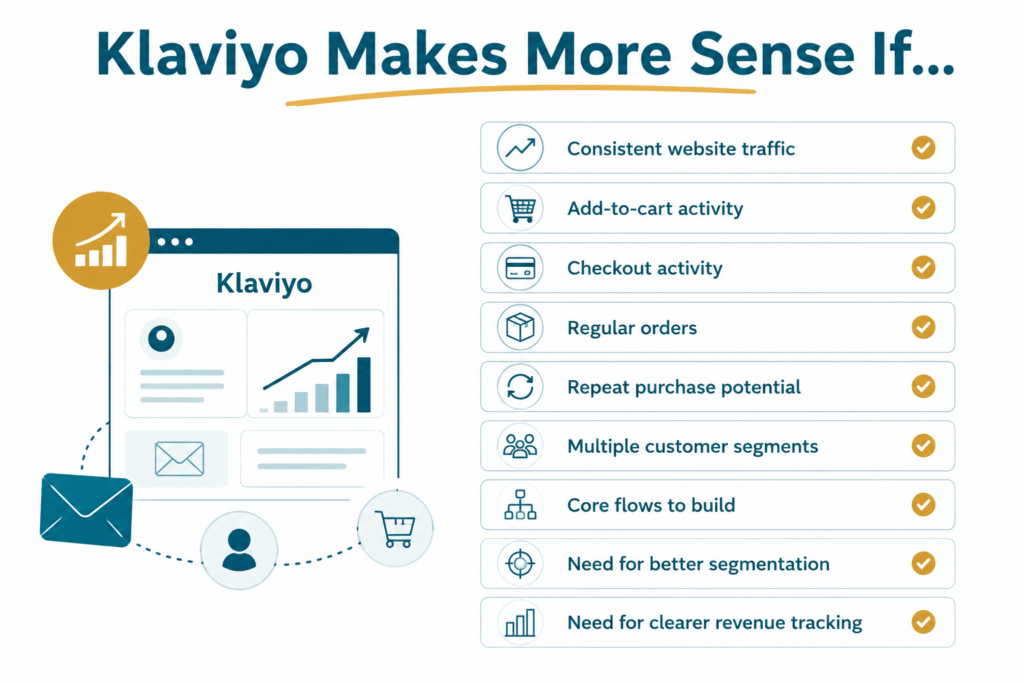
Klaviyo may make more sense if:
- Your store has consistent traffic
- You have add-to-cart activity
- You have checkout activity
- You have regular orders
- You have repeat purchase potential
- You have multiple product categories
- You need better segmentation
- You want stronger abandoned cart follow-up
- You want post-purchase emails
- You want winback emails
- You want clearer revenue tracking
- You want to know which flows and campaigns are working
That’s where Klaviyo becomes useful.
Not because it is popular.
But because your store has customer behavior worth following up on.
Automation: Shopify Email vs Klaviyo
Automation is one of the biggest differences.
Shopify has marketing automation tools that can help merchants automate workflows from the Shopify admin. Shopify Messaging also supports marketing automations for email.
Source: Marketing automation tools
That’s useful.
But Klaviyo is often stronger when your store needs deeper behavior-based flows.
Klaviyo recommends starting with high-impact flows like a welcome series, abandoned cart flow, post-purchase flow, and winback flow.
Source: Getting started with flows
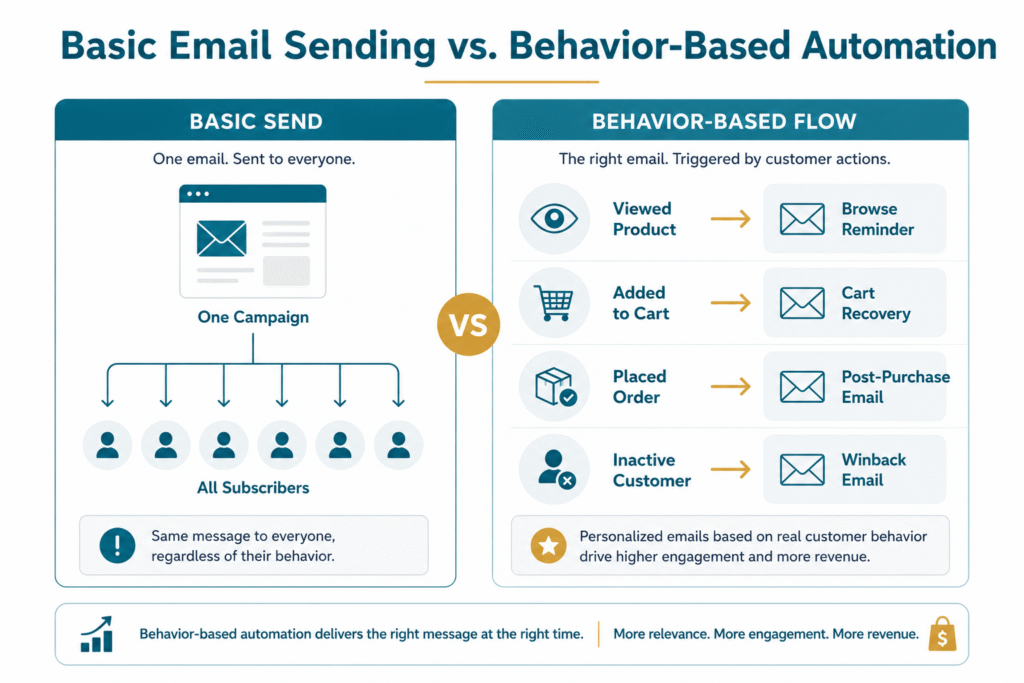
These flows help Shopify stores follow up with people based on customer actions.
Customer Action | Klaviyo Flow |
Joins email list | Welcome flow |
Adds to cart but does not buy | Abandoned cart flow |
Views product but does not add to cart | Browse abandonment flow |
Places first order | Post-purchase flow |
Has not bought in a while | Winback flow |
This is where Klaviyo becomes powerful.
You’re not just sending emails.
You’re building follow-up around the customer journey.
If your store already has these customer moments but no clear automated follow-up, our Klaviyo email marketing agency can help with flow strategy, campaign planning, segmentation, and reporting.
For a deeper flow breakdown, read email flows every Shopify store should set up.
Segmentation: Shopify Email vs Klaviyo
Segmentation means sending emails to the right group of people.
This matters because your list is not one audience.
Your list may include:
- New subscribers
- Non-buyers
- First-time buyers
- Repeat buyers
- Product viewers
- Cart abandoners
- VIP customers
- Inactive customers
Shopify Email can send to customer segments, which is useful for basic targeting.
Klaviyo goes deeper by using Shopify customer data, behavior, and profile information to build more specific audience groups.
For example, in Klaviyo, you can create segments like:
- People who viewed a product in the last 30 days
- People who started checkout but did not order
- People who placed one order but not a second order
- People who bought Product A but not Product B
- People who clicked an email recently
- People who have not bought in 90 days
That gives you more control.
Instead of sending one campaign to everyone, you can send more relevant emails based on what customers actually do.
That can affect clicks, conversions, revenue per recipient, unsubscribes, and overall campaign performance.
For more on this, read how to send more relevant emails using Shopify customer data.
Reporting: Shopify Email vs Klaviyo
If you’re only sending basic campaigns, simple reporting may be enough.
You may only need to know:
Did people open?
Did people click?
Did the campaign perform?
But as your Shopify store grows, you may need better visibility.
You may want to know:
Which flows are making money?
Which campaigns drove orders?
Which segments performed better?
Which email had a strong open rate but weak click rate?
Which send had the best revenue per recipient?
Klaviyo’s campaign analytics documentation explains that campaign reporting includes open and click rates, plus conversion metric reporting.
Source: Understanding available campaign analytics
Klaviyo also has flow analytics that help review flow message performance, including open, click, and conversion rates.
Source: Understanding flow analytics
For marketing managers, this matters.
Because you don’t just need to send emails.
You need to explain what worked, what didn’t, and what should improve next.
For a deeper breakdown, read email marketing metrics every Shopify store should track.
Shopify Email vs Klaviyo Pricing
Pricing is one of the biggest differences between Shopify Email and Klaviyo.
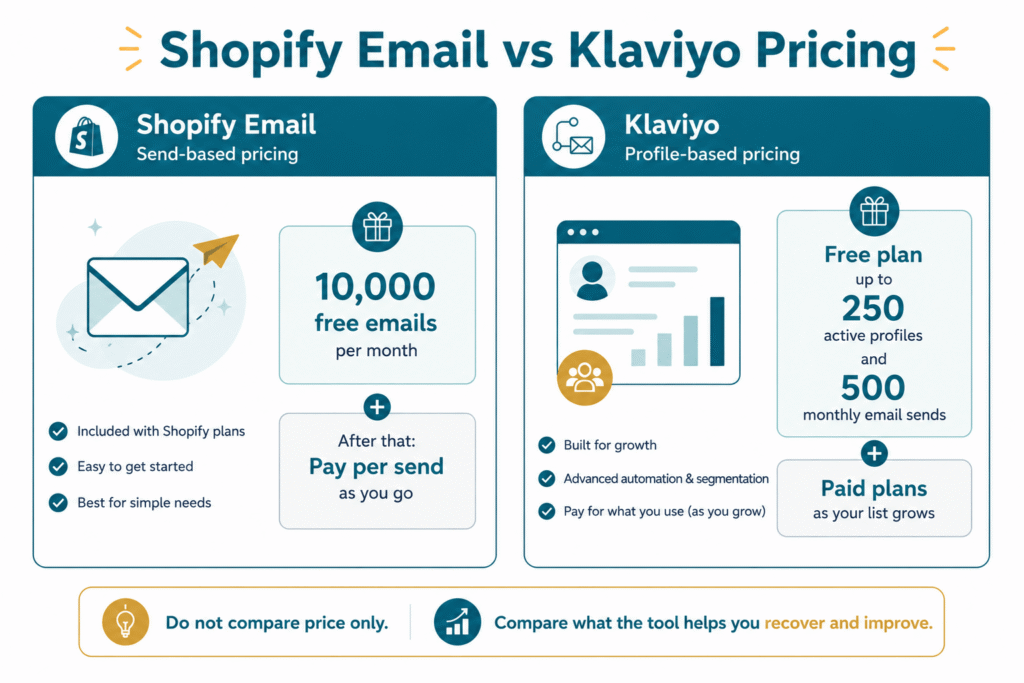
Shopify Email, now part of Shopify Messaging, is built into Shopify. Shopify says merchants get 10,000 free manual or automated emails per month, then pay $1 USD per 1,000 additional emails up to 300,000 emails. After 300,000 emails, Shopify lists pricing at $0.65 USD per 1,000 additional emails, and after 750,000 emails, $0.55 USD per 1,000 additional emails.
Source: Shopify Messaging email pricing
Klaviyo also has a free plan, but the limit is smaller. Klaviyo says its free plan is available while your account has up to 250 active profiles and 500 monthly email sends. If you exceed those limits or need paid-plan features, you need to upgrade.
Source: Klaviyo Pricing
Here’s the simple pricing comparison:
Tool | Pricing Style | What It Means |
Shopify Email | Free monthly email allowance, then pay per additional email send | Usually easier and more cost-friendly for early-stage stores sending simple campaigns |
Klaviyo | Free plan at very small scale, then paid plans based on active profiles, sends, channels, and plan needs | Can become more expensive as your list grows, but gives stronger automation, segmentation, and reporting |
This is why Shopify Email can make sense for stores that only need simple campaigns.
But pricing should not be the only decision.
A cheaper email tool may be enough if your store is early, your list is small, and your campaigns are simple.
But if your store has abandoned carts, product browsers, first-time buyers, lapsed customers, and repeat purchase potential, the better question is:
Which tool helps us make more from the customer activity we already have?
That’s where Klaviyo can justify the extra cost.
Not because it’s cheaper.
But because it gives growing Shopify stores more ways to recover missed sales, follow up automatically, segment customers, and track email revenue.
Cost vs Value: Don’t Only Compare Price
It’s easy to compare tools by price.
But that’s not always the best way to decide.
A cheaper tool may be enough if your needs are simple.
But if your store is missing revenue because carts are not followed up, first-time buyers are not nurtured, and campaigns are not segmented, then the real question is not just:
Which tool costs less?
The better question is:
Which tool helps us recover more missed opportunities?
For early-stage stores, Shopify Email may be a practical starting point.
For growing stores, Klaviyo may create more value if it helps improve:
- Cart recovery
- Browse follow-up
- Post-purchase education
- Repeat purchases
- Winback campaigns
- Campaign targeting
- Flow revenue
- Campaign revenue
That does not mean every store needs Klaviyo immediately.
It means the tool should match the stage of the store.
A simple store may need a simple setup.
A growing store may need a stronger system.
A simple tool used well is better than an advanced tool used poorly.
But once your Shopify store has enough customer behavior to act on, Klaviyo gives you more room to build a stronger follow-up system.
If your current email setup has carts, buyers, and campaigns but the system still feels unclear, an email marketing audit can help identify the biggest gaps before you switch tools or rebuild everything.
Which One Should Your Shopify Store Choose?
Here’s the practical answer.
Choose Shopify Email if:
- You’re just starting
- Your list is small
- You only need simple campaigns
- You don’t need advanced flows yet
- You want everything inside Shopify
- You’re not ready for a separate email platform
Choose Klaviyo if:
- Your store is growing
- You already have customer activity
- You want stronger abandoned cart emails
- You want post-purchase and winback flows
- You need better segmentation
- You want more targeted campaigns
- You need clearer reporting on email revenue
- You want email to become a stronger retention channel
The decision is not about which tool is “best” in general.
It’s about which tool fits your stage.
If your store only needs simple sending, Shopify Email may be enough.
If your store needs customer-data-driven follow-up, Klaviyo may make more sense.
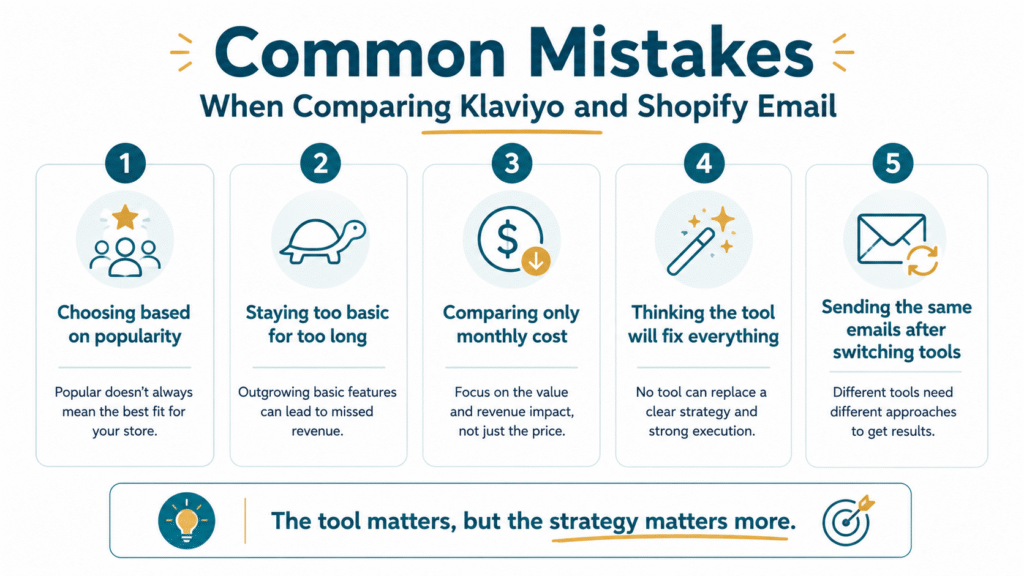
Common Mistakes When Comparing Klaviyo and Shopify Email
Before choosing, avoid these mistakes.
Mistake 1: Choosing Based on Popularity
Klaviyo is popular in ecommerce.
But popularity alone is not a strategy.
Your store should choose Klaviyo because you need what it does.
Not because everyone else is using it.
Mistake 2: Staying Too Basic for Too Long
Shopify Email can be useful for starting.
But if your store has traffic, add-to-cart activity, orders, and repeat purchase potential, basic sending may eventually limit you.
At some point, you may need better automation and segmentation.
Mistake 3: Comparing Only the Monthly Cost
Cost matters.
But so does missed revenue.
If better flows and segmentation help recover carts, bring customers back, and improve repeat purchases, the value may be bigger than the tool cost.
Mistake 4: Thinking the Tool Will Fix Everything
Klaviyo is powerful.
But it won’t fix weak strategy by itself.
You still need:
- Clear flows
- Strong email copy
- Relevant offers
- Good segmentation
- Useful product education
- Clean reporting
- Consistent optimization
The tool helps.
But the strategy matters.
Mistake 5: Sending the Same Emails After Switching Tools
Moving to Klaviyo does not automatically improve email marketing.
If you keep sending the same generic campaigns to everyone, you may not see the full value.
The goal is not to use a more advanced tool to do the same basic thing.
The goal is to send better emails based on customer behavior.
Final Recommendation
Shopify Email is a useful starting point.
It can help early-stage stores send basic campaigns and start building customer touchpoints.
But Klaviyo usually makes more sense when a Shopify store is ready for deeper email marketing.
That means:
More automation.
More segmentation.
More customer behavior tracking.
More targeted campaigns.
More revenue visibility.
If your store is still small and simple, start simple.
But if your store already has traffic, carts, customers, and repeat purchase potential, you may need more than basic sending.
You may need a follow-up system.
That’s where Klaviyo becomes valuable.
At Your Proactive Media, we help Shopify businesses choose, implement, and optimize the right email marketing solution, ensuring their strategy supports customer engagement, automation, and long-term revenue growth.
For the bigger strategy behind this, read why Shopify stores use Klaviyo for email marketing.
Once you are ready to move from tool comparison to setup, use this Klaviyo setup checklist for Shopify stores.
Not Sure Which Email Setup Makes Sense for Your Shopify Store?
Shopify Email may be enough if you only need simple campaigns.
But if your store already has traffic, carts, customers, and repeat purchase potential, your email setup may need stronger automation, segmentation, and reporting.
You don’t need to guess.
FAQs About Klaviyo vs Shopify Email
What is the difference between Klaviyo and Shopify Email?
Shopify Email is Shopify’s built-in email marketing tool for creating and sending email campaigns from the Shopify admin. Klaviyo is a separate email marketing platform that connects with Shopify and supports deeper automation, segmentation, customer behavior tracking, and reporting.
Is Shopify Email enough for a Shopify store?
Shopify Email may be enough for early-stage stores that only need simple campaigns, basic automations, and a convenient tool inside Shopify.
When should a Shopify store use Klaviyo?
A Shopify store should consider Klaviyo when it has traffic, customer activity, add-to-cart behavior, regular orders, repeat purchase potential, and a need for better segmentation, automation, and revenue reporting.
Is Klaviyo better than Shopify Email?
Klaviyo is usually better for growing Shopify stores that need advanced email flows, customer-data-based segmentation, and clearer revenue tracking. Shopify Email can still be useful for simple campaigns and early-stage email marketing.
Can Shopify Email do automations?
Yes. Shopify has marketing automation tools and Shopify Messaging can support email automations. These can be helpful for starting. Klaviyo may make more sense when the store needs more advanced behavior-based flows and segmentation.
Does Klaviyo work with Shopify?
Yes. Klaviyo integrates with Shopify to bring customer profile and order data into Klaviyo, support targeted messaging, enable onsite tracking and signup forms, and sync data between Klaviyo and Shopify.
Which is cheaper, Shopify Email or Klaviyo?
Shopify Email is usually cheaper to start because Shopify includes 10,000 free emails per month, then charges per additional email send. Klaviyo has a free plan at very small scale, but paid plans become necessary as active profiles and sending needs grow.
Source: Shopify Messaging email pricing
Source: Klaviyo Pricing
Which is better for abandoned cart emails, Shopify Email or Klaviyo?
Both can support abandoned checkout or cart-related follow-up depending on setup. Klaviyo is often stronger for stores that want more customizable behavior-based flows, segmentation, and performance tracking around abandoned cart recovery.
Should small Shopify stores use Klaviyo?
It depends. If the store is very new and only needs simple emails, Shopify Email may be enough. If the store already has consistent traffic, carts, sales, and customer behavior worth following up on, Klaviyo may be worth considering.

Jasmin Umali
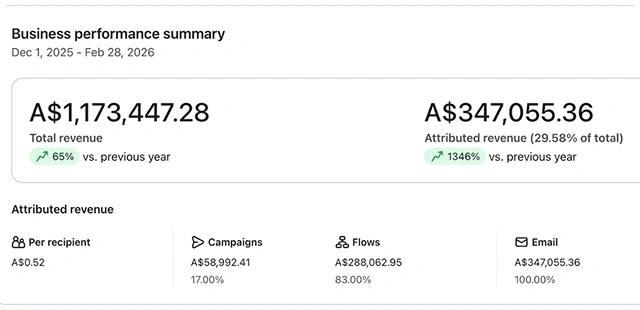
Jasmin Umali is the Founder of Your Proactive Media and a Klaviyo email marketing strategist with 6 years of experience helping ecommerce brands generate an additional 20%–30% or more revenue through email marketing.