Klaviyo is popular.
But if you’re running a small Shopify business, popularity is not the question.
The real question is:
Is Klaviyo worth paying for at our stage?
Because for some small Shopify stores, Shopify Email or basic email marketing may be enough for now.
You may only need simple campaigns.
You may still be building your list.
You may not have enough traffic or orders yet.
You may not be ready to manage flows, segments, and reports.
That’s okay.
But for other small Shopify businesses, Klaviyo can start making sense earlier than expected.
Especially if people are already visiting products, adding to cart, buying once, and not coming back.
Because at that point, you don’t just need an email tool.
You need a better follow-up system.
So the real question is not:
Are we too small for Klaviyo?
The better question is:
Do we have customer behavior worth following up on?
That’s what we’ll answer in this guide.
For the bigger picture, read our guide on Klaviyo email marketing for Shopify stores.
Quick Answer: Is Klaviyo Worth It?
Klaviyo is worth it for small Shopify businesses when your store has customer behavior worth following up on.
That means you already have signs like:
- Website traffic
- Product views
- Add-to-cart activity
- Started checkouts
- Email subscribers
- First-time buyers
- Repeat purchase potential
- Products that need education
- Regular campaigns or promos
- A need for better reporting
If your store has those signals, Klaviyo can help you build more relevant flows, campaigns, and customer segments.
But if your store is very new, has almost no traffic, few subscribers, and only occasional orders, Klaviyo may be too early.
Here’s the simple version:
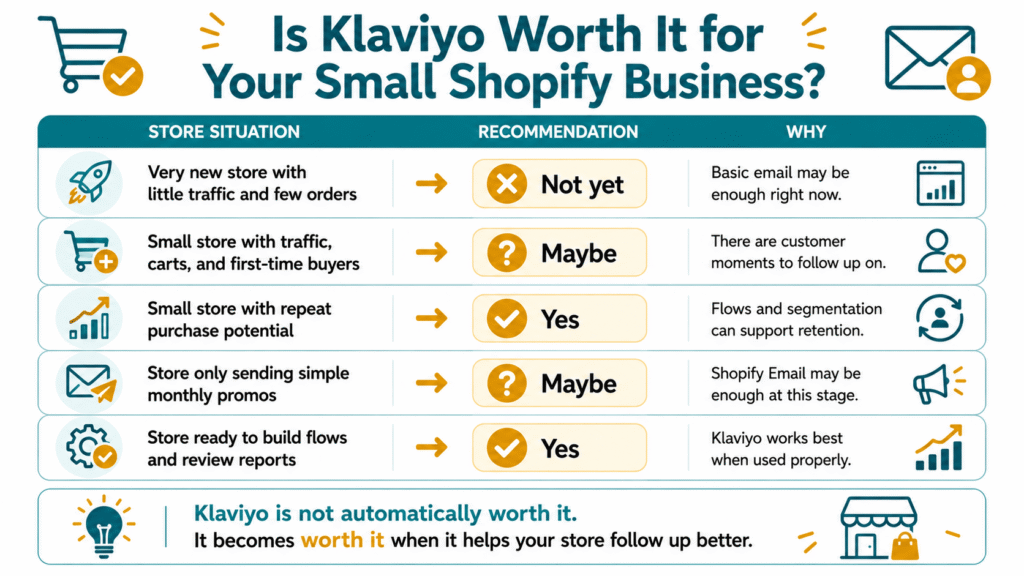
Store Situation | Is Klaviyo Worth It? | Why |
Very new store with little traffic and few orders | Not yet | Basic email may be enough |
Small store with traffic, carts, and first-time buyers | Maybe / likely | There are customer moments to follow up on |
Small store with repeat purchase potential | Yes, worth considering | Flows and segmentation can support retention |
Store only sending simple monthly promos | Maybe not yet | Shopify Email may be enough |
Store ready to build flows and review reports | Yes, stronger fit | Klaviyo works best when used properly |
Klaviyo is not automatically worth it because it’s popular.
It becomes worth it when it helps your store follow up better.
What Does “Small Shopify Business” Actually Mean?
Small does not always mean “not ready.”
A small Shopify business could mean:
- You have a small team
- You have a small or growing email list
- You have low but improving traffic
- You have inconsistent sales
- You handle most marketing yourself
- You have a simple email setup
- You’re still testing your offers or products
- You don’t have a full marketing team yet
But size is not the only factor.
A small Shopify store with steady traffic, carts, and repeat purchase potential may get more value from Klaviyo than a larger store that never uses it properly.
So don’t only ask:
Are we small?
Ask:
Do we have customer moments worth following up on?
That question is more useful.
Because Klaviyo is not only for big brands.
But it does work best when there is enough customer activity to turn into better email follow-up.
When Shopify Email May Be Enough for Now
Shopify Email can be a good starting point for small Shopify businesses.
It’s built into Shopify, easier to access, and useful when your email needs are still simple.
Shopify says Shopify Messaging, formerly known as Shopify Email, lets merchants create and send email campaigns from the Shopify admin, and also create marketing automations. For this blog, we’re focusing on email, not SMS.
Source: Email and SMS marketing with Shopify Messaging (Shopify Help Center)
Shopify also says stores on supported plans get 10,000 free emails at the beginning of every month. After that, charges apply based on additional email sends.
Source: Shopify Messaging email pricing (Shopify Help Center)
Shopify Email may be enough if:
- You’re still validating your store
- You only need simple campaigns
- Your email list is very small
- You don’t have much cart or checkout activity yet
- You don’t need advanced segmentation
- You want to keep email inside Shopify
- You’re not ready to manage another platform
- You only send occasional promos or announcements
That doesn’t mean you’re doing email wrong.
It just means your current stage may not need a more advanced setup yet.
A simple tool used well is better than an advanced tool used poorly.
For a full comparison, read Klaviyo vs Shopify Email.
When Klaviyo Starts to Make More Sense
Klaviyo starts making more sense when basic email can no longer support your customer journey.
This usually happens when your store already has customer actions worth turning into automated follow-up.
For example:
People view products but don’t buy.
People add to cart but leave.
Customers buy once but don’t come back.
You send campaigns but don’t know which ones drive revenue.
You want to send different emails to different customer groups.
That’s when Klaviyo becomes more useful.
Not because it sends prettier emails.
But because it can help you use customer behavior.
Klaviyo says its Shopify integration can bring customer profile and order data into Klaviyo, enable onsite tracking and sign-up forms, and sync data between Klaviyo and Shopify.
Source: Getting started with Shopify (Klaviyo Help Center)
Klaviyo may make more sense if:
- Your store has consistent traffic
- You have add-to-cart activity
- You have checkout activity
- You have first-time buyers
- You have products people buy again
- You run regular campaigns
- You want better abandoned cart emails
- You want post-purchase emails
- You want winback emails
- You want clearer revenue tracking
- You want to segment customers by behavior
Klaviyo becomes more useful when your store has signals, not just subscribers.
The Customer Behavior That Makes Klaviyo More Valuable
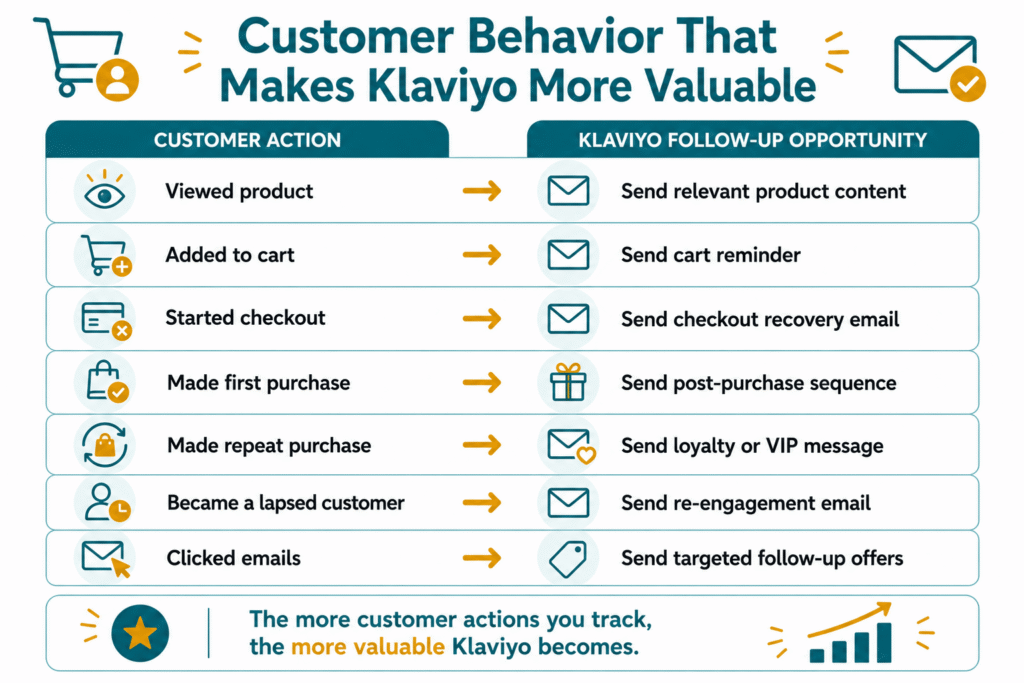
Klaviyo is strongest when there is customer behavior to act on.
That behavior gives your email system something useful to respond to.
Customer Behavior | What Klaviyo Can Help You Do |
Product views | Send browse abandonment emails |
Added to cart | Send abandoned cart follow-up |
Started checkout | Recover checkout intent |
First purchase | Send post-purchase education |
Repeat purchase | Identify loyal customers |
No purchase in months | Send winback emails |
Clicked emails | Target engaged subscribers |
This is the difference between basic email and behavior-based email.
Basic email asks:
What campaign should we send?
Behavior-based email asks:
What did this customer do, and what follow-up makes sense?
That’s a much better question.
The First Klaviyo Flows That Usually Matter Most
A small Shopify business does not need every advanced automation on day one.
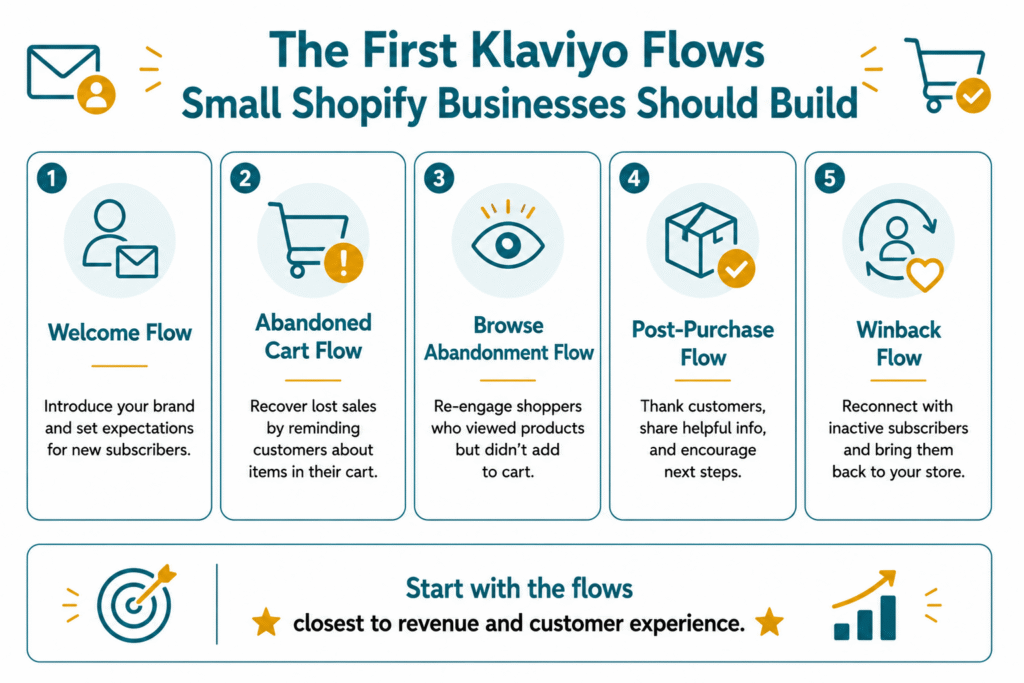
Start with the flows closest to revenue and customer experience.
Klaviyo recommends starting with high-impact flows such as a welcome series, abandoned cart flow, post-purchase flow, and winback flow.
Source: Getting started with flows (Klaviyo Help Center)
Here are the flows that usually matter first:
Flow | Why It Matters |
Welcome flow | Helps turn new subscribers into first-time buyers |
Abandoned cart flow | Helps recover shoppers who showed buying intent |
Browse abandonment flow | Follows up with product viewers |
Post-purchase flow | Supports customers after the first order |
Winback flow | Helps bring inactive buyers back |
These flows are practical because they follow up on moments that already happen inside your store.
Someone joins your list.
Someone views a product.
Someone adds to cart.
Someone buys once.
Someone disappears.
You don’t need to chase each person manually.
Your flows handle the follow-up.
If your store already has these customer moments but no clear automated follow-up, our Klaviyo email marketing agency can help with lifecycle flow strategy, campaign planning, segmentation, and reporting.
Read our guide on email flows every Shopify store should set up.
Klaviyo Pricing: How Small Stores Should Think About Cost
Pricing is one of the biggest reasons small Shopify businesses hesitate.
And that makes sense.
For a small business, every monthly tool needs to justify its cost.
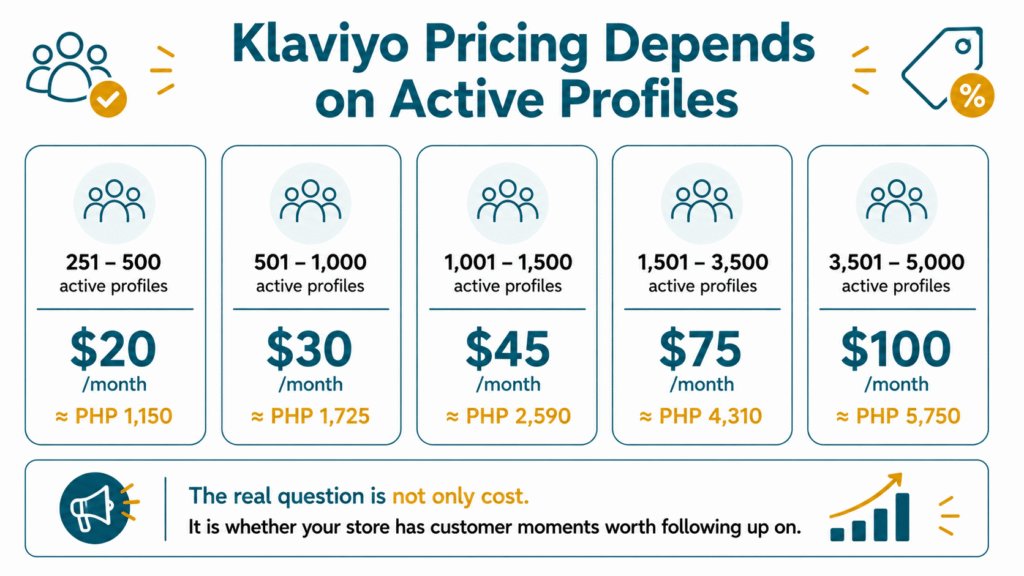
Klaviyo has a free plan at a very small scale, and paid plans change based on active profiles, sends, and plan needs. Always check Klaviyo’s live pricing before deciding because pricing can change.
Source: Klaviyo Pricing (Klaviyo)
Based on the pricing structure you shared and Klaviyo’s pricing model, cost scales by active profiles and monthly email send limits.
Active Profiles | Email Sends / Month | Monthly Price | Approx. PHP |
251–500 | 5,000 | $20 | ~₱1,230 |
501–1,000 | 10,000 | $30 | ~₱1,850 |
1,001–1,500 | 15,000 | $45 | ~₱2,770 |
1,501–2,500 | 25,000 | $60 | ~₱3,700 |
2,501–3,000 | 30,000 | $70 | ~₱4,310 |
3,501–5,000 | 50,000 | $100 | ~₱6,160 |
PHP estimates use an approximate exchange rate of around ₱61.6 per $1. Exchange rates change, so always check the live rate before deciding.
Source: USD to PHP exchange rate (Wise)
The important lesson:
Klaviyo pricing depends heavily on active profiles.
Not just “how many Instagram followers you have.”
Not just “how many people visited your site.”
But the number of active profiles in your Klaviyo account and the plan tier you need.
So for a small Shopify business, the pricing question should not only be:
Can we afford Klaviyo?
The better question is:
Do we have enough customer activity to make Klaviyo useful?
If you have carts to recover, buyers to nurture, and repeat purchases to encourage, the cost may be easier to justify.
But if you have almost no traffic, no list, and very few orders, even a lower monthly cost may feel too early.
Cost vs Value: The Question Small Stores Should Ask
A cheaper tool can be better if your needs are simple.
But a more advanced tool can be worth it if it helps recover missed revenue.
So don’t compare Klaviyo only by monthly cost.
Compare it against the customer moments you may be missing.
Question | Why It Matters |
Do we have carts being abandoned? | Cart flows may help recover missed sales |
Do first-time buyers come back? | Post-purchase and winback emails may support retention |
Do we sell products that need education? | Email can explain value before and after purchase |
Do we send every email to everyone? | Segmentation may improve relevance |
Do we know which emails drive revenue? | Reporting can guide better decisions |
Will we actually set up and maintain flows? | Klaviyo only works if used properly |
This is the real value question.
Not:
Is Klaviyo cheap?
But:
Can Klaviyo help us make more from the traffic, carts, and customers we already have?
That’s the better way to decide.
If your email setup has traffic, carts, buyers, and campaigns but the results still feel unclear, an email marketing audit can help identify the biggest gaps before you rebuild everything.
Signs You May Be Too Early for Klaviyo
Klaviyo may be too early if your store is not ready to use it properly.
You may be too early if:
- Your store has very little traffic
- You have almost no email subscribers
- You have very few orders
- You don’t have consistent cart activity
- You only send one simple campaign once in a while
- You’re not ready to set up or maintain flows
- You won’t check analytics
- You’re still testing whether people want the product
This does not mean you should ignore email.
It means you may want to start simple.
Use Shopify Email.
Collect subscribers.
Send basic campaigns.
Learn what customers respond to.
Build traffic and sales first.
Then move to Klaviyo when there is more customer activity to follow up on.
A simple tool used well is better than an advanced tool used poorly.
Signs You Might Be Waiting Too Long
There is also a risk in waiting too long.
You may be waiting too long if:
- Carts are being abandoned often
- First-time buyers are not coming back
- You send every campaign to everyone
- You don’t know which emails drive sales
- You rely too much on promos
- Customers ask the same product questions
- You sell products with repeat purchase potential
- You run launches but don’t segment audiences
- You have traffic but weak follow-up
This matters because traffic is not free.
Even organic traffic costs effort.
Paid traffic costs money.
Influencer traffic costs time or budget.
TikTok and Meta traffic can disappear fast.
Marketplace buyers may not always become owned customers.
So if your Shopify store is already getting attention, you need a way to follow up.
Waiting too long can mean letting customer moments go cold.
What to Set Up First If You Choose Klaviyo
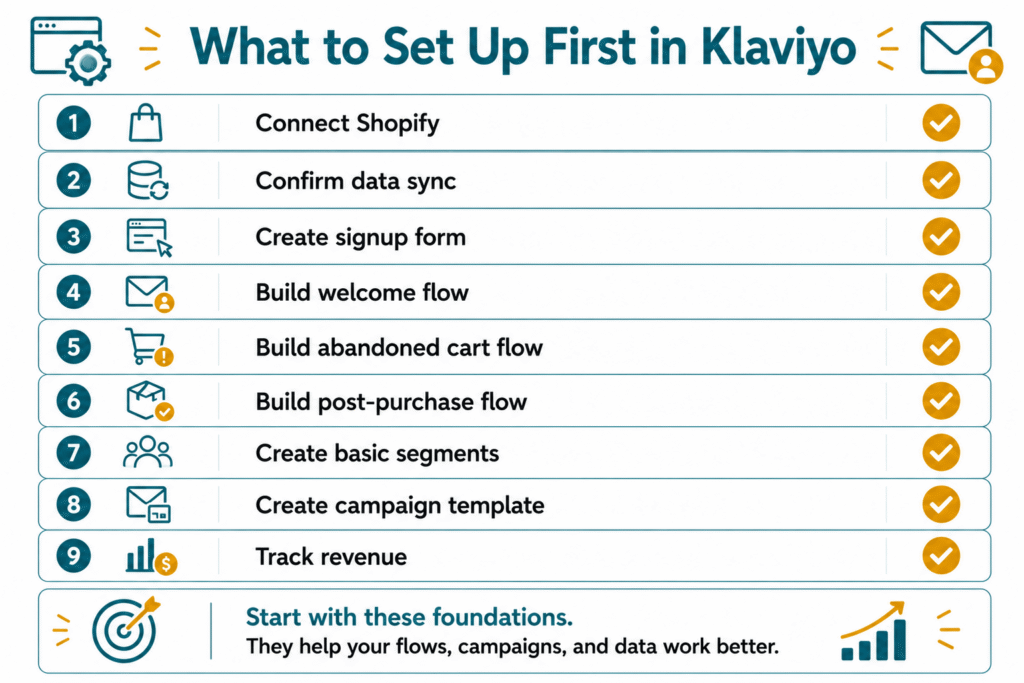
If you decide Klaviyo makes sense, don’t try to build everything at once.
Start with the basics.
Setup Step | Why It Matters |
Connect Shopify and Klaviyo | Lets customer and order data sync |
Confirm data is syncing | Makes sure your flows and segments use the right information |
Create or improve signup form | Helps grow your owned list |
Build welcome flow | Guides new subscribers toward first purchase |
Build abandoned cart flow | Recovers shoppers with buying intent |
Build post-purchase flow | Supports customers after the first order |
Create basic segments | Helps send more relevant campaigns |
Create a simple campaign template | Makes regular sending easier |
Track flow and campaign revenue | Shows what’s working |
You don’t need twenty flows.
You need the right few first.
Start with the customer moments closest to revenue and retention.
Use our Klaviyo setup checklist for Shopify stores when you’re ready.
So, Who Is Klaviyo Really For?
Klaviyo is for small Shopify businesses that are ready to use customer behavior more seriously.
It is a better fit for stores that:
- Have traffic worth following up on
- Have carts worth recovering
- Have buyers worth nurturing
- Have products worth explaining
- Have campaigns worth segmenting
- Have repeat purchase potential
- Want email to become a revenue channel
It may not be the best fit yet if your store only needs simple emails and has very little customer activity.
That’s the honest answer.
Klaviyo is not only for big brands.
But it works best when there is enough customer behavior to turn into better follow-up.
You may not need every Klaviyo feature immediately. A Klaviyo email marketing agency can help prioritise the setup, flows, and campaigns most relevant to your current stage.
Final Thoughts
So, is Klaviyo worth it for small Shopify businesses?
It depends on your stage.
If your Shopify store is still very early, Shopify Email or basic email may be enough for now.
But if your store already has traffic, carts, customers, and repeat purchase potential, Klaviyo may help you build a stronger follow-up system.
Don’t decide based only on size.
Decide based on customer behavior.
Because the question is not just:
Is Klaviyo worth it?
The better question is:
Are we ready to use customer behavior better?
If the answer is yes, Klaviyo may be worth considering.
At Your Proactive Media, we help Shopify businesses evaluate, implement, and optimize Klaviyo so their email marketing strategy aligns with customer behavior, business goals, and long-term growth.
Not Sure If Klaviyo Is Worth It for Your Shopify Store?
If your store already has traffic, carts, customers, and repeat purchase potential, your email setup may be ready for a stronger follow-up system.
But you don’t need to guess.
FAQs About Klaviyo for Small Shopify Businesses
Is Klaviyo worth it for small Shopify businesses?
Yes, Klaviyo can be worth it for small Shopify businesses if the store has enough traffic, carts, buyers, and repeat purchase potential to use flows, segmentation, and reporting properly. If the store is very new with little customer activity, Shopify Email or a simpler setup may be enough for now.
Is Klaviyo only for big brands?
No. Klaviyo is not only for big brands. Small Shopify businesses can use Klaviyo, but it works best when there is real customer behavior to follow up on, such as product views, abandoned carts, first purchases, and inactive buyers.
When should a Shopify store start using Klaviyo?
A Shopify store should consider Klaviyo when basic email no longer supports the customer journey. This usually happens when the store needs welcome flows, abandoned cart emails, post-purchase emails, winback emails, customer segmentation, and clearer revenue tracking.
Is Shopify Email enough for a small Shopify store?
Shopify Email can be enough for a small Shopify store if the business only needs simple campaigns, has limited traffic, has a small list, and does not need advanced automation or segmentation yet.
Is Klaviyo too expensive for small businesses?
Klaviyo can feel expensive if a small business does not use its features properly. The cost depends on active profiles and plan needs. It becomes easier to justify when Klaviyo helps recover carts, support repeat purchases, and track email revenue.
What Klaviyo flows should a small Shopify store set up first?
A small Shopify store should usually start with a welcome flow, abandoned cart flow, browse abandonment flow, post-purchase flow, and winback flow. These flows support the most common customer moments in ecommerce.
Can I start with Shopify Email and move to Klaviyo later?
Yes. Many small Shopify businesses can start with Shopify Email for simple campaigns, then move to Klaviyo when they need stronger automation, segmentation, and revenue reporting.
How do I know if my store is ready for Klaviyo?
Your store may be ready for Klaviyo if you have consistent traffic, add-to-cart activity, checkout activity, first-time buyers, repeat purchase potential, and a need to send more relevant emails based on customer behavior.

Jasmin Umali
Jasmin Umali is the Founder of Your Proactive Media and a Klaviyo email marketing strategist with 6 years of experience helping ecommerce brands generate an additional 20%–30% or more revenue through email marketing.