Klaviyo can feel overwhelming at first.
There are so many flows you can build.
Welcome.
Cart.
Browse.
Post-purchase.
Winback.
Back-in-stock.
Replenishment.
Review request.
VIP.
Sunset.
And suddenly, your “simple email setup” starts looking like a control room.
But here’s what I usually recommend:
Don’t build everything first.
Build the flows that match the biggest customer moments inside your Shopify store.
Someone joins your list.
Someone views a product.
Someone adds to cart.
Someone buys.
Someone stops coming back.
That’s your foundation.
Once those moments are covered, your email marketing becomes less random and more useful.
You’re not just sending emails because there’s a sale coming up.
You’re following up when the customer actually does something.
That’s the shift.
If you’d rather have this handled for you, our klaviyo email marketing services cover full flow setup, or If you’re still getting familiar with the basics, start with how Klaviyo email flows work for Shopify stores.
Once that foundation is clear, the next question becomes simple.
Which flows should you build first?
Quick Answer: The 5 Klaviyo Email Flows to Set Up First
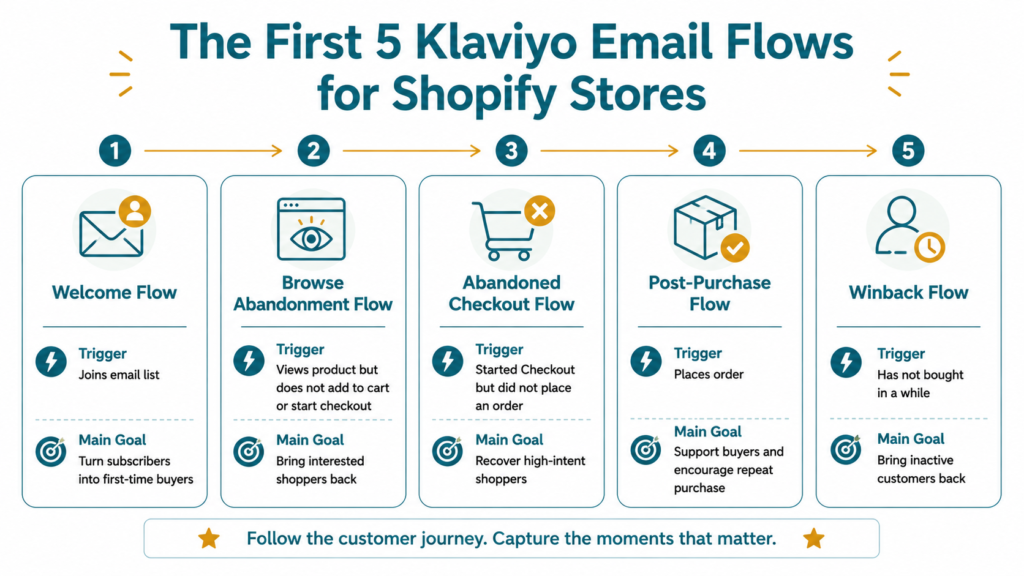
For most Shopify stores, I recommend starting with these five Klaviyo email flows:
Flow | Trigger | Main Goal |
Welcome Flow | Joins email list | Turn subscribers into first-time buyers |
Abandoned Cart Flow | Adds to cart but does not buy | Recover high-intent shoppers |
Browse Abandonment Flow | Views product but does not add to cart | Bring interested shoppers back |
Post-Purchase Flow | Places order | Support buyers and encourage repeat purchase |
Winback Flow | Has not bought in a while | Bring inactive customers back |
These five flows work because they follow how shoppers actually move.
They subscribe.
They browse.
They add to cart.
They buy.
They either come back or go quiet.
That’s why I don’t recommend starting with every advanced flow right away.
Not because those flows are bad.
But because your foundation should be clean first.
Klaviyo’s getting-started guide recommends prioritizing high-impact flows such as welcome, abandoned cart, post-purchase, and winback flows. It also recommends reviewing and customizing flows before turning them live. (Klaviyo Help Center)
The list is simple.
But the order matters.
Because not every flow has the same job.
Why These 5 Flows Should Come First
When I look at a Shopify email setup, I’m usually looking for the biggest customer drop-offs first.
Where are people getting stuck?
A subscriber joins, but does not buy.
A shopper views a product, but does not start checkout.
A shopper starts checkout, but leaves.
A customer buys once, then gets no support.
A past buyer stops coming back.
Those are the moments your first flows should cover.
Not because they’re fancy.
Because they’re practical.
They sit close to revenue, retention, and customer experience.
Your campaigns can still handle planned sends like sales, launches, education, and seasonal messages.
But flows handle the moments that happen every day.
That’s why the right flow setup can make your email marketing feel more organized.
A campaign waits for your calendar.
A flow reacts to customer behavior.
And that matters because your Shopify store already has customer signals.
Product views.
Checkout activity.
Orders.
Purchase history.
Email engagement.
Klaviyo’s Shopify integration can bring customer profile and order data into Klaviyo, enable onsite tracking and signup forms, and sync data between Klaviyo and Shopify. (Klaviyo Help Center)
That’s one of the reasons Shopify stores use Klaviyo for email marketing instead of relying only on basic email sending.
Start with the customer journey.
The first important moment happens before someone buys.
A Quick Note on Timing and Subject Lines
The timing and subject lines below are starting points.
Not fixed rules.
Your best timing depends on your product, buying cycle, shipping time, price point, traffic volume, and customer behavior.
A skincare brand may need different timing from a fashion brand.
A supplement brand may need different timing from a high-ticket product.
So use these as a guide.
Then adjust based on what your customers actually do.
Now let’s start with the first customer moment.
Someone joins your list.
Flow 1: Welcome Flow
A welcome flow starts when someone joins your email list.
This is usually your first chance to turn a subscriber into a customer.
And this is where a lot of brands move too fast.
They give the code.
They show a product.
They push the sale.
But they forget one thing.
The subscriber may not trust the brand yet.
They may still be comparing.
They may still be learning what makes you different.
They may have joined only because the offer looked interesting.
So your welcome flow should not only say “welcome.”
It should help the subscriber understand why your brand is worth buying from.
A welcome flow can include:
- Welcome message
- Signup offer, if available
- Brand introduction
- Product promise
- Bestsellers or key collections
- Trust, reviews, or proof
- Clear CTA
A simple welcome flow can look like this:
Timing | Purpose | Sample Subject Line | |
Email 1 | Immediately after signup | Welcome them and deliver the offer | Welcome to [Brand Name] |
Email 2 | 1 day later | Introduce your brand and product promise | What makes [Brand Name] different |
Email 3 | 2–3 days later | Show bestsellers, proof, or helpful education | Start with our most-loved picks |
Email 4 | 3–5 days later | Give a clear reason to shop | Last chance to use your welcome code |
You can also test subject line angles like:
- Your [benefit/value prop] starts here
- Meet your new [product/category] favorite
- The easiest way to start with [Brand Name]
- Still thinking it over?
The first email catches fresh interest.
The next emails build the trust they need before buying.
That’s the part I’d focus on.
Don’t overload email one.
Give them a simple next step.
Then another.
Then another.
That’s how interest becomes momentum.
If this is your priority flow, go deeper into how a welcome flow turns new subscribers into first-time buyers.
But not every shopper starts by subscribing.
Some browse first.
Some start checkout.
Then leave.
Flow 2: Abandoned Checkout Flow
An abandoned checkout flow follows up when someone starts checkout but does not place an order.
This shopper is different.
They were not just browsing.
They were close.
They picked a product.
They reached checkout.
They showed strong buying intent.
Then something stopped them.
Maybe they got distracted.
Maybe shipping made them pause.
Maybe they wanted to compare.
Maybe they needed one more reason to trust the purchase.
That’s why abandoned checkout is one of the first flows I usually check in a Klaviyo account.
It sits close to purchase intent.
If this flow is weak, your store may be leaving warm shoppers without proper follow-up.
In Klaviyo, this flow is triggered by Started Checkout.
That means someone reached the checkout step, but did not complete the order.
A good abandoned checkout flow can include:
- Product reminder
- Product image
- Product benefits
- Reviews or trust
- FAQ or hesitation handling
- CTA back to checkout
A simple abandoned checkout flow can look like this:
Timing | Purpose | Sample Subject Line | |
Email 1 | 1–4 hours after checkout abandonment | Remind them what they were about to buy | You left something behind |
Email 2 | 1 day later | Reinforce product value or social proof | Still thinking it over? |
Email 3 | 2–3 days later | Handle hesitation or add an incentive if needed | We can’t hold this forever |
You can also use subject lines like:
- Your checkout is waiting
- Still interested in this?
- About your [Product Name]
- Need help deciding?
- Your picks are still here
These subject lines should feel direct because the shopper already showed intent.
Keep the first email clear before adding urgency or incentives later.
And remember this:
Not every abandoned checkout flow needs a discount.
Start with product clarity and trust first.
If the customer already wanted the product, the first job is to make it easy to return.
A discount can help in some cases.
But it should not be the only reason your checkout recovery flow works.
Many people call this an abandoned cart flow, but in Klaviyo for Shopify, the clearer trigger is Started Checkout.
So in this blog, we’ll call it an abandoned checkout flow for accuracy.
If checkout drop-off is your biggest leak, learn how an abandoned checkout flow helps Shopify stores recover lost sales.
But there is an earlier moment most stores miss.
The shopper showed interest.
They just never made it to checkout.
Flow 3: Browse Abandonment Flow
A browse abandonment flow follows up when someone views a product but does not add it to cart or start checkout.
This is a softer moment.
The shopper showed interest, but not strong buying intent yet.
They may still be thinking.
They may be checking options.
They may need more context.
They may simply forget to come back.
That’s why I usually treat browse abandonment as a softer follow-up.
Not a hard sell.
The goal is to bring the product back into view without making the shopper feel pushed.
A browse abandonment flow can include:
- Viewed product
- Product benefits
- Similar items
- Bestsellers
- Reviews or social proof
- Helpful product education
A simple browse abandonment flow can look like this:
Timing | Purpose | Sample Subject Line | |
Email 1 | 2–6 hours after product view | Reintroduce the product they viewed | Still thinking about this? |
Email 2 | 1 day later | Share benefits, reviews, or product education | Why customers choose [Product Name] |
Email 3 | 2–3 days later | Recommend similar products or bestsellers | More picks you might like |
You can also use subject lines like:
- A closer look at [Product Name]
- Something caught your eye
- Your recently viewed pick
- See why this one stands out
- Not sure where to start?
The tone matters here.
Browse abandonment subject lines should feel softer than checkout reminders.
Why?
Because the shopper has not shown checkout-level intent yet.
So instead of pushing hard, help them understand the product better.
Why it matters.
How it helps.
What makes it worth considering.
For shoppers who show interest before starting checkout, browse abandonment emails help bring them back without being too pushy.
Then comes the moment many brands celebrate too early.
The first purchase.
Flow 4: Post-Purchase Flow
A post-purchase flow starts after someone places an order.
A lot of stores get the first sale, then go quiet.
That’s a mistake.
The first purchase is not the finish line.
It is the start of the customer relationship.
After someone buys, they still need support.
They may want to know what happens next.
They may need help using the product.
They may need reassurance.
They may be open to another purchase later.
For retention, this is one of the most important flows to get right.
A weak post-purchase flow can make the customer experience feel transactional.
A strong one makes it feel supported.
A post-purchase flow can include:
- Thank you message
- What happens next
- Product education
- Usage tips
- Care instructions, if needed
- FAQs
- Review request later
- Relevant next product recommendation
A simple post-purchase flow can look like this:
Timing | Purpose | Sample Subject Line | |
Email 1 | Immediately after purchase | Thank them and set expectations | We got your order — here’s what’s next |
Email 2 | 1–3 days later | Help them use or enjoy the product | How to get the most from your [Product Name] |
Email 3 | 5–10 days later | Share education, care tips, or FAQs | A few tips before it arrives |
Email 4 | 10–21 days later | Ask for a review or recommend the next product when timing makes sense | How did it go? |
You can also use subject lines like:
- Thanks for your order
- Your [Brand Name] order is in
- Here’s how to use your [Product Name]
- Quick tips for your first use
- Ready for your next pick?
Timing depends heavily on shipping time and product type.
Don’t ask for a review before the customer has had time to receive and use the product.
The post-purchase flow should support the customer first.
Then it can guide the next purchase naturally.
That’s the part many stores miss.
They rush to sell again before the customer has even experienced the first product properly.
Support first.
Then recommend.
To build more repeat purchase potential after the first sale, it helps to understand how post-purchase emails turn first-time buyers into repeat customers.
But what happens when the customer buys once, then disappears?
That’s where the fifth flow comes in.
Flow 5: Winback Flow
A winback flow targets customers who have not bought in a while.
These are not cold strangers.
They already know your brand.
They bought before.
They trusted you once.
They may still be interested.
They may just need a reason to come back.
In most accounts, I don’t treat winback as begging customers to return.
I treat it as a clean re-entry point.
A way to say:
Here’s what’s new.
Here’s what you may still like.
Here’s a reason to revisit.
A winback flow can include:
- Reminder of the brand
- What is new
- Bestsellers
- Relevant product recommendations
- Clear reason to return
- Offer or incentive only if needed
A simple winback flow can look like this:
Timing | Purpose | Sample Subject Line | |
Email 1 | 45–90 days after last purchase | Remind them of the brand and what they liked | It’s been a while |
Email 2 | 3–5 days later | Show what’s new, popular, or relevant | Here’s what’s new at [Brand Name] |
Email 3 | 5–7 days later | Give a clear reason to return | Ready to come back? |
You can also use subject lines like:
- We saved your favorites
- Still into [Product Category]?
- A reason to revisit [Brand Name]
- Your next [Product Category] pick is here
- Come back to something new
Winback timing depends on your buying cycle.
A skincare replenishment brand may need a shorter window.
A fashion or higher-ticket brand may need a longer one.
Winback subject lines should feel like a re-entry point.
Not a guilt trip.
Keep it warm, useful, and relevant.
This flow is especially useful for stores with repeat purchase potential, like skincare, supplements, food, beauty, wellness, apparel, pet products, and other ecommerce categories where customers may buy again.
When past customers stop coming back, winback emails can help create a simple path back to your store.
Those five flows give you the foundation.
But if your time is limited, you may still be wondering where to start.
Which Flow Should You Build First?
When I prioritize flows for a Shopify store, I look at where the biggest customer drop-off happens first.
Use this simple guide:
Store Situation | Start With |
You are growing your list | Welcome Flow |
You have checkout activity | Abandoned Checkout Flow |
You have product views but weak checkout starts | Browse Abandonment Flow |
You have first-time buyers | Post-Purchase Flow |
You have past buyers who have not returned | Winback Flow |
There is no need to overthink it.
Look at your store.
Where are people dropping off?
If people subscribe but do not buy, start with welcome.
If people start checkout but do not place an order, start with abandoned checkout.
If people buy once and never return, start with post-purchase and winback.
That’s the smarter way to prioritize.
Build based on customer behavior.
Not based on what looks advanced.
After that, it is tempting to build every flow you see online.
But that can create more mess than momentum.
What About Other Klaviyo Flows?
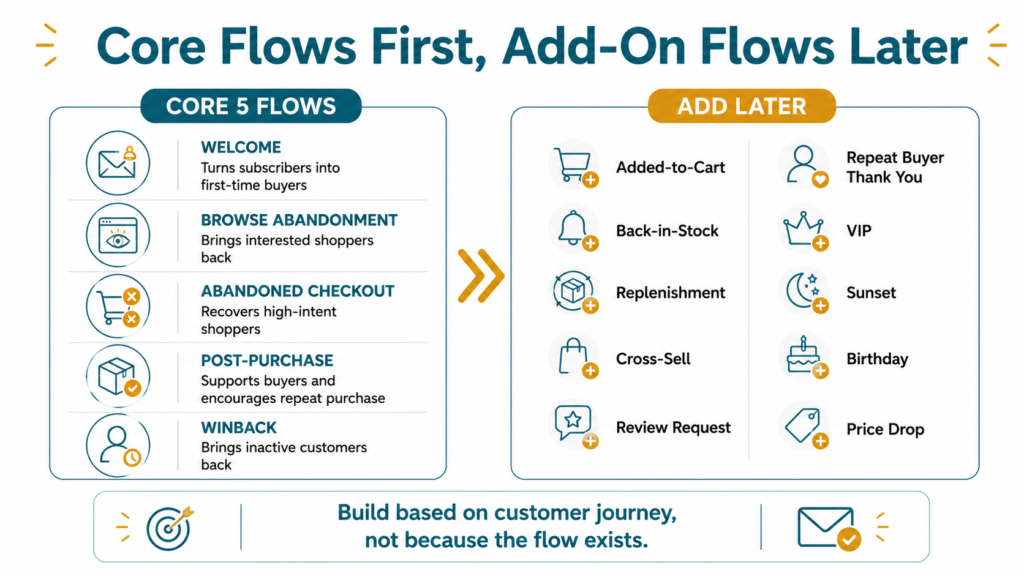
The first five flows create the foundation.
Other flows can come later.
And yes, there are many useful ones.
But useful does not always mean urgent.
Flow Add-On | When to Add It |
Added-to-Cart Flow | When people add products to cart but do not start checkout |
Back-in-Stock Flow | When products often sell out |
Replenishment Flow | When products run out or need reordering |
Cross-Sell Flow | When products naturally pair together |
Review Request Flow | When customers have had time to use the product |
Repeat Buyer Thank You Flow | When customers place a second or repeat order |
VIP Flow | When you have loyal or high-value customers |
Sunset Flow | When you need to clean inactive subscribers |
Birthday Flow | When you collect birthdates |
Price Drop Flow | When markdowns matter to your customer journey |
Don’t build add-on flows just because they exist.
Build them when your store has a real customer moment to support.
That one rule can save you from a messy Klaviyo account.
Also, for Philippine Shopify brands, this guide is focused on email flows. Klaviyo SMS is not currently listed as available in the Philippines. Klaviyo’s SMS availability page lists its Asia-Pacific availability as Australia and New Zealand. (Klaviyo Help Center)
A focused setup beats a crowded one.
But even the right flows can fail if they are built the wrong way.
Common Mistakes When Setting Up the First 5 Flows
The first five flows can make a big difference.
But only if they are built properly.
These are the mistakes I often see when brands build flows too quickly or turn on templates without reviewing the customer journey.
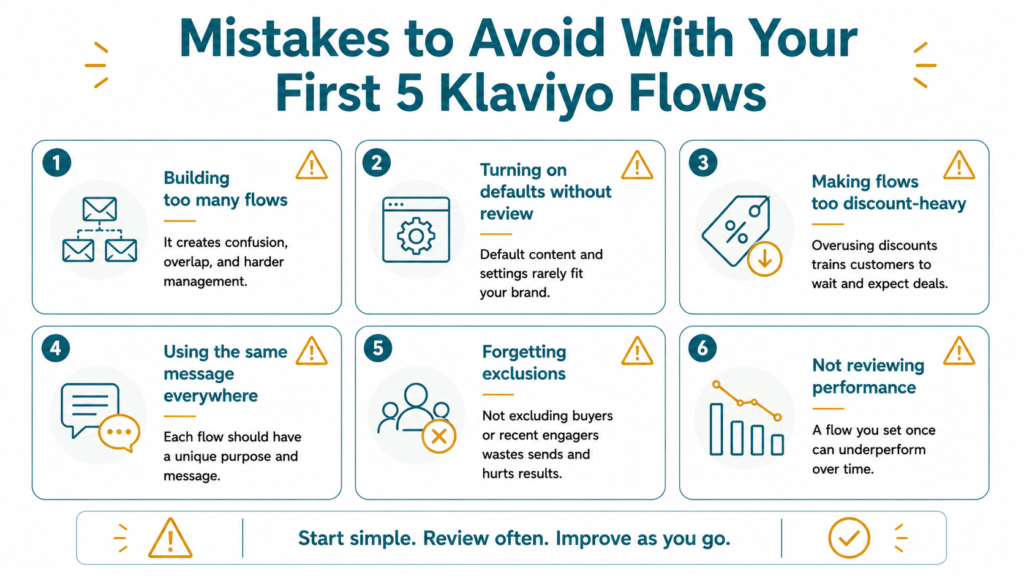
Mistake 1: Building too many flows before the core five are clean
More flows do not automatically mean better email marketing.
If your welcome, abandoned checkout, browse, post-purchase, and winback flows are weak, adding more automations will not fix the foundation.
It just adds clutter.
Start with the core five.
Make them clean.
Then expand.
Mistake 2: Turning on default flows without reviewing them
Pre-built flows can help you move faster.
But do not turn them on blindly.
Klaviyo recommends reviewing, customizing, and previewing default flow messages before going live. (Klaviyo Help Center)
Check the timing.
Check the copy.
Check the branding.
Check the filters.
Check the customer journey.
A default flow is a starting point.
Not the final strategy.
Mistake 3: Making every flow too discount-heavy
Discounts can work.
But they should not be the only reason your flows convert.
If every flow depends on a discount, customers may learn to wait for the next offer.
Some flows should educate.
Some should build trust.
Some should answer objections.
Some should support the product experience.
Not every flow needs a discount to work.
Mistake 4: Using the same message in every flow
A checkout abandoner needs a different message from a product viewer.
A first-time buyer needs a different message from a past customer.
A new subscriber needs a different message from a VIP buyer.
That is the whole point of flows.
Match the message to the customer moment.
Mistake 5: Forgetting exclusions
This one creates awkward emails fast.
Someone buys, but still gets a checkout reminder.
Someone already received a message, but keeps getting pushed through the wrong flow.
Someone becomes inactive, but still receives emails that do not match their behavior.
Filters and exclusions help prevent that.
They keep the right people in the flow.
And the wrong people out.
Mistake 6: Ignoring mobile readability
Most customers will not read your email like a printed brochure.
They scan.
Especially on mobile.
If the email is crowded, hard to read, or the CTA is buried, performance can suffer.
Keep the message clear.
Make the CTA easy to find.
Mistake 7: Turning flows on and never improving them
A flow is not done just because it is live.
It still needs review.
Look at clicks.
Orders.
Revenue per recipient.
Unsubscribes.
Spam complaints.
Then improve.
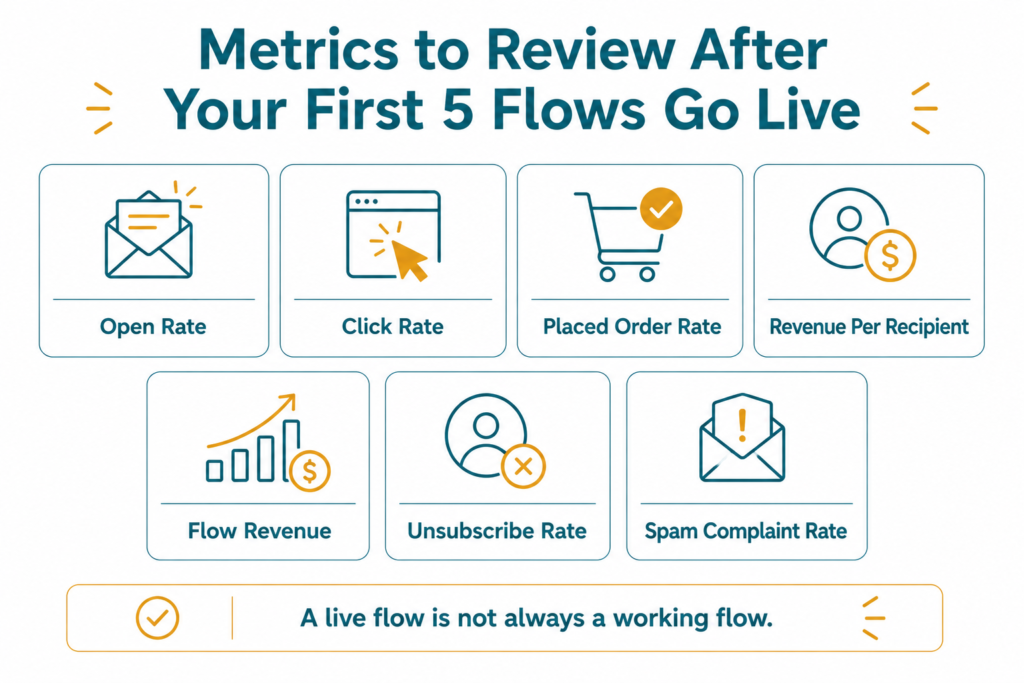
A live flow is not always a working flow.
Mistake | Better Approach |
Building too many flows | Start with the core five |
Turning on defaults without review | Check timing, copy, branding, and logic |
Relying on discounts | Use value, trust, clarity, and timing first |
Same message in every flow | Match the message to the customer moment |
No exclusions | Remove customers who already bought |
No reporting | Review clicks, orders, and flow revenue |
Once the flows are live, the work is not finished.
Now you need to know if they are actually helping.
How to Know If Your First 5 Flows Are Working
Do not judge your flows only by whether they are active.
Judge them by what they are doing.
Klaviyo flow analytics can help you review flow message performance, including open, click, and conversion rates. (Klaviyo Help Center)
For Shopify stores, these are the numbers to watch:
Metric | What It Tells You |
Open rate | Are people opening? |
Click rate | Are people interested enough to click? |
Placed order rate | Are flows helping drive orders? |
Revenue per recipient | Is the flow valuable per recipient? |
Flow revenue | Is the automation generating revenue? |
Unsubscribe rate | Does the flow feel irrelevant? |
Spam complaint rate | Is trust being affected? |
Open rate is useful.
But it is not the full story.
A flow can get opened and still fail to drive clicks.
A flow can get clicks and still fail to drive orders.
A flow can make revenue but also cause too many unsubscribes.
That is why you need to review the full picture.
To review the numbers properly, you need to know which email marketing metrics every Shopify store should track.
And if those numbers look unclear, that is usually a sign the setup needs a closer look.
When Should You Get Help Setting Up These Flows?
You can build basic flows yourself, especially if your store is still early.
But if your account already has traffic, checkouts, buyers, and inactive customers, the setup needs more strategy than “turning flows on.”
You may need help if:
- Flows are missing or inactive
- Triggers are confusing
- Filters and exclusions are unclear
- Flow copy feels generic
- Designs are hard to read on mobile
- Reporting is not being reviewed
- Your team has no time to manage flows
- You are not sure which flow should come first
Building the first five flows creates the foundation. A Klaviyo email marketing agency can help connect them, improve their performance, and identify the next customer journeys worth building.
The goal is not to build the most complicated setup.
It is to build the one your store actually needs first.
Final Thoughts
You do not need every Klaviyo automation right away.
Start with the five flows that cover the biggest customer moments:
- Welcome
- Abandoned checkout
- Browse abandonment
- Post-purchase
- Winback
These create the foundation for better email follow-up.
Then add more flows when your store is ready.
A clean foundation beats a crowded account every time.
At Your Proactive Media, we help Shopify brands build and optimize Klaviyo email flows that support every stage of the customer journey, creating a strong foundation for long-term growth.
Want to Know Which Klaviyo Flows Your Shopify Store Should Set Up First?
If your Shopify store already has traffic, checkouts, subscribers, and customers, your email flows should do more than exist.
They should help you welcome subscribers, recover checkout drop-offs, support first-time buyers, and bring past customers back.
FAQs About Klaviyo Email Flows for Shopify
What are the first Klaviyo flows Shopify stores should set up?+
The first Klaviyo flows most Shopify stores should set up are welcome flow, abandoned checkout flow, browse abandonment flow, post-purchase flow, and winback flow.
Do Shopify stores need all five flows right away?+
Not always. Start with the flow that matches your biggest customer drop-off, then build the rest. For example, if you have checkout activity, start with abandoned checkout. If you are growing your list, start with welcome.
Which Klaviyo flow should I build first?+
If you have new subscribers, start with welcome. If you have checkout activity, start with abandoned checkout. If you have buyers, start with post-purchase. The best first flow depends on where customers are dropping off.
Do Klaviyo flows need discounts?+
No. Discounts can help in some cases, but flows should also use clarity, product value, trust, education, and timing. Not every flow needs a discount to work.
What is the difference between a welcome flow and a post-purchase flow?+
A welcome flow starts when someone joins your email list. A post-purchase flow starts after someone buys. The welcome flow helps guide first purchase, while the post-purchase flow supports the customer after the sale.
What is the difference between abandoned checkout and browse abandonment?+
Abandoned checkout follows up after someone starts checkout but does not place an order. Browse abandonment follows up after someone views a product but does not add it to cart or start checkout.
What Klaviyo flows can I add later?+
After the core five, Shopify stores can add flows like added-to-cart, back-in-stock, replenishment, cross-sell, review request, repeat buyer thank you, VIP, sunset, birthday, and price drop flows.
How do I know if my Klaviyo flows are working?+
Track click rate, placed order rate, revenue per recipient, flow revenue, unsubscribe rate, and spam complaint rate. Open rate is useful, but it does not tell the full story by itself.

Jasmin Umali
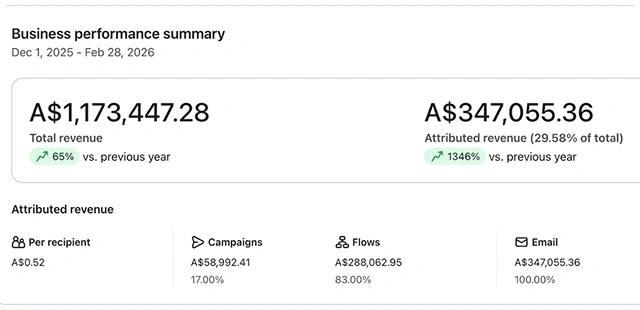
Jasmin Umali is the Founder of Your Proactive Media and a Klaviyo email marketing strategist with 6 years of experience helping ecommerce brands generate an additional 20%–30% or more revenue through email marketing.